You can access the distribution details by navigating to My Print Books(POD) > Distribution
Add a Review
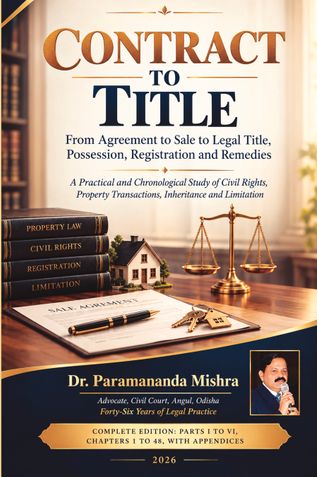
CONTRACT TO TITLE
From Agreement to Sale to Legal Title, Possession, Registration and Remedies
Dr. Paramananda Mishra Advocate, Civil Court, Angul, Odisha Forty-Six Years of Legal Practice
This book ships within India only.
Description
Civil litigation concerning immovable property presents the advocate with a deceptively simple question: who has title to the property?
In practice the answer requires the examination of a chain of events. One person claims ownership on the strength of an agreement to sell. Another relies on a registered sale deed. A third claims through inheritance. A fourth relies on a gift or a will. A fifth has been in possession for many years and invokes limitation or adverse possession. Each claim looks persuasive when examined alone. The advocate's responsibility is to examine them in the order in which they occurred.
This book follows one journey:
CONTRACT → OBLIGATION → PERFORMANCE → TRANSFER → REGISTRATION → POSSESSION AND MUTATION → TITLE → SUCCESSION → LIMITATION → REMEDY
Why this edition is organised as it is. The first working outline of this book ran to forty-two chapters in five Parts. In preparing the full edition the plan has been widened to forty-eight chapters in six Parts, because the practical questions that actually decide property cases need chapters of their own: registration and stamp duty, delivery of possession and mutation, injunctions, and cancellation of instruments. These were treated only in passing in the first outline.
What the book assumes of its reader. It assumes no more than a working acquaintance with the statutes. Each chapter begins with the statutory framework, states the governing principles, identifies leading authorities, and then turns to what the practitioner actually does: how to draft the pleading, how to read the document, what to ask in cross-examination, and what errors recur in practice.
Method and sources. The text has been prepared from the author's master outline and extended with statutory analysis and case law drawn from the standard Indian law reports. The manuscript was prepared without access to the certified reports, which is why every chapter closes with a table of authorities to be verified.
A word on method. Three habits are taught throughout. The first is to separate the layers of a transaction: the promise, the transfer, the possession and the record. The second is to ask of every document, "what is the source of the executant's right?" The third is to fix the date on which each cause of action arose, because limitation is a matter to be settled at the start of a case and not discovered at its end.
About the Authors
Book Details
Number of Pages: 342
Dimensions: 6"x9"
Interior Pages: B&W
Binding:
Paperback (Perfect Binding)
Availability:
In Stock (Print on Demand)
Ratings & Reviews
CONTRACT TO TITLE
Review This Book
Write your thoughts about this book.

Currently there are no reviews available for this book.
Be the first one to write a review for the book CONTRACT TO TITLE.
Other Books in Law
Dr Naresh Singhal

Siva Prasad Bose

Vedant Batra (Goeman Bind)
![SanDune Intellectual Property Rights [IPR] Digest #1](https://simg.pothi.com/BQche-ns1eejocmHf2JacRx5A_5oFlYuKhobkH-qd2w/rs:fit/w:130/h:175/el:1/g:sm/cb:rev-1/bG9jYWw6Ly8vaW1h/Z2VzL3Byb2R1Y3Rz/LzIwMTkvMDEvZWJv/b2s0Nzc5L0ltYWdl/XzAuanBn.jpg)
Gowthami Reddy D, Chandrasekar R