You can access the distribution details by navigating to My Print Books(POD) > Distribution
Add a Review
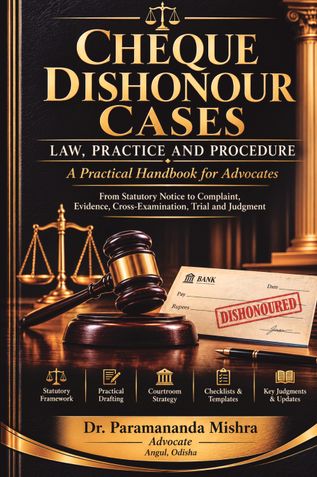
CHEQUE DISHONOUR CASES
A Practical Handbook for Advocates From Statutory Notice to Complaint, Evidence, Cross-Examination, Trial and Judgment
Dr. Paramananda Mishra
This book ships within India only.
Description
Cheque dishonour litigation is one of the most common forms of criminal complaint practice before the courts of Judicial Magistrates First Class in India. An advocate who practises in this field must understand not only the statutory provisions but also the practical requirements of drafting, filing, evidence, cross-examination, arguments and judgment.
A successful complaint under Section 138 does not depend merely on proving that a cheque was dishonoured. The complainant must establish the statutory requirements of the Negotiable Instruments Act, 1881: the existence of a legally enforceable debt or liability, presentation of the cheque within its validity, timely issuance of a demand notice, failure to pay within the statutory period, and timely institution of the complaint.
The defence, similarly, cannot succeed by merely denying the transaction. The accused must understand the statutory presumptions, the standard required to rebut them, and the importance of documentary and oral evidence.
This handbook has been prepared as a practical guide for practising advocates, particularly young lawyers appearing before Magistrates’ Courts. It combines the law with practical examples, specimen pleadings, examination-in-chief, cross-examination, applications, final arguments and checklists.
The law in this field has moved quickly. Between 2022 and 2026 the Supreme Court has reshaped several working assumptions: how the statutory presumptions operate even at the stage of issuing process, whether a cash loan above ₹20,000 can support a complaint, how a part-payment must be handled before a cheque is re-presented, what directions courts must now follow for summons, synopsis, compounding and interim compensation, and whether a complainant may appeal against an acquittal without special leave. The Bankers’ Books Evidence Act, 2026 has replaced the 1891 Act. This edition takes account of all these developments, and the law is stated as it stood on 2 November 2026.
The handbook draws upon important decisions of the Supreme Court of India and selected judgments of the Orissa High Court. The cases are discussed to help advocates understand the principles that govern cheque dishonour litigation. Before relying upon any authority in court, the advocate should read the complete judgment, identify the relevant paragraph, check its subsequent treatment, and confirm its applicability to the facts of the case.
My purpose is to promote accurate drafting, responsible advocacy and the fair administration of justice.
About the Author
Book Details
Number of Pages: 130
Dimensions: 6"x9"
Interior Pages: B&W
Binding:
Paperback (Perfect Binding)
Availability:
In Stock (Print on Demand)
Ratings & Reviews
CHEQUE DISHONOUR CASES
Review This Book
Write your thoughts about this book.

Currently there are no reviews available for this book.
Be the first one to write a review for the book CHEQUE DISHONOUR CASES.
Other Books in Law

Advocate Seraj Shekh

G. SHIVAPRAKASH IYER

ADV CHERRY KUSHWAHA

Liam M Birkett