You can access the distribution details by navigating to My Print Books(POD) > Distribution
Add a Review
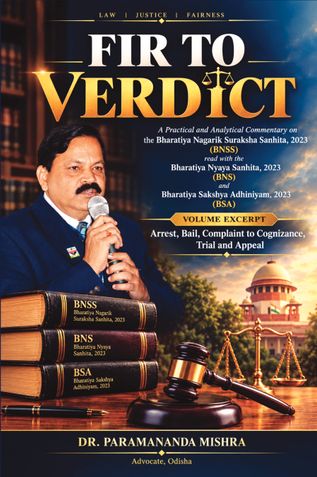
FIR TO VERDICT
A Practical and Analytical Commentary on the Bharatiya Nagarik Suraksha Sanhita, 2023 (BNSS) read with the Bharatiya Nyaya Sanhita, 2023 (BNS) and Bharatiya Sakshya Adhiniyam, 2023 (BSA)
Dr. Paramananda Mishra
This book ships within India only.
Description
The title of this book — “FIR to Verdict” — is deliberately chosen to capture the entire arc of a criminal proceeding rather than any single stage of it. Yet a criminal case does not always begin with a First Information Report. A very large proportion of criminal litigation in India begins instead with a private complaint before a Magistrate. The complaint route deserves the same rigorous, courtroom-oriented treatment as the FIR route, and this excerpt is written to supply exactly that.
The chapter at the heart of this volume, on Section 223 of the BNSS (Examination of Complainant), has been selected for detailed treatment because it illustrates, better than almost any other provision, the working method of this entire book. For every important provision, five questions are asked and answered: what the law says; why the law exists; how the Supreme Court and the High Courts have interpreted it; how it works in actual practice; and what can go wrong. The reader who works through this chapter carefully will not merely know Section 223 — the reader will know how to think about any comparable procedural provision under the new criminal codes.
This book follows a consistent chapter architecture: statutory text, plain-English explanation, clause-by-clause analysis, the CrPC comparison, Supreme Court and High Court authorities, practical courtroom application from the perspective of the complainant, the defence and the Magistrate, case studies, illustrative diagrams, model drafts, checklists, frequently asked questions and a chapter summary. This structure will be maintained across the full manuscript so that the reader develops a consistent method of approaching every provision of the BNSS, BNS and BSA.
A word on rigour: nothing in this book invents a case, a citation, a quotation or a holding. Every reported decision discussed here has been checked against publicly available law-report and court-record sources. Emerging propositions are identified as emerging; settled propositions are identified as settled; and unresolved questions are candidly presented as unresolved. This is, I believe, the only responsible way to write a law book about a code that is still less than three years old and whose jurisprudence is developing month by month.
About the Author
Book Details
Number of Pages: 110
Dimensions: 6"x9"
Interior Pages: B&W
Binding:
Paperback (Perfect Binding)
Availability:
In Stock (Print on Demand)
Ratings & Reviews
FIR TO VERDICT
Review This Book
Write your thoughts about this book.

Currently there are no reviews available for this book.
Be the first one to write a review for the book FIR TO VERDICT.
Other Books in Law

CA Mohit Punetha

Shreeyanshu Tripathi, Legal Specs

Shambhu Choudhary

Devansh Saraswat, Rhishika Srivastava