You can access the distribution details by navigating to My Print Books(POD) > Distribution
Add a Review
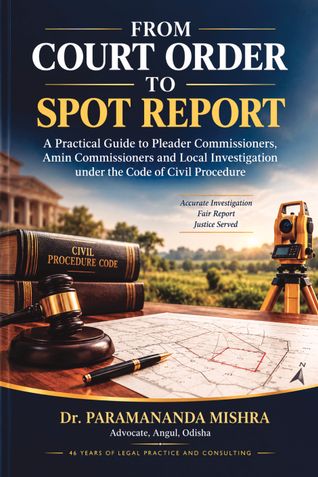
FROM COURT ORDER TO SPOT REPORT
A Practical Guide to Pleader Commissioners, Amin Commissioners and Local Investigation under the Code of Civil Procedure
Dr. Paramananda Mishra
This book ships within India only.
Description
The work of a civil court does not end with the filing of a plaint, written statement or counterclaim. In many cases, the court must understand the physical condition of the disputed property before it can properly decide the questions raised by the parties.
A dispute concerning land may involve the identification of a plot, the position of a boundary, the existence of a pathway, the location of a structure, the extent of an alleged encroachment or the relationship between the land described in a document and the land found at the spot.
These questions cannot always be understood from pleadings and oral evidence alone. Where the law permits and the circumstances require, the court may appoint a commissioner to conduct a local investigation and report the relevant findings.
However, the appointment of a commissioner creates important responsibilities.
The commissioner must first understand the court’s order. The purpose of the commission must be clear. The relevant documents must be examined. The parties must receive proper notice. The spot visit must be conducted fairly. Measurements must be recorded accurately. The instruments used must be suitable for the task. The rough sketch must represent the observations made at the site, and a scaled map must be prepared only on a reliable and stated basis.
Where the commission authorises the recording of evidence, the commissioner must follow the applicable procedural requirements. Where police assistance or other arrangements are necessary, the commissioner must obtain lawful assistance through the proper authority rather than assume powers that have not been granted.
Finally, the report must be clear, impartial, complete and confined to the matters entrusted by the court. The commissioner must be prepared to explain the method of investigation, the measurements taken, the documents consulted and the conclusions recorded in the report.
This book is intended to explain these matters in simple English.
It is not intended to replace the Code of Civil Procedure, the applicable Orissa Civil Court rules, the terms of a particular commission or the directions of the court. Rather, it is designed to help practitioners understand how those requirements are translated into practical work.
The book also discusses the limitations of a commission. A commissioner should not decide title, determine the ultimate rights of the parties, interpret disputed legal documents as though exercising judicial power or collect evidence for one party outside the authority granted by the court.
The report is an aid to the court. The final decision remains with the court.
I hope this work will help young advocates and commissioners perform their duties with greater confidence, accuracy and fairness.
About the Author
Book Details
Number of Pages: 724
Dimensions: 6"x9"
Interior Pages: B&W
Binding:
Hard Cover (Case Binding)
Availability:
In Stock (Print on Demand)
Ratings & Reviews
FROM COURT ORDER TO SPOT REPORT
Review This Book
Write your thoughts about this book.

Currently there are no reviews available for this book.
Be the first one to write a review for the book FROM COURT ORDER TO SPOT REPORT.
Other Books in Law

Dr. Justice S. Vimala

Anoop Gupta

Dr. T. Srinivasa Rao, MA, LLM, Ph.D (Gold ...

RAY BRADBURY