You can access the distribution details by navigating to My Print Books(POD) > Distribution
Add a Review
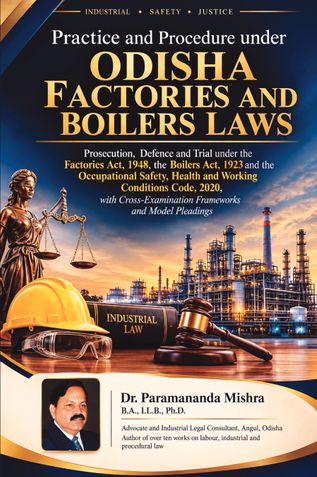
Practice and Procedure under Odisha Factories and Boilers Laws
Prosecution, Defence and Trial under the Factories Act, 1948, the Boilers Act, 1923 and the Occupational Safety, Health and Working Conditions Code, 2020, with Cross-Examination Frameworks and Model Pleadings
Dr. Paramananda Mishra
This book ships within India only.
Description
Industrial criminal law in India places heavy personal liability on corporate officers and plant leadership. In Odisha’s metallurgical, power, mining, chemical and manufacturing sectors, the penal provisions of Section 92 of the Factories Act, 1948 and Sections 23 and 24 of the Boilers Act, 1923 have been invoked routinely.
In the course of my work I have seen a pattern in these prosecutions that deserves candour. It can be summarised in four observations.
• Mechanical prosecutions. Every accident or perceived irregularity is too often treated as an automatic offence, and the statutory opportunity for remediation is bypassed.
• Indiscriminate impleadment. Directors, non-executive board members and executives posted elsewhere are arrayed as accused persons without regard to the statutory scheme of occupier identification settled by the Supreme Court.
• Suppression of the defence record. Written explanations, standard operating procedures and maintenance logs filed in answer to a show-cause notice are frequently not placed before the sanctioning authority or the Magistrate.
• Procedural transition. The move from the Code of Criminal Procedure, 1973 to the Bharatiya Nagarik Suraksha Sanhita, 2023, and from the Indian Evidence Act, 1872 to the Bharatiya Sakshya Adhiniyam, 2023, has altered the stages of complaint, cognizance, trial and proof, and these changes have not yet been applied systematically to industrial prosecutions.
A fifth development arrived while this book was being completed. The Factories Act has been repealed and replaced by the Occupational Safety, Health and Working Conditions Code, 2020. I have therefore added a chapter on the transition, and I have marked throughout the points at which the old and the new law differ.
This book comes from courtroom work in the trial courts of Odisha and in the High Court of Orissa. Its purpose is to give advocates, managers and safety engineers the statutory understanding, the arguments and the documents they need at the pre-trial and trial stages. I have tried to write in direct language so that the book can be used immediately.
I have also tried to be fair. A prosecution that is properly founded deserves a proper answer, and a safety statute that protects human life deserves respect. The defence strategies in this book are strategies for testing the prosecution’s case, not for avoiding the obligations of safety.
About the Author
Book Details
Number of Pages: 105
Dimensions: 6"x9"
Interior Pages: B&W
Binding:
Paperback (Perfect Binding)
Availability:
In Stock (Print on Demand)
Ratings & Reviews
Practice and Procedure under Odisha Factories and Boilers Laws
Review This Book
Write your thoughts about this book.

Currently there are no reviews available for this book.
Be the first one to write a review for the book Practice and Procedure under Odisha Factories and Boilers Laws.
Other Books in Law

Noel Lorenz

Frank Calneggia

Adv cherry kushwaha

Siva Prasad Bose, Joy Bose