You can access the distribution details by navigating to My Print Books(POD) > Distribution
Add a Review
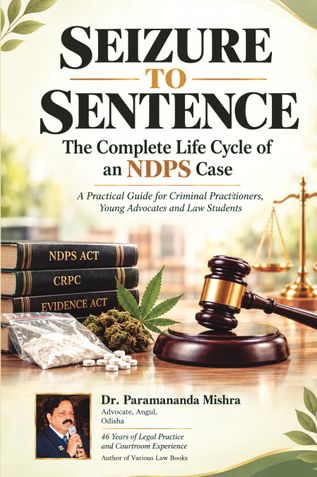
SEIZURE TO SENTENCE
The Complete Life Cycle of an NDPS Case A Practical Guide for Criminal Practitioners, Young Advocates and Law Students
Dr. Paramananda Mishra
This book ships within India only.
Description
I have practised law for 46 years. In that time I have appeared before District and Sessions Courts, Special Courts and High Courts, and have had the privilege of observing criminal litigation — not as a spectator, but as a participant whose client's liberty, and sometimes life, depended on the discipline brought to the case. I have also authored several law books during this period. The present work responds to a need I have seen repeat itself across four decades: a young advocate armed with the bare text of the NDPS Act, but without a working method for turning that text into a courtroom strategy.
The title Seizure to Sentence was chosen deliberately. An NDPS prosecution begins long before the first hearing and its consequences may extend well beyond the trial court's judgment, into appeal. An advocate who reads only the charge misses the foundation of the case. An advocate who reads only the seizure memo may miss a broken chain of custody. An advocate who reads only the FSL report may miss the more fundamental question of whether the tested sample has ever been properly connected to the substance said to have been seized from the accused. An advocate who reads only the judgment may miss the precise factual or procedural point that could succeed in appeal.
The chapters that follow are accordingly arranged in the sequence a real case actually follows: information and search, seizure, sampling, arrest, bail, investigation, charge-sheet, cognizance, charge, evidence, cross-examination, expert evidence, recall, defence evidence, final arguments, judgment, sentence and appeal. The book then provides a practical toolkit — model applications, cross-examination formats, written-submission structures, a file-management system, and a provision-wise index of authorities.
I have written this book to sit beside the case file, not on a shelf. Each chapter repeatedly asks the same working questions: What is the fact? Which provision applies to it? What document proves it? Which witness proves that document? What is the contradiction, if any? What legal consequence follows? Which authority supports the proposition being advanced? What precise relief should be sought?
I ask the reader to hold this book with appropriate professional caution. No legal text can remain permanently current. Statutes are amended, Rules are revised, Standing Orders change, and judicial interpretation continues to develop — sometimes, as the reader will see in the chapters on Sections 42 and 52A, quite significantly even within the span of a few years. Every authority cited here must be verified against its current, authoritative source before it is placed before a court.
It is my sincere hope that Seizure to Sentence assists criminal practitioners — particularly young advocates — and helps law students understand criminal litigation as the disciplined, practical craft that it is, rather than as an examination subject to be memorised and set aside.
Dr. Paramananda Mishra
About the Author
Book Details
Number of Pages: 104
Dimensions: 6"x9"
Interior Pages: B&W
Binding:
Paperback (Perfect Binding)
Availability:
In Stock (Print on Demand)
Ratings & Reviews
SEIZURE TO SENTENCE
Review This Book
Write your thoughts about this book.

Currently there are no reviews available for this book.
Be the first one to write a review for the book SEIZURE TO SENTENCE.
Other Books in Law

Deepak Bajaj

SILVIA PAUL

Siva Prasad Bose, Joy Bose
