You can access the distribution details by navigating to My Print Books(POD) > Distribution
Add a Review
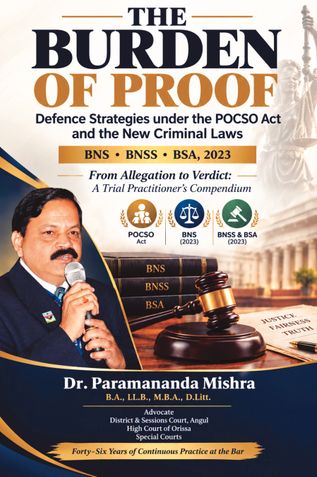
THE BURDEN OF PROOF
Defence Strategies under the POCSO Act and the New Criminal Laws (BNS, BNSS and BSA, 2023) From Allegation to Verdict: A Trial Practitioner’s Compendium
Dr Paramananda Mishra
This book ships within India only.
Description
Forty-six years in the corridors of justice, from the District and Sessions Court at Angul to the High Court of Orissa and various Special Tribunals, have given me an unvarnished, ringside view of human nature, human malice and penal justice. In those four and a half decades I have seen society change, the language of the law adapt and the statute book swell. Yet no legislative intervention has altered the rhythm and moral landscape of the criminal trial court quite like the Protection of Children from Sexual Offences Act, 2012, the POCSO Act.
We live in an age of distressing reports of rape, violence and depravity. It was against this background of escalating violence against vulnerable minors that Parliament enacted the POCSO Act. The legislative impulse was noble, overdue and necessary. Children require an unyielding shield against predators. To ensure that trials were not diluted by systemic lethargy, the Legislature created Special Courts, mandated child-friendly procedures, and enacted stringent statutory presumptions under Sections 29 and 30.
But a law written in the quiet halls of Parliament often meets a turbulent reality in the courthouses of the district. Over the last decade of POCSO litigation, one question began to trouble me as a practising advocate: what happens when the statutory shield is forged into a sword of vengeance? How does an innocent accused obtain relief when an accusation alone unleashes a statutory presumption of guilt?
In the villages and small towns of Odisha, as across the nation, human animosities run deep. Ancestral land partitions, bitter panchayat elections, money-lending transactions turned sour and broken matrimonial alliances all go in search of a weapon with which to crush an opponent. Too often, that weapon has become a fabricated POCSO complaint. Elsewhere, natural adolescent romances, consensual courtships between young teenagers, are abruptly criminalised by indignant parents, and rural youth are dragged into judicial custody alongside hardened offenders.
When a citizen is brought before a Special Court, the atmosphere is heavy with moral outrage. There is a tendency in some courtrooms to treat Section 29 as though it delivers an automatic verdict of guilt the moment a charge sheet is presented. That is a misreading, and this book explains why. At the same time, the reforms introduced by the Bharatiya Nyaya Sanhita (BNS), the Bharatiya Nagarik Suraksha Sanhita (BNSS) and the Bharatiya Sakshya Adhiniyam (BSA), 2023 offer the accused no automatic rescue. The POCSO Act remains a special statute whose provisions override the general law.
In such an arena, an innocent accused cannot rely on general sympathy or perfunctory denials. Liberty must be fought for through forensic mastery, procedural discipline and a firm grasp of case law.
This book is born of forty-six years of trial advocacy. It is conceived not as an ivory-tower commentary but as a field-tested handbook for the advocate standing at the bar table. It follows a POCSO case in the order in which it unfolds: from the hour an allegation is made, through quashing, age determination, bail, the presumptions, medical and forensic evidence and the examination of the accused, to final arguments, sentence and appeal.
I offer these pages to the legal fraternity with one conviction: that justice is not a zero-sum game. The law must protect every child from the shadow of abuse, and it must equally protect an innocent man from the ruin of a fabricated charge.
About the Author
Book Details
Number of Pages: 104
Dimensions: 6"x9"
Interior Pages: B&W
Binding:
Paperback (Perfect Binding)
Availability:
In Stock (Print on Demand)
Ratings & Reviews
THE BURDEN OF PROOF
Review This Book
Write your thoughts about this book.

Currently there are no reviews available for this book.
Be the first one to write a review for the book THE BURDEN OF PROOF.
Other Books in Law
Dr. Paramananda Mishra Advocate, Civil Court, Angul, Odisha ...

Anuradha Chakraborty

Prachi Gupta, Amardeep Singh

Anmol Singh, G.B. Singh