You can access the distribution details by navigating to My Print Books(POD) > Distribution
Add a Review
This book ships within India only.
Description
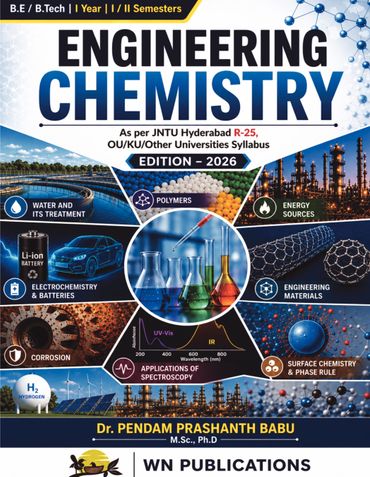
Engineering Chemistry is presented as a foundational, application-oriented resource for B.E./B.Tech I Year II-Semester students under the R-25 Regulations (Applicable from AY 2025–26; 2026 first edition), with complete syllabus coverage aligned to JNTU Hyderabad. The objective is to bridge core chemical principles with engineering decision-making in water quality management, electrochemical energy systems, corrosion mitigation, materials selection, and fuel/energy technologies. Content is developed through a structured pedagogical methodology: logically sequenced chapters progressing from fundamentals to industrial practice, uniform explanatory style, inclusion of numerical problem-solving (e.g., EDTA hardness estimation; Nernst equation and EMF calculations), process descriptions, and formative assessment via MCQs and fill-in-the-blanks, supported by reduced yet comprehensive indexing for usability. Major coverage and consolidated outcomes include: quantitative assessment and treatment of water for potable and boiler applications (WHO specifications; screening–sedimentation–filtration–disinfection; chlorination and breakpoint chlorination; defluoridation by Nalgonda technique; fluoride monitoring by ion-selective electrode; boiler troubles and their prevention via Calgon, phosphate, colloidal conditioning; external ion-exchange softening/demineralization; desalination by reverse osmosis with membrane types, operating pressures, performance factors, and maintenance). Electrochemistry is developed from electrode potential and the Nernst equation to galvanic cells, reference electrodes (SHE and calomel), pH measurement, and energy-storage/conversion devices, including zinc–air and lithium-ion batteries (EV pack design and BMS), fuel cells (DMFC and SOFC), and photovoltaic solar cells with performance metrics. Corrosion science integrates chemical/electrochemical theories, galvanic/water-line/pitting mechanisms, rate factors, cathodic protection (sacrificial and impressed current), and surface coatings (electroplating, hot dipping, cladding; copper plating, galvanization, tinning). Energy sources are addressed through calorific value (HCV/LCV; Dulong’s formula), fuel classification, and coal analysis (proximate/ultimate). Overall, the work provides an integrated framework enabling engineers to select technologies based on performance, safety, economics, and sustainability, supporting responsible practice in water, energy, and infrastructure systems.
About the Author
Book Details
ISBN: 9789372861624
Publisher: WN PUBLICATIONS
Number of Pages: 270
Dimensions: 7"x9"
Interior Pages: B&W
Binding:
Paperback (Perfect Binding)
Availability:
In Stock (Print on Demand)
Ratings & Reviews
ENGINEERING CHEMISTRY
Review This Book
Write your thoughts about this book.

Currently there are no reviews available for this book.
Be the first one to write a review for the book ENGINEERING CHEMISTRY.
Other Books in Science & Technology
spc Academic

रणबीर सिंह बैंसला

Abhishek kumar

Prof.(Dr) Rakesh Kumar Azad