You can access the distribution details by navigating to My Print Books(POD) > Distribution
Add a Review
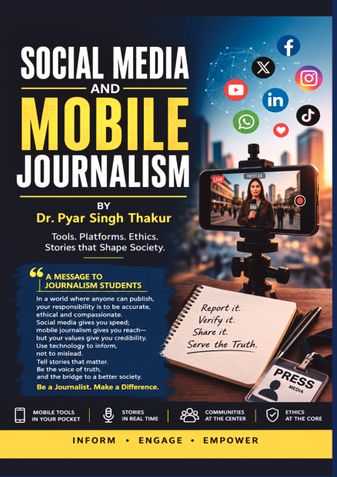
SOCIAL MEDIA AND MOBILE JOURNALISM
Tools, platforms, ethics, stories that shape society
Dr. Pyar Singh ThakurType:
Print Book
Genre: Education & Language, History
Language: English
Price:
₹729
+ shipping
This book ships within India only.
Description
The rapid growth of the Internet, smartphones, social media platforms, and digital technologies has brought a fundamental transformation in the field of journalism. Journalism is no longer confined to newspapers, radio, and television. Today, news can be gathered, produced, edited, published, and distributed within minutes through a smartphone. This transformation has given rise to new forms of journalism, particularly Social Media Journalism and Mobile Journalism (MoJo). The book “Social Media & Mobile Journalism” has been written primarily for students of Journalism and Mass Communication. The main purpose of this book is to provide students with a simple, systematic, comprehensive, and practical understanding of the changing nature of journalism in the digital age. The book introduces learners to the concepts, tools, techniques, processes, opportunities, challenges, and ethical dimensions of Social Media and Mobile Journalism. The contemporary media environment demands a journalist who is not only a good writer and reporter but also possesses technological and digital skills. A modern journalist may use a smartphone as a camera, audio recorder, video recorder, editing studio, newsroom, communication device, and publishing platform. Therefore, knowledge of mobile journalism has become increasingly important for students and aspiring media professionals. This book has been prepared with the specific needs of students in mind. The concepts have been explained in a simple and accessible manner so that students can understand both the theoretical and practical aspects of the subject. Important technical terms and professional concepts have been retained in their commonly used English form, while explanations have been presented in a student-friendly style. The book is intended to help learners connect classroom knowledge with real-world media practices. The book covers a wide range of topics related to Social Media and Mobile Journalism, including social media platforms, digital news, social media content, mobile journalism, smartphone-based reporting, mobile photography, mobile videography, audio recording, video editing, live reporting, multimedia storytelling, social media writing, citizen journalism, audience engagement, news verification, fact-checking, misinformation, disinformation, digital ethics, copyright, privacy, Artificial Intelligence (AI), and emerging trends in digital journalism. Special emphasis has been placed on the practical skills required by a contemporary journalist. In today's competitive media environment, theoretical knowledge alone is not sufficient. Students must learn how to identify a news story, gather information, verify facts, record quality audio and video, capture effective photographs, write for digital platforms, edit multimedia content, and publish information responsibly. The objective of this book is therefore to bridge the gap between theory and practice. Social media has also changed the relationship between journalists, media organizations, and audiences. Audiences are no longer passive consumers of news. They can comment, share, react, create content, participate in discussions, and even contribute information to news organizations. This has created new opportunities for public participation and citizen journalism, but it has also created challenges related to credibility, verification, privacy, online abuse, manipulation, and misinformation. The speed of digital communication makes accuracy and verification more important than ever. False information, fake news, manipulated photographs, misleading videos, deepfakes, and artificially generated content can spread rapidly through social media. A responsible journalist must therefore understand the principles of verification, fact-checking, source evaluation, objectivity, accuracy, fairness, privacy, copyright, and professional ethics. Another important dimension discussed in this book is the growing role of Artificial Intelligence (AI) in journalism. AI-based tools are increasingly being used for research, transcription, translation, data analysis, content generation, image creation, video production, and other media-related activities. These technologies provide new opportunities for journalists, but they also raise important questions about accuracy, transparency, originality, authorship, employment, bias, privacy, and journalistic responsibility. Students must therefore learn to use AI as a responsible professional tool while maintaining human judgment and ethical standards.
I firmly believe that the future of journalism belongs to professionals who can combine journalistic values, creativity, critical thinking, and digital competence. Technology can provide journalists with powerful tools, but technology alone cannot produce credible journalism. The credibility of journalism ultimately depends upon the journalist's commitment to truth, accuracy, fairness, public interest, and ethical responsibility.
A good mobile journalist must be curious, observant, creative, technically competent, adaptable, and responsible. The ability to work quickly with limited resources is particularly important in mobile journalism. Whether reporting from a village, a public event, a disaster site, an educational institution, or a major news event, a journalist equipped with a smartphone and appropriate digital skills can produce meaningful multimedia stories for a global audience.
This book is designed not merely as an examination-oriented textbook but also as a practical learning resource. Students can use it for classroom study, assignments, examinations, practical exercises, field reporting, projects, presentations, research, and professional preparation. Teachers can also use the material as a foundation for lectures, discussions, workshops, and practical activities.
The changing nature of journalism requires continuous learning. New social media platforms, mobile applications, artificial intelligence tools, content formats, algorithms, and audience behaviours continue to emerge. Therefore, students must develop the habit of learning beyond textbooks. They should experiment with new technologies, critically evaluate digital information, observe changing media practices, and develop their own professional skills.
I hope that “Social Media & Mobile Journalism” will help students understand the contemporary media environment and prepare themselves for the opportunities and challenges of digital journalism. My sincere effort has been to make the subject easy to understand while maintaining its academic and professional relevance.
I would like to express my gratitude to all teachers, students, researchers, media professionals, and well-wishers whose ideas, experiences, and academic contributions have helped shape my understanding of contemporary journalism. Their valuable suggestions and constructive feedback will always be welcome for improving future editions of this book.
Finally, I hope that this book will inspire students not only to become technically skilled media professionals but also to become responsible, ethical, creative, and socially conscious journalists. In an age where information travels faster than ever before, the responsibility to communicate truthfully and responsibly has become more important than ever.
______ Dr. Pyar Singh Thakur
About the Author
Book Details
Publisher: Shagun and Anirudh Publications
Number of Pages: 478
Dimensions: A5
Interior Pages: B&W
Binding:
Paperback (Perfect Binding)
Availability:
In Stock (Print on Demand)
Ratings & Reviews
SOCIAL MEDIA AND MOBILE JOURNALISM
Review This Book
Write your thoughts about this book.

Currently there are no reviews available for this book.
Be the first one to write a review for the book SOCIAL MEDIA AND MOBILE JOURNALISM.
Other Books in Education & Language, History

Namita Ambani

Manmohan Jindal

Lash Class

JAYAKRISHNAN