You can access the distribution details by navigating to My Print Books(POD) > Distribution
Add a Review
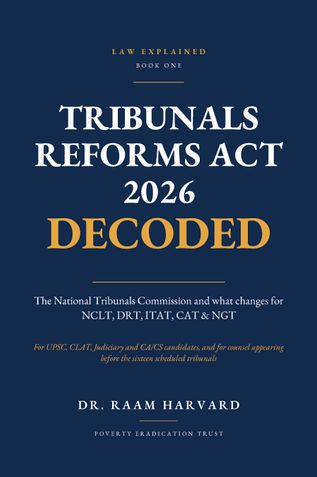
Tribunals Reforms Act 2026 Decoded
All 24 Sections Explained — The National Tribunals Commission and What Changes for NCLT, DRT, ITAT, CAT & NGT | For UPSC, CLAT, Judiciary and CA/CS Aspirants and Practitioners
Dr. Raam HarvardType:
Print Book
Genre: Law, Politics & Society
Language: English
Price:
₹799
+ shipping
Description
The Tribunals Reforms Act, 2026 came into force on 25 August 2026 and changed how sixteen tribunals are staffed and run. It creates a National Tribunals Commission, rewrites the Search-cum-Selection Committee process, puts statutory clocks on appointment, and repeals the 2021 Act.
Between the bare statute and the full commentary that will take a year to arrive, there is very little for the reader who has to deal with the Act now. This book is written for that reader.
It works through the Act in the order Parliament wrote it, section by section, all 24 sections, and for each provision says three things: what it means in ordinary English, what changed from the 2021 Act, and which direction of the Supreme Court it answers. Every chapter in Parts II and III closes with five boxes — Plain English, What changed from 2021, The Supreme Court direction it implements, Exam pointer, Practice pointer.
WHAT IS INSIDE
- Part I: why India needed a new tribunals law, forty years of courts versus executive, and why the 2021 Act fell
- Part II: the section-by-section commentary, ss. 1 to 24, plus the Schedules
- Part III: how the new system works — the Commission as an institution, the selection pipeline end to end, the discipline pipeline, the National Tribunals Data Grid, and the transition rules
- Part IV: separate guides for candidates seeking tribunal posts, for litigants and counsel, and a one-page treatment of each of the sixteen tribunals
- Part V: the objections commentators have raised on ss. 5, 13, 14, 16 and 24(3), each set out as fully as its author made it, with the answers and the precedents on both sides
- Part VI: an exam kit — cheat sheet and mind map, sixty multiple-choice questions with explanations, model answers, and recall cards
- Annexures: the Act as gazetted on 13 August 2026, the commencement notification S.O. 4713(E), the Bill documents, and digests of the Madras Bar Association line
COVERS NCLT, DRT, ITAT, CAT, NGT, SAT, TDSAT, APTEL, AFT and the other tribunals in the First Schedule.
FOR UPSC, CLAT, judiciary and CA/CS candidates, and for counsel with a matter listed before any of the sixteen.
THREE EDITORIAL RULES
No prediction. The constitutional objections are presented as argument, counter-argument and precedent. No view is offered on how a challenge would be decided.
Every figure sourced. Pendency and vacancy numbers come from a Parliament answer, a tribunal annual report or the National Judicial Data Grid, and are attributed. Where no reliable figure existed, none is given.
Honest about its gaps. The Commission is not yet constituted and the rules under s. 20 are not yet notified. Passages that need them are marked, and a second edition will carry that material.
The law is stated as on 13 September 2026.
This book is an explanatory commentary on a statute. It is not legal advice.
About the Author
Book Details
ISBN: 9789389788150
Publisher: Poverty Eradication Trust (Triple ISO)
Number of Pages: 314
Dimensions: 6"x9"
Interior Pages: B&W
Binding:
Paperback (Perfect Binding)
Availability:
In Stock (Print on Demand)
Ratings & Reviews
Tribunals Reforms Act 2026 Decoded
Review This Book
Write your thoughts about this book.

Currently there are no reviews available for this book.
Be the first one to write a review for the book Tribunals Reforms Act 2026 Decoded.
Other Books in Law, Politics & Society

Sarthak Gupta

Aarish Chhabra

राहुल वर्मा