You can access the distribution details by navigating to My Print Books(POD) > Distribution
Add a Review
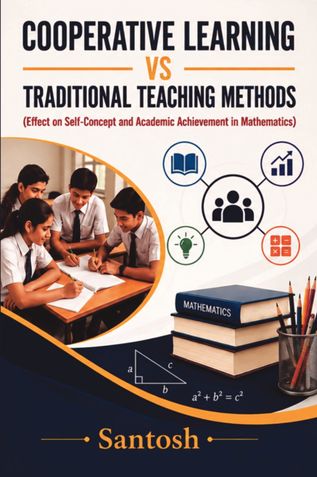
COOPERATIVE LEARNING VS TRADITIONAL TEACHING METHODS
Effect on Self-Concept and Academic Achievement in Mathematics
Dr. SantoshType:
Print Book
Genre: Education & Language, Mathematics
Language: English
Price:
₹550
+ shipping
This book ships within India only.
Description
This book explores some of the most fundamental questions in contemporary classroom teaching: How can students' academic achievement be enhanced through effective instructional strategies? How can cooperative learning be successfully implemented in Indian classrooms? Which cooperative learning approach is most suitable for culturally and socially diverse classrooms comprising students from different castes, classes, religions, regions, and value systems? In what ways can cooperative learning overcome the limitations of conventional teaching practices? Which cooperative learning environment best promotes the development of students' self-concept? How do cooperative and non-cooperative learning experiences influence the teaching–learning process? Most importantly, how do the Student Teams–Achievement Divisions (STAD) and Jigsaw methods contribute to improving the academic achievement and self-concept of seventh-grade students in Mathematics?
Drawing upon systematic research and practical classroom experiences, this book presents a comprehensive introduction to cooperative learning with particular emphasis on the STAD and Jigsaw models. Rather than claiming to be a definitive work for experts, it is designed as a practical and research-oriented resource for pupil teachers, in-service teachers, teacher educators, researchers, and all educators who are eager to adopt innovative, collaborative, and learner-centred pedagogical practices.
By combining theoretical foundations with practical applications, this book equips readers with the knowledge and confidence to implement cooperative learning strategies effectively, thereby fostering higher academic achievement, stronger self-concept, and a more inclusive, participative, and engaging classroom environment.
About the Author
Book Details
ISBN: 9789359373751
Publisher: Self Published and Powered by Pothi.com
Number of Pages: 285
Dimensions: 6"x9"
Interior Pages: B&W
Binding:
Paperback (Perfect Binding)
Availability:
In Stock (Print on Demand)
Ratings & Reviews
COOPERATIVE LEARNING VS TRADITIONAL TEACHING METHODS
Review This Book
Write your thoughts about this book.

Currently there are no reviews available for this book.
Be the first one to write a review for the book COOPERATIVE LEARNING VS TRADITIONAL TEACHING METHODS.
Other Books in Education & Language, Mathematics
Niraj Kumar
DEVESH GUPTA
IPREPTODAY SKILLS FOUNDATION