You can access the distribution details by navigating to My Print Books(POD) > Distribution
Add a Review
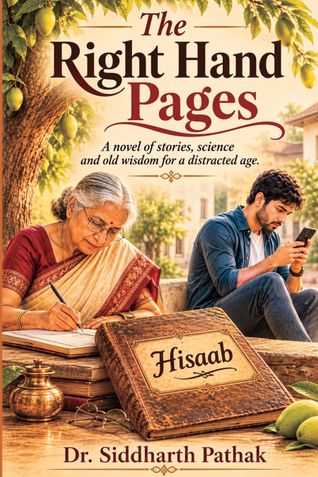
The Right Hand Pages
A novel of stories, science and old wisdom for a distracted age
Dr. SIDDHARTH PATHAKDescription
DADI'S HISAAB, MANGO, PLOT AND YUG
We did not lose the plot. We sold it, a little at a time, for comfort, for convenience, for a life that looks better than the one we are living. We traded curiosity for comfort, depth for dopamine, thinking for scrolling.
When Yug Gautam, a 31-year-old product manager who builds an app for managing time, returns to Nagpur to clear his late grandmother’s house, he finds a sealed envelope in her cupboard: “Open when you can sit alone for one hour, without a phone.” He lasts eight minutes.
Beside it lies her Hisaab, a ledger with no numbers. Instead it holds one line for every day of forty years, recording only what she saw: a mango tree in flower, a rainy afternoon, a son’s voice on the phone. Its right-hand pages are blank.
Over one year, Yug learns to look again. A railway chai seller remembers every customer’s order because, he says, he doesn’t remember, he looks. At a cousin’s wedding, forty-one phones record the pheras while an eighty-two-year-old woman weeps, unfilmed, in the front row. A father still pats his pocket each morning for a bus pass he gave up three years ago. A neighbour comforts Yug with a plate of poha and not a single word.
But this is a novel before it is a guide. A builder offers a fortune for the house and the mango tree. An old friend has not called his father in two years. A colleague is quietly losing her mother’s memory. And a week has been cut out of the ledger, for a reason no one expects.
Every chapter opens with a story from everyday Indian life. It then adds what psychology knows about attention, habit, honesty, silence, enjoyment and love, draws on the wisdom of the Upanishads, the Gita and Kabir, and ends with one small habit you can try that week. The chapters echo one another, so a story from the first pages returns, changed, near the last. Between them come single pages from the grandmother’s ledger, and short scenes from Yug’s office in Pune, where he tries to persuade his company to build something kinder.
Warm, funny and quietly moving, The Right-Hand Pages is for anyone who feels busy, connected and strangely absent. It is for readers of gentle, thoughtful fiction who would rather have a story than a manual, and for readers in India and the diaspora who want to see their own kitchens, railway platforms and weddings on the page. No background in philosophy or psychology is needed. Every idea arrives inside a scene.
Part novel, part gentle guide, it asks one question: what would you write on the blank page?
About the Author
Book Details
Number of Pages: 131
Dimensions: 6.00"x9.00"
Interior Pages: B&W
Binding:
Paperback (Perfect Binding)
Availability:
In Stock (Print on Demand)
Ratings & Reviews
The Right Hand Pages
Review This Book
Write your thoughts about this book.

Currently there are no reviews available for this book.
Be the first one to write a review for the book The Right Hand Pages.
Other Books in Self-Improvement
Rashim Gera
Vijay K Banda

Aditi Kaushik

B. S. Sujendra Prakash, Ph.D.