You can access the distribution details by navigating to My Print Books(POD) > Distribution
Add a Review
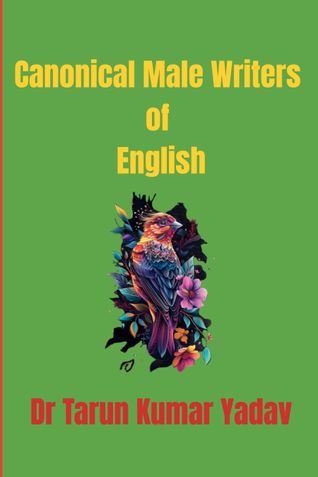
Canonical Male Writers of English
Canonical Male Writers of English, English Writers,
Dr Tarun Kumar YadavType:
Print Book
Genre: Literature & Fiction, Poetry
Language: English
Price:
₹1,250
+ shipping
This book ships within India only.
Description
Literature offers a meaningful way to understand human life, social relationships, cultural traditions, and historical change. Canonical writers of English have contributed significantly to the development of literary thought by exploring the complexities of individual experience and the societies in which individuals live. Their works continue to invite new interpretations as readers approach them through changing intellectual, cultural, and theoretical perspectives.
Canonical Male Writers of English brings together scholarly engagements with literary texts through a range of critical approaches. The volume moves beyond the conventional understanding of canonical literature as a collection of established texts and examines how literary works respond to questions of identity, power, memory, inequality, language, gender, and the environment. It seeks to demonstrate that the significance of literary writing lies not only in its historical reputation but also in its continuing capacity to generate critical reflection.
The contributions in this volume examine important social and cultural concerns through close readings of literary works. The discussion of Mulk Raj Anand’s Untouchable, for instance, foregrounds caste discrimination, social exclusion, and the struggle for human dignity. The ecocritical engagement with Ruskin Bond’s The Blue Umbrella considers the relationship between human beings, nature, community, and material desire. Similarly, the study of Amitav Ghosh’s The Hungry Tide explores ecological vulnerability, displacement, and environmental justice. These discussions demonstrate how literature can illuminate the connections between human experience and wider social and ecological structures.
Other contributions explore cultural memory, family relationships, linguistic identity, postcolonial experience, and the representation of gender. The analyses of A. K. Ramanujan’s poetry and Nissim Ezekiel’s literary world, for example, offer opportunities to consider the relationships among memory, language, belonging, and cultural inheritance. The engagement with Salman Rushdie’s Midnight’s Children further opens up questions of historical memory, national identity, linguistic diversity, and the complexities of postcolonial experience. Together, these studies demonstrate the value of interdisciplinary literary criticism in understanding the multiple meanings of canonical texts.
An important objective of this volume is to encourage readers to approach literature as an evolving field of inquiry. Established literary works are not confined to a single interpretation. Their meanings emerge through the interaction of textual details, historical contexts, theoretical frameworks, and the experiences of readers. By bringing different critical perspectives into conversation, this collection seeks to support independent thinking and responsible scholarly engagement.
The volume is intended for postgraduate students, research scholars, university teachers, and readers interested in English literature and literary criticism. It may also serve as a useful resource for classroom discussions, research projects, and further studies in literary and cultural theory.
I express my sincere gratitude to all the contributors for sharing their research and participating in this academic endeavour. I am also thankful to T T International Publication for supporting the publication of this collection. I hope the volume will encourage further research, constructive debate, and renewed engagement with the literary works discussed in its chapters.
It is my hope that Canonical Male Writers of English will contribute to the continuing study of English literature by demonstrating how canonical texts can be read critically, contextually, and meaningfully in the present.
About the Author
Book Details
ISBN: 9789347454035
Publisher: T T International Publication
Number of Pages: 256
Dimensions: 6.00"x9.00"
Interior Pages: B&W
Binding:
Paperback (Perfect Binding)
Availability:
In Stock (Print on Demand)
Ratings & Reviews
Canonical Male Writers of English
Review This Book
Write your thoughts about this book.

Currently there are no reviews available for this book.
Be the first one to write a review for the book Canonical Male Writers of English.
Other Books in Literature & Fiction, Poetry

Aman Gautam

Tanush Kotak, Ahana Shetty, Akshita Singh, Kashvi Shylesh, ...

Colonel Ajay K Raina, SM

PREM GUPTA "MANI"