You can access the distribution details by navigating to My Print Books(POD) > Distribution
Add a Review
This book ships within India only.
Description
When Satyam, IL&FS, and DHFL collapsed, their boards were not empty.
They were staffed by seasoned veterans: former bank chairmen, retired civil servants, corporate lawyers, and prominent academics. They attended four meetings a year, collected their sitting fees, nodded through the annexures, and never spoiled the mood.
The board was treated as a prestigious lunch club. That model is dead.
Under Section 166 and Section 149(12) of the Companies Act, alongside NFRA's tightening audit circulars, passive silence is no longer neutrality. It is legally construed as negligence. When an unhedged guarantee unspools or an unlisted related-party transaction collapses, enforcement agencies do not care that you were a non-executive appointee. Your personal assets and your DIN are on the line.
Yet, conventional governance advice is detached from reality.
Textbooks tell directors to act like courtroom prosecutors. That does not work. If you walk into a Monday morning board meeting quoting legal sections across the table, you back the promoter into a corner, embarrass executive leadership in front of their teams, and get marginalised from informal strategic discussions.
An independent director does not protect a company by picking fights. You protect it by putting the unvarnished numbers on the record.
This book draws on over twenty years of managing capital projects, institutional real assets, and infrastructure portfolios across three continents: from managing governance for Goldman Sachs' headquarters in London and Bengaluru, to directing 7.5 million square feet of commercial assets at Tata Realty, and serving on infrastructure boards in India.
About the Author
Book Details
ISBN: 9789334510898
Number of Pages: 167
Dimensions: 6"x9"
Interior Pages: B&W
Binding:
Paperback (Perfect Binding)
Availability:
In Stock (Print on Demand)
Ratings & Reviews
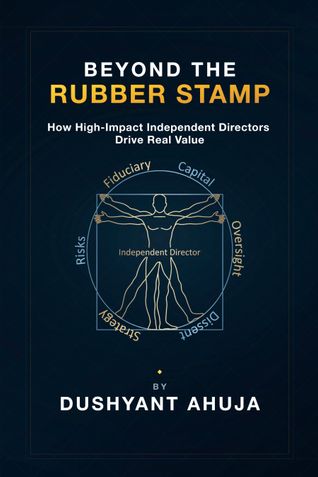
Beyond the Rubber Stamp
Review This Book
Write your thoughts about this book.

Currently there are no reviews available for this book.
Be the first one to write a review for the book Beyond the Rubber Stamp.
Other Books in Business & Economics

Suman Sarkar

V. Basil Hans
Bombay Books Publications

Narender Sharma