You can access the distribution details by navigating to My pre-printed books > Distribution
Add a Review
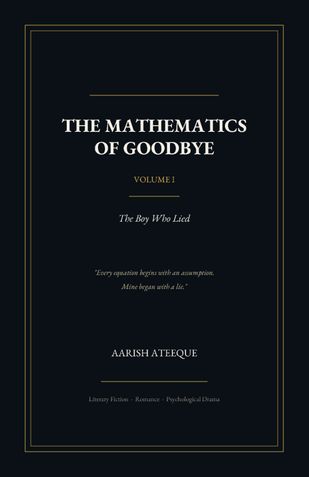
Type:
e-book
Genre: Romance, Philosophy
Language: English
Price:
₹129
(Immediate Access on Full Payment)
Description
Aariz enters university carrying the ordinary ambitions of a mathematics student and an
extraordinary fear: that the truth about himself will never be enough for someone to love him.
When he meets Shanya, a relationship slowly develops through messages, conversations, shared
silences, mathematics, friendship and the strange intimacy of being understood by another person.
For Aariz, however, love becomes inseparable from fear. Afraid that the real version of himself will
not be enough, he constructs a version of his life that he believes will make him easier to love.
At first, the deception seems harmless. Shanya loves the person she believes him to be, and Aariz
convinces himself that the affection between them makes the lie worthwhile. But a lie told for love
does not remain small forever. It demands maintenance, creates insecurity, and gradually changes
the person who tells it.
As their relationship deepens, Aariz's fear of losing Shanya begins to transform affection into
calculation. He starts measuring what he gives, what he receives, how much he has sacrificed, and
what he believes he deserves in return. His notebooks, once filled with poetry and observations
about Shanya, slowly acquire another language—the language of lists, dates, gifts and amounts.
Meanwhile, the world around them continues with the ordinary rhythm of university life:
mathematics lectures, examinations, hostel friendships, tea stalls, cricket matches and evenings
beneath the neem tree. Their friends sense the distance growing between them, even when Aariz
and Shanya refuse to name it.
Eventually, the original deception can no longer remain buried. The truth reaches Shanya, forcing
her to confront the painful possibility that the person she trusted was partly an invention.
What follows is not a simple breakup. Aariz's fear turns into resentment, and resentment turns into
an attempt to reduce the emotional history between them to something measurable. A relationship
that once existed through affection is dragged into the language of debts, gifts and fairness. The
consequences become irreversible.
The novel culminates in a confrontation where Aariz finally receives what he thought he wanted,
only to discover that getting the numbers to balance has destroyed the relationship that gave those
numbers meaning.
Leaving Aligarh becomes the final consequence. Yet The Mathematics of Goodbye is not
ultimately a story about a man losing the woman he loves. It is about the more difficult discovery
that sometimes the greatest damage we cause others begins with the parts of ourselves we are
most desperate to protect. Through mathematics, memory and philosophy, the novel asks: What happens when the person
you create to be loved eventually destroys the person you actually are?
The Mathematics of Goodbye is a literary coming-of-age story about love, deception, insecurity,
friendship, guilt and the mathematics of trying to measure something that was never meant to be
measured.
About the Author
Book Details
ISBN: 9798191463339
Publisher: Aarish Ateeque
Number of Pages: 181
Availability:
Available for Download (e-book)
Ratings & Reviews
The MATHEMATICS of good bye
Review This Book
Write your thoughts about this book.

Currently there are no reviews available for this book.
Be the first one to write a review for the book The MATHEMATICS of good bye.
Other Books in Romance, Philosophy

Prashant Trivedi

Aditya Kunapareddy

Mark Ferns

Rowena Portch