Description
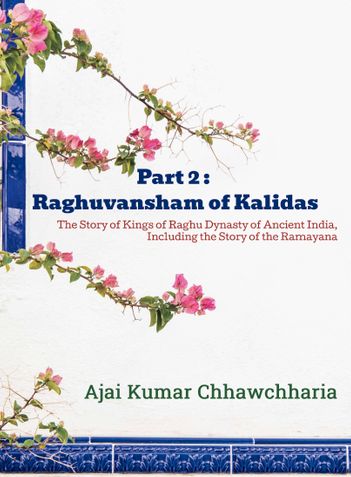
This is the 2nd part of the 2-Part marvellous Book titled 'Kalidas' Raghuvansham' which tells us the fascinating historical story of ancient India about the great dynasty of king Raghu which had Lord Ram, the hero of the epic Ramayana, as one of its 29 great kings. It is in classical Sanskrit language, with Roman Transliteration, and a detailed English rendering with explanatory notes and references. The beauty of the Sanskrit text is that it liberally uses analogies, similes and metaphors to give a vivid mental idea of what is being actually said in the main part of the verse.
There are 19 Cantos in all that are divided into 3 primary Chapters. Chapter 1 tells the story of Lord Ram's forefathers; Chapter 2 deals with the story of the Ramayana and its hero, Lord Ram; and Chapter 3 narrates the story of Lord Ram's descendants, till the last king after whom this dynasty ended. Chapter 4 has a list of all the Kings of this Dynasty.
The present Part 2 of the Book contains Chapter no. 2 that covers Canto nos. 10-15, Chapter no. 3 that covers Canto nos. 16-19, as well as one extra Chapter no. 4 which lists the names of all the great Kings of this dynasty, along with the Canto nos. in which their stories are narrated.
The story of the Book straddles two eras of Hinduism's 4-era one cycle of creation and destruction, i.e. the Treta Yuga and the Dwapar Yuga corresponding to the 2nd and the 3rd eras.
Part 1 of this Book has Chapter no. 1. It is published simultaneously alongside this Part 2.
Ajai Kumar Chhawchharia left home when he was approximately 29 years of age due to an inner call of his heart that told him to devote his life in the service of his beloved Lord God, Sri Ram. Worldly attractions did not enchant him at all. So, he didn’t marry, and after his father’s death he came and settled permanently in Ayodhya, the holy town in India associated with Lord Ram.
Presently he works as an honorary manager of a world famous Kanak Bhavan Temple at Ayodhya, and spends his time writing in English so that the world can access the wonderful nectar of metaphysical, spiritual and devotional philosophy that is contained in Indian scriptures for which they are so renowned.
His English Books published separately by a reputed publisher of India, the details of whom can be had by contacting the author on his email given below, include: (i) The series on ‘108 Upanishads’ in five volumes having eighteen parts, (ii) Veda Vyas’ ‘Adhyatma Ramayan’ in two parts, (iii) ‘Devi Puran Ramayan’, (iv) Valmiki’s ‘Adbhut Ramayan’, and (v) ‘Biography of Lord Ram’ based on Tulsidas’ books.
Genre of Writing: Hindu Spiritualism, Philosophy, Metaphysics, Religious, Devotional, Theological, and Historical Narratives from ancient classical Sanskrit texts.
The author’s Books are available for order online both in ‘e-book’ format and ‘paper-back book’ format at www.pothi.com (in their ‘paper-back book’ + 'ebook' versions).
(A) List of Books that are currently available as mentioned above :-
(A-1) (1) The Chariot of God: Dharma Rath; (2) OM and Naad; (3) YOGA—Its Practice and Philosophy according to the Upanishads; (4) Ram Geeta; (5) The Revelation of Creation—as envisioned in the Upanishads; (6) The Pentagon of Creation: As Expounded in the Upanishads; (7) The Triumvirate of Creation; (8) Maya: The Whirlpool of Delusions in Creation; (9) Surdas-Ram Charitawali; (10-a) The legend of Lord Shiva: Book 1 ‘Lord Shiva’s marriage with Parvati’; (10-b) Book 2 ‘Lord Shiva’s Sacred Hymns’; (10-c) Book 3 ‘Shiva’s different names & their significance, Shiva Puran, Upanishads’; (11) the Mahavakyas of the Upanishads; (13) Lord Ram’s marriage with Sita (based on Tulsidas’ books “Ram Charit Manas”, “Janki Mangal”, “Ram Lala Nahachu” & “Geetawali”, and sage Veda Vyas’ book “Adhyatma Ramayan”; (14) “Anthology of Sacred Hymns, Stotras & Mantras of Lord Ram”; (15) “Vairagya Shatkam” of king-sage Bhartrihari; (16) An Anthology of the Sanyas Upanishads-Parts 1 and 2; (17) “Kaag-Bhusund Ramayan” or the “Aadi Ramayan” based on Tulsidas’ Ram Charit Manas; (18) The Legendary Glory of Hanuman; (19) “Narad Bhakti Sutra”—Aphorisms for Devotion for God and the Principles of Love for the Lord; (20) “Shandilya Bhakti Sutra”—Aphorisms for Devotion for God and the Principles of Love for the Lord according to the illustrious sage Shandilya; (21) “Bhakti Sutra Mala”—A Garland of Spiritual Wisdom in the form of an Anthology of Aphorisms pertaining to Bhakti or devotion, love and affection for Lord God; (22) Glory of Lord Ram’s Holy Name, Sacred Mantras, Stotras & Hymns; (23) Saints and Non-Saints: Their Distinguishing Characters and Qualities; (24) A True Guru (Qualities, Importance and Need of a True Teacher, Preceptor, Guide and Advisor); (25) “Sundar Kand” of Ram Charit Manas; (26) The Story of Ravana and the Epic War of Lanka—Told in Slow Motion (based on, and will have the full relevant Text of, Ram Charit Manas, Adhyatma Ramayan, Anand Ramayan, Geetawali Ramayan, and Kavitawali Ramayan); (27) The Great Ancient Sages, Seers, Saints and Enlightened Kings of India; (28) The Metaphor of the Hansa in the Upanishads: The symbolism of a Grand Swan used to explain the wisdom of spiritual and metaphysical principles by the Upanishads; (29) Devotional Stotras and Stutis (hymns and prayers) of Lord Hanuman; (30) The Legendary Story of Lord Hanuman—spanning three eras of Treta, Dwapar and Kali Yugas; (31) An Anthology of the Ramayan-The Story of Lord Ram from Mahabharat, Srimad Bhagwat & Kalidas' Raghuvansham; (32) Raghuvansham of Kalidas.
(A-2) Goswami Tulsidas Series: (1) ‘Dohawali’; (2) ‘Parvati Mangal’; (3) ‘Kavitawali’; (4) ‘Janki Mangal’; (5) ‘Ram Lala Nahachu’; (6) ‘Geetawali Ramayan’; (7) ‘Vairagya Sandipani’; (8) ‘Vinai Patrika’; (9) ‘Barvai Ramayan’.
(A-3) A full-blown English rendering of Tulsidas’ epic ‘Ram Charit Manas’, otherwise also known as the “Ramayana” according to Goswami Tulsidas. My English version of this Book is comprehensive and an elaborate one, as it runs into many thousands of pages that endeavour to explain each single verse of the Book ‘Ram Charit Manas’ in fine detail from different perspectives, with the aid of explanatory notes and references.
(A-4) Detailed English renderings, with explanatory notes and commentaries of the 108 Upanishads classified according to the Vedic tradition = 6 volumes; 18 parts. [Vol. 1=Rig Veda Upanishads; Vol. 2= Sam Veda Upanishads; Vol. 3= Shukla Yajur Veda Upanishads; Vol. 4= Krishna Yajur Veda Upanishads; Vol. 5= Atharva Veda Upanishads; Vol. 6= Vedanta Concepts explained with specific references to the relevant Upanishads.
(A-5) (i) English rendering of Adbhut Ramayan by sage Valmiki.
(ii) English rendering of Adhyatma Ramayan by sage Veda Vyas.
(iii) English rendering of Devi Puran’s Ramayan by sage Veda Vyas.
(iv) A Divine Biography of Lord Ram & Glory of Lord’s Holy Name.
Contact details of Ajai Kumar Chhawchharia—
Postal address:-36-A, Rajghat Colony, Parikrama Marg, P.O.—Ayodhya, Pin—224123, Distt. Ayodhya (Faizabad), U.P. India.
Phone:—(India) +91-9451290400 (call + whatsapp); +91-9935613060 (call only).
Email of Author: (i) < ajaichhawchharia@gmail.com >
(ii) < ajaikumarbooks@gmail.com >