You can access the distribution details by navigating to My pre-printed books > Distribution
Add a Review
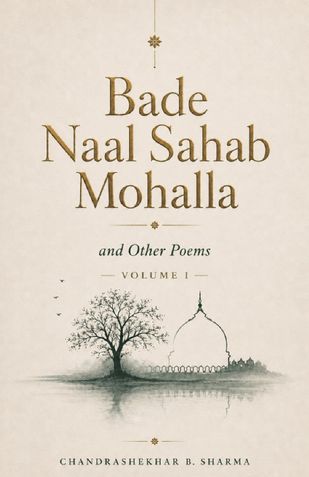
BADE NAAL SAHAB AND OTHER POEMS VOLUME I (eBook)
Type:
e-book
Genre: Literature & Fiction, Poetry
Language: English
Price:
₹100
(Immediate Access on Full Payment)
Description
Some places disappear long before they are demolished. They survive only in memory—in the cadence of forgotten voices, in the scent of damp courtyards after rain, in the shadow of an old tamarind tree, in the echo of a neighbour calling across a lane. Bade Naal Sahab Mohalla and Other Poems Volume I is an attempt to recover one such world before it vanishes into silence.
Drawing upon the poet's childhood in a small Indian mohalla, this collection transforms personal remembrance into a meditation on memory, belonging, and the fragile architecture of human relationships. The neighbourhood is not merely a backdrop but the central protagonist of the book: a living organism where every lane, doorstep, school, shrine, courtyard, and rooftop carries the imprint of countless anonymous lives.
The poems inhabit a landscape populated not by celebrated figures but by ordinary people whose lives possess extraordinary emotional resonance. Elders, parents, neighbours, teachers, widows, labourers, itinerant performers, and forgotten women emerge with remarkable tenderness, each becoming part of a shared moral universe. Characters such as Bade Tauji, Bela Bai, Sando (Alias Tara Bai), Papaji,Insoumise, and Asgar Dhilli ke Abba, are at once deeply individual and quietly archetypal, representing the countless lives that rarely find a place in official histories yet remain unforgettable to those who knew them.
Interwoven with these portraits are poems that elevate the ordinary into the symbolic. Everyday objects and experiences—a lock, lice, inheritance, skin, slavery—become metaphors through which the poet explores identity, memory, dignity, mortality, love, and the invisible inheritances passed from one generation to another. The collection continually moves between the intimate and the universal, suggesting that the smallest incidents of childhood often contain life's deepest philosophical truths.
Although rooted in a specific locality in central India, these poems transcend geography. They evoke a world in which Hindu and Muslim households, festivals and prayers, affection and grief, coexist with effortless intimacy, reminding us of a social fabric woven through everyday acts of neighbourliness rather than grand declarations. The mohalla becomes a metaphor for community itself—a space where identity is shaped not in isolation but through shared lives.
Written in a language rich with sensory detail, lyrical precision, and quiet emotional intensity, Bade Naal Sahab Mohalla and Other Poems belongs to the tradition of memory literature while remaining unmistakably contemporary. These poems resist nostalgia even as they honour the past; they understand that memory is never an attempt to return home but a way of discovering what home continues to mean.
At its heart, this is a book about the anonymous custodians of our childhood—the people whose names seldom enter history but whose presence endures within us long after streets have changed, houses have crumbled, and generations have passed. It is an elegy for disappearing neighbourhoods, a celebration of ordinary lives, and a testament to poetry's power to rescue the overlooked from oblivion.
In giving voice to one forgotten mohalla, Chandrashekhar Bansilal Sharma ultimately speaks to every reader who has ever carried an invisible homeland within.
About the Author
Book Details
ISBN: 9789360126773
Publisher: CHANDRASHEKHAR BANSILAL SHARMA
Number of Pages: 165
Availability:
Available for Download (e-book)
Ratings & Reviews
BADE NAAL SAHAB AND OTHER POEMS VOLUME I
Review This Book
Write your thoughts about this book.

Currently there are no reviews available for this book.
Be the first one to write a review for the book BADE NAAL SAHAB AND OTHER POEMS VOLUME I.
Other Books in Literature & Fiction, Poetry

David Oldham

SARADI BINDHANI
RAJA TALIB
MISS RATUL BANERJEE