You can access the distribution details by navigating to My pre-printed books > Distribution
Add a Review
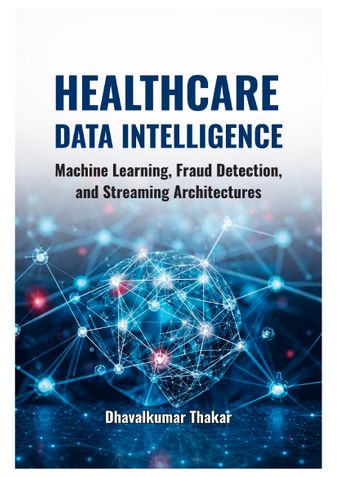
Healthcare Data Intelligence: Machine Learning, Fraud Detection, and Streaming Architectures (eBook)
Type:
e-book
Genre: Diet & Health
Language: English
Price:
₹484
(Immediate Access on Full Payment)
Description
Healthcare is experiencing one of the most significant transformations in its history. The rapid growth of digital technologies, electronic health records, connected medical devices, wearable sensors, and cloud computing platforms has created an unprecedented volume of healthcare data. Every patient interaction, diagnostic test, treatment procedure, insurance claim, and monitoring device contributes valuable information that can be used to improve healthcare outcomes. However, the true value of this data lies not in its collection alone, but in the ability to transform it into meaningful intelligence that supports better decisions, more efficient operations, and enhanced patient care.
The book "Healthcare Data Intelligence: Machine Learning, Fraud Detection, and Streaming Architectures" has been developed to provide a comprehensive understanding of the technologies, methodologies, and architectural principles that are shaping the future of healthcare analytics. It explores how modern healthcare organizations can leverage data intelligence to improve clinical effectiveness, detect fraudulent activities, optimize resource utilization, and deliver real-time healthcare services. The objective is to bridge the gap between healthcare knowledge and emerging digital technologies, providing readers with both conceptual foundations and practical insights.
Healthcare systems today face numerous challenges, including rising operational costs, increasing patient expectations, complex regulatory requirements, and the growing burden of chronic diseases. At the same time, healthcare providers must manage vast amounts of structured and unstructured information generated from diverse sources. Machine learning and advanced analytics offer powerful solutions for extracting actionable insights from these complex datasets. By identifying hidden patterns, predicting future outcomes, and supporting evidence-based decision-making, these technologies are helping healthcare organizations become more proactive, efficient, and patient-centered.
A unique focus of this book is healthcare fraud detection, an area of growing importance in modern healthcare ecosystems. Fraudulent claims, billing irregularities, identity misuse, and other forms of abuse impose significant financial burdens on healthcare systems worldwide. The book examines how machine learning, anomaly detection, behavioral analytics, and risk-scoring models can be used to identify suspicious activities and strengthen healthcare integrity. Readers will gain an understanding of both the technical and operational aspects of fraud prevention in healthcare environments.
Another major theme explored throughout the book is the emergence of streaming architectures and real-time healthcare intelligence. As healthcare increasingly relies on continuous data streams from connected devices and remote monitoring systems, traditional batch-processing approaches are no longer sufficient. Real-time analytics enables healthcare providers to respond rapidly to changing patient conditions, support continuous monitoring, and deliver timely interventions. The discussion of streaming systems, event-driven architectures, and intelligent monitoring demonstrates how modern healthcare organizations can build scalable and responsive digital infrastructures.
The book is organized into nine chapters that collectively cover the foundations of healthcare data intelligence, data engineering, machine learning, clinical analytics, fraud detection, streaming systems, intelligent monitoring, cloud-native healthcare platforms, and future innovations. Each chapter is designed to build upon previous concepts while introducing practical examples and contemporary applications. The progression from fundamental principles to advanced technologies allows readers from diverse backgrounds to develop a comprehensive understanding of the field.
This book is intended for a broad audience, including healthcare professionals, health informatics specialists, data scientists, researchers, technology architects, students, policymakers, and organizational leaders. Whether the reader is interested in healthcare analytics, artificial intelligence, fraud management, cloud technologies, or digital transformation, the content provides valuable perspectives on the evolving landscape of healthcare intelligence.
The future of healthcare will increasingly depend on the ability to harness data effectively, responsibly, and securely. Technologies such as artificial intelligence, federated learning, digital twins, edge computing, and intelligent automation are creating new opportunities for innovation while also introducing new challenges related to privacy, ethics, and governance. By understanding these developments and their implications, healthcare organizations can position themselves to deliver more effective, accessible, and sustainable healthcare services.
It is hoped that this book will serve as a useful resource for understanding the principles, technologies, and strategies that define healthcare data intelligence. More importantly, it aims to inspire further exploration and innovation in the pursuit of smarter healthcare systems that improve lives, empower healthcare professionals, and contribute to the advancement of global health.
About the Author
Book Details
Publisher: WISSIRA RESEARCH LAB
Number of Pages: 216
Availability:
Available for Download (e-book)
Ratings & Reviews
Healthcare Data Intelligence: Machine Learning, Fraud Detection, and Streaming Architectures
Review This Book
Write your thoughts about this book.

Currently there are no reviews available for this book.
Be the first one to write a review for the book Healthcare Data Intelligence: Machine Learning, Fraud Detection, and Streaming Architectures.
Other Books in Diet & Health
Writers' Kalam
YOUR FAVOURITE BOOK

Dipanshu Aggarwal
Dr.Nagendra Kumar Sinha