You can access the distribution details by navigating to My pre-printed books > Distribution
Add a Review
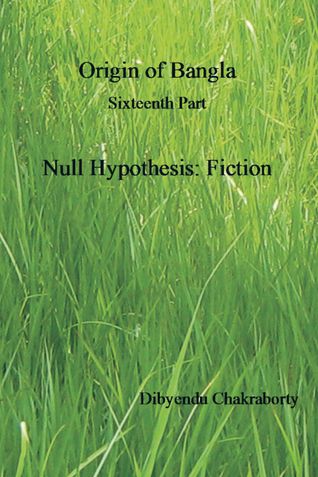
Origin of Bangla Sixteenth Part Null Hypothesis: Fiction (eBook)
বাংলার উৎপত্তি ষোড়শ পর্ব প্রাথমিক অনুমান: কল্পগল্প
Type:
e-book
Genre: History
Language: English
Price:
₹500
(Immediate Access on Full Payment)
Description
In the discernible past, the entire expanse of North India was submerged under water. At a time when evidence suggests that organized human societies had begun their civilisational advance in other parts of the world, the geographical region known as ‘North India’ lay submerged beneath the sea. The water gradually receded, giving rise to dry land. The region known as ‘Bangla’ is an important part of geographical North India. The part of North India known as ‘Bangla’ began to transform from submerged land into dry land sometime around 5,000 years ago.
Without exception, the journey of all the scholars intent on forming an understanding of India's past has concluded upon reaching the edge of that vast wetland which, approximately 5,000 years ago, spanned the entirety of North India. That group of brilliant scholars included not only local intellectuals who participated in the Bengal Renaissance but also many distinguished scholars from Europe. Consequently, obstacles have arisen in properly comprehending the past of Bengal and, by extension, India.
In more recent times—during the Bengal Renaissance, when initiatives were undertaken under European supervision to rescue Indian culture and the Bengali language from the ruins—the Sanskrit language emerged as the sole universally accepted Indian standard-bearer of that endeavour. The flag-bearers of Indian society and culture have failed to put forward irrefutable arguments—valid in today's world—capable of refuting that opposing view. In the realm of traditional scholarship, those accounts are currently regarded as elements of myth or legend.
In post-Vedic India, there was a tendency to name individuals or places with great deliberation. Evidence of this is found everywhere in prehistoric and ancient literature. The process of the Sanskrit language's origin and its grammar-based structure discourage baseless speculation and arbitrary assertions. The study of Sanskrit grammar inspires a learner to naturally follow the path of logic.
At the end of the journey, Naru came to realise that there is a complete correspondence between the history of the evolution of the Bengali language and the geological process by which a shallow marine region—situated in the geographical location of Bengal—was filled in and transformed into dry land suitable for human habitation.
A search on the internet today reveals that the words ‘Bangla’ and ‘Bāūngo’ are nouns. The primary reason for the current decision is that the process of exploring Bengal's past comes to a halt when tracing back about five thousand years. Up to that point in the investigation, nothing had come to the researchers' attention that would allow the two words to be interpreted as adjectives. No manifestation of any quality could be found within those two words.
Naru's journey has shown him that in prehistoric India, the naming process was carried out almost entirely using adjectives. An examination of prehistoric and ancient Indian literature makes it abundantly clear that the practice of using adjectives in the naming of places and individuals was prevalent in the Indian subcontinent during those times. At the end of his journey, Naru has come to realise that neither ‘Bangla’ nor ‘Bāūngo’ is of the nature of a noun. Those two words are adjectival in nature. That exploratory journey was rooted in the belief that those two words signified some form of quality. Naru's journey has been undertaken in search of those presumed qualities.
This book is a presentation that encapsulates the essence of Naru’s entire cerebral journey concerning everything that constitutes ‘Bangla’, alias, Bengal. In this book, Naru has attempted to present the entire account in the form of a conventional investigative narrative, aiming to fulfill the compelling demand of the very force that served as a navigator throughout his journey.
About the Author
Book Details
Number of Pages: 203
Availability:
Available for Download (e-book)
Ratings & Reviews
Origin of Bangla Sixteenth Part Null Hypothesis: Fiction
Review This Book
Write your thoughts about this book.

Currently there are no reviews available for this book.
Be the first one to write a review for the book Origin of Bangla Sixteenth Part Null Hypothesis: Fiction.
Other Books in History

Srirangaraj N C


Safaan Shawl
डॉ. राजदुलारी