You can access the distribution details by navigating to My pre-printed books > Distribution
Add a Review
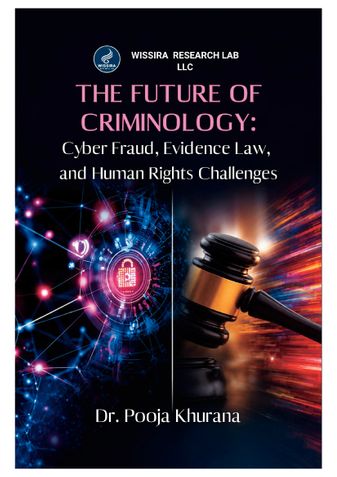
The Future of Criminology: Cyber Fraud, Evidence Law, and Human Rights Challenges (eBook)
Type:
e-book
Genre: Law
Language: English
Price:
₹200
(Immediate Access on Full Payment)
Description
The study of crime has always evolved alongside the development of human civilization. As societies have changed through industrialization, globalization, and technological advancement, the nature of criminal behaviour has transformed in equally profound ways. Today, humanity is experiencing one of the most significant transitions in the history of criminology-the emergence of a digitally connected world where crimes are increasingly committed through computers, mobile devices, artificial intelligence, cloud platforms, cryptocurrencies, and global communication networks.
This transformation has created both remarkable opportunities and complex challenges. Technology has improved communication, commerce, education, healthcare, governance, and financial inclusion, yet it has also provided criminals with sophisticated tools for cyber fraud, identity theft, ransomware attacks, digital espionage, financial manipulation, misinformation, and transnational organized crime.
Throughout this volume, special attention has been given to the relationship between innovation and justice. Artificial intelligence, predictive analytics, digital surveillance, blockchain technology, cloud computing, quantum computing, and virtual environments are rapidly transforming criminal investigations and legal proceedings. These technologies offer powerful opportunities for crime prevention and evidence analysis, but they also raise important questions regarding transparency, accountability, privacy, fairness, discrimination, and due process.
The book also recognizes that cybercrime is fundamentally a global phenomenon. Criminals routinely exploit international communication systems, cross-border financial networks, cloud-based infrastructure, and decentralized digital platforms. Consequently, no country can effectively combat cybercrime in isolation. International cooperation harmonized legal standards, digital evidence-sharing mechanisms, and coordinated law enforcement efforts are indispensable for addressing emerging transnational threats.
One of the distinguishing features of this work is its multidisciplinary perspective. Criminology today extends far beyond the study of offenders and criminal acts. It encompasses the experiences of victims, the psychology of online behaviour, digital forensic science, cybersecurity governance, ethical artificial intelligence, cyber psychology, financial crime prevention, evidence law, and institutional resilience.
The chapters have been organized in a logical progression. The book begins with the evolution of criminology and the emergence of cybercrime, followed by discussions on cyber fraud, digital evidence, artificial intelligence, surveillance, human rights, digital forensics, comparative cyber law, victimology, cyber psychology, and international cooperation. It concludes by examining future developments such as quantum computing, the metaverse, technology-driven justice systems, and policy directions that will shape criminology in the decades ahead.
This book has been prepared for a broad readership, including undergraduate and postgraduate students of criminology, law, cyber law, criminal justice, forensic science, cybersecurity, sociology, public administration, and information technology. It is equally intended to serve researchers, legal practitioners, judges, prosecutors, police officers, forensic experts, cybersecurity professionals, policymakers, and educators who seek a deeper understanding of contemporary criminal justice challenges.
About the Author
Book Details
ISBN: 9789375590071
Publisher: Wissira Research Lab
Number of Pages: 131
Availability:
Available for Download (e-book)
Ratings & Reviews
The Future of Criminology: Cyber Fraud, Evidence Law, and Human Rights Challenges
Review This Book
Write your thoughts about this book.

Currently there are no reviews available for this book.
Be the first one to write a review for the book The Future of Criminology: Cyber Fraud, Evidence Law, and Human Rights Challenges.
Other Books in Law

Nurul Mostafa Kamal Zafari


Professor (Dr.) C. R. Jilova, Dr. Nishant Kumar ...

Shubhankar Paul