You can access the distribution details by navigating to My pre-printed books > Distribution
Add a Review
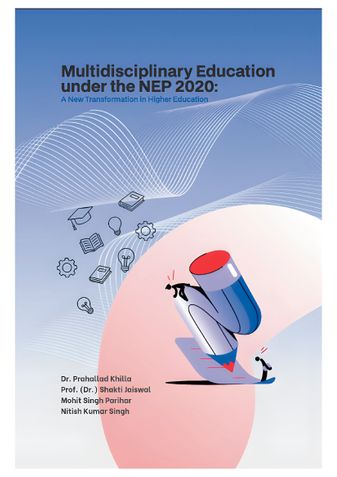
Multidisciplinary Education under the NEP 2020: A New Transformation in Higher Education (eBook)
Type:
e-book
Genre: Education & Language
Language: English
Price:
₹200
(Immediate Access on Full Payment)
Description
Higher education across the world is undergoing a profound transformation, driven by rapid technological change, shifting economic demands, and the increasing complexity of global challenges. In India, this transformation has taken a decisive direction through the National Education Policy (NEP) 2020, which envisions a holistic, flexible, and multidisciplinary approach to learning. This book, Multidisciplinary Education under the NEP 2020: A New Transformation in Higher Education, seeks to explore the philosophical foundations, structural reforms, practical implications, and future possibilities associated with this landmark policy.
For decades, higher education in India largely followed compartmentalized disciplinary structures, where students were expected to specialize narrowly within predefined academic boundaries. While this system produced competent professionals, it often limited creativity, adaptability, and cross-domain understanding. In contrast, contemporary problems-ranging from climate change and public health to artificial intelligence and social equity-demand integrated perspectives that draw upon multiple fields of knowledge. NEP 2020 responds to this need by promoting multidisciplinary universities, flexible curricula, and learner-centred pedagogies designed to cultivate well-rounded individuals capable of critical thinking and innovation.
This book has been written with the intention of providing a comprehensive yet accessible examination of multidisciplinary education as envisioned by NEP 2020. It traces the historical evolution of higher education in India, explains the policy’s guiding principles, and analyses its emphasis on academic flexibility, integration of liberal arts with professional education, and the role of digital technologies. Particular attention is given to institutional reforms, governance changes, skill development initiatives, and the strengthening of research culture. By presenting both opportunities and challenges, the book aims to offer a balanced perspective on the practical realities of implementing such large-scale reforms.
The content is designed to serve a wide audience, including policymakers, educators, administrators, researchers, and students. Teachers and institutional leaders may find insights useful for curriculum design and organizational transformation, while students can gain a clearer understanding of how the new system expands their academic choices and career possibilities. Researchers and scholars may also benefit from the analytical discussions and references that connect Indian reforms with global educational trends.
Multidisciplinary education is not merely an administrative restructuring of universities; it represents a shift in the philosophy of learning itself. It emphasizes intellectual curiosity, ethical awareness, creativity, and the capacity to collaborate across diverse fields. By encouraging students to explore subjects beyond their primary specialization, the new framework aims to nurture individuals who can contribute meaningfully to society while adapting to an unpredictable future.
About the Authors
Book Details
ISBN: 9789375590088
Publisher: Wissira Research Lab
Number of Pages: 135
Availability:
Available for Download (e-book)
Ratings & Reviews
Multidisciplinary Education under the NEP 2020: A New Transformation in Higher Education
Review This Book
Write your thoughts about this book.

Currently there are no reviews available for this book.
Be the first one to write a review for the book Multidisciplinary Education under the NEP 2020: A New Transformation in Higher Education.
Other Books in Education & Language

VIKAS KUMAR LODHI

Ashwini Kumar Aggarwal

विंग कमांडर शशिकांत ओक

Vivek Hattangadi