You can access the distribution details by navigating to My pre-printed books > Distribution
Add a Review
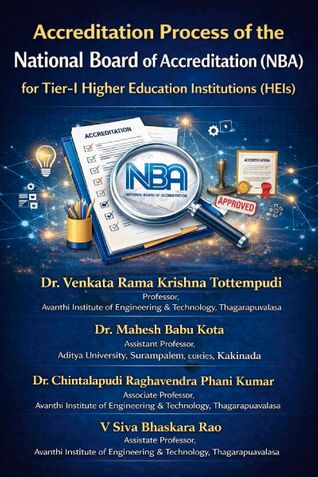
Accreditation Process of the National Board of Accreditation (NBA) for Tier-I Higher Education Institutions (HEIs) (eBook)
Type:
e-book
Genre: Self-Improvement
Language: English
Price:
₹500
(Immediate Access on Full Payment)
Description
The accreditation process of the National Board of Accreditation (NBA) for Tier-I Higher Education Institutions (HEIs) is a structured, outcome-based, and quality-driven evaluation framework designed to ensure that engineering and technical programs meet nationally and internationally recognized standards. Tier-I institutions, which are autonomous or deemed-to-be universities with academic autonomy, are assessed based on Outcome-Based Education (OBE) principles aligned with the Washington Accord. The NBA accreditation process emphasizes program-level evaluation rather than institutional-level assessment and focuses on continuous quality improvement, stakeholder satisfaction, and attainment of defined learning outcomes.
The process begins with the institution’s decision to seek accreditation for eligible programs and the submission of an online application along with a Self-Assessment Report (SAR). The SAR is a comprehensive document that presents quantitative and qualitative evidence across various criteria defined by NBA. For Tier-I HEIs, the evaluation framework generally includes criteria such as Vision, Mission, and Program Educational Objectives (PEOs); Program Outcomes (POs) and Course Outcomes (COs); Curriculum Design and Development; Students’ Performance; Faculty Contributions; Facilities and Technical Support; Continuous Improvement; and Governance, Institutional Support, and Financial Resources. Each criterion carries a specific weightage, reflecting its importance in maintaining academic excellence and sustainability.
A distinctive feature of the NBA accreditation framework is its strong emphasis on Outcome-Based Education. Programs must clearly define Program Outcomes aligned with graduate attributes, map Course Outcomes to Program Outcomes, and demonstrate attainment through systematic assessment processes. Direct assessment tools such as Continuous Internal Evaluation (CIE), Semester End Examinations (SEE), laboratory evaluations, projects, internships, and capstone work are used to measure CO attainment. Indirect assessment tools, including exit surveys, alumni feedback, and employer feedback, supplement the evaluation. The overall attainment is calculated using weighted formulas, and the results are analyzed to identify gaps and initiate Continuous Quality Improvement (CQI) measures.
Following the submission and scrutiny of the SAR, NBA constitutes an Expert Team comprising academic and industry professionals to conduct an on-site evaluation. The visit typically spans two to three days and includes interactions with faculty, students, alumni, employers, and institutional leadership. The team verifies documentary evidence, inspects laboratories and infrastructure, evaluates question papers and answer scripts, reviews project work, and assesses governance mechanisms. The evaluation focuses not only on compliance but also on the effectiveness of processes in achieving stated outcomes.
The expert team submits a detailed report to NBA, highlighting strengths, weaknesses, concerns, and deficiencies. Based on this evaluation, the Accreditation Committee makes recommendations regarding accreditation status, which may range from full accreditation for six years, accreditation for three years, or non-accreditation. Accredited programs are expected to maintain standards and submit annual compliance reports demonstrating sustained quality and improvement initiatives.
The NBA accreditation process serves multiple purposes. It assures students and parents of the quality of education, enhances employability and global mobility of graduates, strengthens industry confidence, and promotes accountability and transparency in higher education. For Tier-I institutions, accreditation also reinforces academic autonomy while ensuring alignment with international benchmarks. Moreover, the process fosters a culture of data-driven decision-making, documentation, and systematic review mechanisms within departments.
In conclusion, the NBA accreditation process for Tier-I HEIs represents a comprehensive quality assurance mechanism grounded in Outcome-Based Education and continuous improvement. By integrating curriculum design, assessment practices, stakeholder feedback, governance, and infrastructure evaluation into a unified framework, NBA ensures that engineering programs produce competent, ethical, and globally competitive graduates. The structured approach not only validates academic standards but also drives institutional excellence and sustainable development in technical education
About the Authors
Book Details
Publisher: Self
Number of Pages: 1275
Availability:
Available for Download (e-book)
Ratings & Reviews
Accreditation Process of the National Board of Accreditation (NBA) for Tier-I Higher Education Institutions (HEIs)
Review This Book
Write your thoughts about this book.

Currently there are no reviews available for this book.
Be the first one to write a review for the book Accreditation Process of the National Board of Accreditation (NBA) for Tier-I Higher Education Institutions (HEIs).
Other Books in Self-Improvement

ARCHANA BHAT

Manoj Mahendru

Amina Mehmood

Dada Bhagwan