You can access the distribution details by navigating to My pre-printed books > Distribution
Add a Review
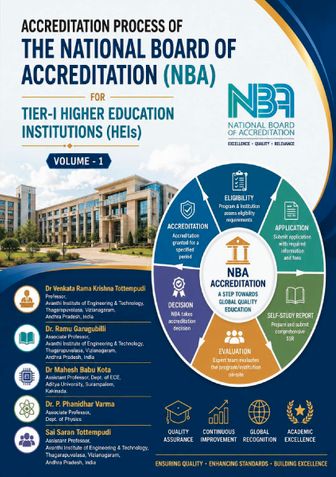
Accreditation Process of the National Board of Accreditation Process of the National Board of Accreditation (NBA) for Tier-I Higher Education Institutions (HEIs) Volume -1 (eBook)
Type:
e-book
Genre: Self-Improvement
Language: English
Price:
₹200
(Immediate Access on Full Payment)
Description
The National Board of Accreditation (NBA) plays a pivotal role in promoting quality assurance, academic excellence, and continuous improvement in technical education across India. With the increasing emphasis on global competitiveness, employability, innovation, and accountability in higher education, accreditation has evolved from a regulatory requirement into a strategic mechanism for institutional transformation. The book, Accreditation Process of the National Board of Accreditation (NBA) for Tier-I Higher Education Institutions (HEIs): Volume–1, has been developed as a comprehensive reference for faculty members, administrators, institutional leaders, quality assurance professionals, NBA coordinators, and policymakers seeking a thorough understanding of the accreditation framework for Tier-I institutions. It provides a systematic and practical approach to implementing Outcome-Based Education (OBE), preparing Self-Assessment Reports (SAR), measuring outcome attainment, and fostering a culture of continuous quality improvement in engineering and technical institutions.
This volume begins by introducing the philosophy and significance of accreditation in higher education and explains the evolution, objectives, and organizational structure of the National Board of Accreditation. It highlights the distinction between Tier-I and Tier-II accreditation systems and discusses the relevance of Washington Accord membership in enhancing the international recognition of engineering qualifications awarded by accredited institutions. The book explains the NBA accreditation process in detail, including eligibility requirements, stages of accreditation, evaluation procedures, peer team visits, and post-accreditation quality assurance mechanisms, enabling institutions to understand the complete accreditation lifecycle.
A major focus of this book is the implementation of **Outcome-Based Education (OBE)**, which forms the foundation of the NBA accreditation framework. The concepts of Vision and Mission statements, Program Educational Objectives (PEOs), Program Outcomes (POs), Program Specific Outcomes (PSOs), and Course Outcomes (COs) are explained with practical methodologies for their formulation, alignment, and implementation. The volume provides systematic guidance on curriculum design, outcome mapping, CO-PO-PSO articulation matrices, Bloom's Taxonomy, assessment planning, and attainment calculations. These concepts are illustrated using practical examples that enable faculty members to effectively design learner-centric curricula and establish measurable academic outcomes aligned with institutional objectives and stakeholder expectations.
The book also provides comprehensive coverage of curriculum planning, teaching-learning processes, and assessment methodologies required under the NBA framework. It discusses modern pedagogical practices including active learning, experiential learning, project-based learning, problem-based learning, blended learning, digital education, flipped classrooms, industry-integrated learning, and multidisciplinary approaches. Strategies for improving student engagement, academic performance, employability, innovation, entrepreneurship, and lifelong learning are presented to assist institutions in achieving excellence in educational delivery while satisfying NBA evaluation criteria.
A significant contribution of this volume is its detailed explanation of assessment and attainment methodologies. The procedures for direct and indirect assessment, internal and external evaluation, course outcome attainment, program outcome attainment, target setting, gap analysis, statistical interpretation, and continuous improvement are presented using structured approaches and practical templates. The book demonstrates how data collected through examinations, assignments, laboratory assessments, projects, internships, alumni feedback, employer surveys, graduate exit surveys, and stakeholder interactions can be effectively analyzed to support evidence-based decision-making and institutional quality enhancement. Special emphasis is placed on documentation practices, evidence collection, and data management to facilitate successful accreditation visits.
The volume further addresses all major NBA criteria applicable to Tier-I Higher Education Institutions, including Vision, Mission and Program Educational Objectives; Curriculum and Teaching-Learning Processes; Course Outcomes and Program Outcomes; Students' Performance; Faculty Contributions; Facilities and Technical Support; Continuous Improvement; Governance, Institutional Support and Financial Resources; and Program-Specific Criteria. Each criterion is discussed in detail with recommended institutional practices, performance indicators, documentation requirements, and evidence generation strategies that help institutions systematically prepare for accreditation while strengthening academic governance and institutional effectiveness.
Recognizing that accreditation extends beyond compliance, the book emphasizes the establishment of an institutional quality culture driven by continuous improvement. It explains the functioning of Internal Quality Assurance Cells (IQAC), departmental quality committees, academic audits, curriculum review mechanisms, stakeholder participation, faculty development initiatives, industry collaborations, research promotion, innovation ecosystems, and extension activities. The importance of integrating accreditation with strategic planning, institutional governance, and long-term academic development is highlighted to ensure sustainable quality enhancement rather than short-term accreditation preparation.
The book also discusses the role of digital technologies in supporting accreditation processes. The use of Learning Management Systems (LMS), Enterprise Resource Planning (ERP), academic analytics, outcome attainment software, digital repositories, e-governance platforms, online assessment tools, and institutional dashboards is presented as an effective means of improving transparency, documentation, monitoring, and decision-making. These technologies enable institutions to automate data collection, monitor performance indicators in real time, and maintain comprehensive evidence repositories required during NBA evaluations.
In addition to theoretical concepts, this volume provides numerous practical resources including sample formats, templates, flowcharts, checklists, attainment calculation methods, documentation guidelines, committee structures, and best practices adopted by successful accredited institutions. These practical tools assist faculty members and accreditation coordinators in preparing high-quality Self-Assessment Reports (SARs), organizing documentary evidence, conducting internal audits, and implementing corrective and preventive actions before peer team visits. The book further discusses common challenges encountered during accreditation and proposes effective strategies to overcome them through institutional planning, faculty involvement, stakeholder engagement, and systematic monitoring.
The ultimate objective of this volume is to help Higher Education Institutions establish robust academic systems that continuously improve educational quality, research productivity, innovation, governance, student learning outcomes, and societal impact. Rather than viewing accreditation as a one-time evaluation exercise, the book advocates embedding quality assurance into the institutional culture through evidence-based planning, periodic review, performance assessment, and continuous improvement initiatives. Such an approach not only enhances accreditation outcomes but also contributes significantly to institutional reputation, graduate employability, international recognition, research excellence, and sustainable academic development.
Overall, Accreditation Process of the National Board of Accreditation (NBA) for Tier-I Higher Education Institutions (HEIs): Volume–1 serves as a comprehensive, practical, and evidence-based guide for successfully implementing Outcome-Based Education and navigating the NBA accreditation process. By combining conceptual clarity with implementation strategies, institutional best practices, and practical documentation techniques, the book provides a valuable resource for administrators, faculty members, accreditation coordinators, quality assurance professionals, researchers, and policymakers committed to advancing excellence in technical education. It is expected to support Higher Education Institutions in achieving successful NBA accreditation while fostering a culture of continuous quality improvement, academic innovation, institutional accountability, and global competitiveness.
About the Authors
Book Details
Publisher: Self
Number of Pages: 1170
Availability:
Available for Download (e-book)
Ratings & Reviews
Accreditation Process of the National Board of Accreditation Process of the National Board of Accreditation (NBA) for Tier-I Higher Education Institutions (HEIs) Volume -1
Review This Book
Write your thoughts about this book.

Currently there are no reviews available for this book.
Be the first one to write a review for the book Accreditation Process of the National Board of Accreditation Process of the National Board of Accreditation (NBA) for Tier-I Higher Education Institutions (HEIs) Volume -1.
Other Books in Self-Improvement

कुनाल परिहार

Mukesh Vaswani

Gagandeep Singh

Ketki Shah