You can access the distribution details by navigating to My pre-printed books > Distribution
Add a Review
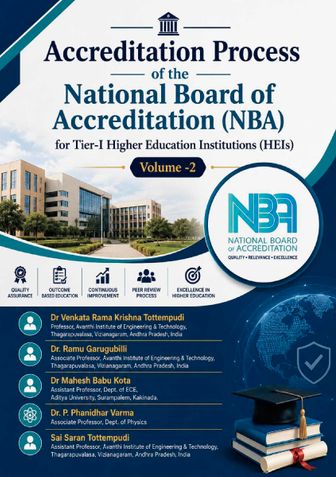
Accreditation Process of the National Board of Accreditation Process of the National Board of Accreditation (NBA) for Tier-I Higher Education Institutions (HEIs) Volume-2 (eBook)
Type:
e-book
Genre: Self-Improvement
Language: English
Price:
₹200
(Immediate Access on Full Payment)
Description
The National Board of Accreditation (NBA) has become the cornerstone of quality assurance and continuous quality improvement in technical education in India by promoting excellence through the principles of Outcome-Based Education (OBE). While the first volume of this series introduces the conceptual foundations, accreditation framework, and essential requirements for Tier-I Higher Education Institutions (HEIs), Volume–2 extends the discussion by focusing on advanced implementation strategies, evidence-based documentation, institutional best practices, governance mechanisms, quality assurance systems, and continuous improvement processes necessary for achieving and sustaining NBA accreditation. This volume serves as a practical handbook for institutional leaders, accreditation coordinators, faculty members, Internal Quality Assurance Cells (IQACs), quality assurance professionals, academic administrators, researchers, and policymakers committed to developing globally competitive engineering institutions that meet national and international quality standards.
The book provides a comprehensive understanding of the operational aspects of NBA accreditation by emphasizing systematic institutional planning, strategic governance, and evidence-driven decision-making. It explains how accreditation should be viewed not merely as a periodic evaluation exercise but as an ongoing institutional commitment to academic excellence, innovation, accountability, transparency, and stakeholder satisfaction. Through a structured approach, the volume demonstrates how quality assurance practices can be integrated into every academic and administrative activity to establish a sustainable culture of continuous improvement.
A significant emphasis of this volume is placed on institutional strategic planning and governance. The book discusses the formulation and implementation of Vision and Mission statements, strategic development plans, quality policies, academic governance models, decentralized decision-making processes, and leadership frameworks that support accreditation readiness. It explains the responsibilities of governing bodies, academic councils, boards of studies, department advisory committees, program assessment committees, IQACs, and NBA coordination committees in strengthening institutional quality systems. Effective governance mechanisms are presented as essential enablers for achieving measurable educational outcomes and ensuring long-term institutional sustainability.
Volume–2 provides extensive guidance on preparing high-quality Self-Assessment Reports (SARs) by explaining each criterion of the NBA accreditation framework in a practical and evidence-oriented manner. Detailed methodologies are presented for organizing documentary evidence, developing institutional databases, maintaining digital repositories, preparing criterion-wise reports, validating quantitative data, and demonstrating compliance with NBA expectations. The book includes recommendations for developing comprehensive documentation systems that simplify accreditation preparation while ensuring transparency, traceability, and consistency during peer team evaluations.
The volume further elaborates on advanced Outcome-Based Education (OBE) implementation by strengthening the processes of curriculum design, curriculum revision, stakeholder participation, program articulation, and continuous curriculum improvement. It discusses methods for aligning Program Educational Objectives (PEOs), Program Outcomes (POs), Program Specific Outcomes (PSOs), and Course Outcomes (COs) with graduate attributes, institutional objectives, industry expectations, and societal needs. Practical approaches for curriculum mapping, competency-based education, interdisciplinary learning, multidisciplinary integration, project-based learning, experiential education, and skill-oriented teaching methodologies are explained to assist institutions in producing industry-ready graduates with strong technical, professional, and ethical competencies.
Another major contribution of this volume is its comprehensive treatment of assessment systems and outcome attainment methodologies. It presents advanced techniques for direct and indirect assessment, attainment calculations, target setting, statistical analysis, performance benchmarking, gap identification, root-cause analysis, corrective actions, and continuous quality improvement. Faculty members are guided in designing effective assessment tools, preparing evaluation rubrics, mapping assessment instruments to Course Outcomes, analyzing attainment data, and documenting improvement initiatives based on measurable evidence. The systematic integration of assessment with institutional planning enables departments to continuously monitor academic performance and improve student learning outcomes.
Recognizing that faculty members are the driving force behind quality education, this volume dedicates significant attention to faculty development and academic excellence. It discusses faculty recruitment, qualification enhancement, induction programs, mentoring systems, pedagogical training, research capacity building, industry exposure, consultancy, innovation, intellectual property generation, and professional development initiatives. Strategies for promoting teaching excellence, academic leadership, collaborative research, interdisciplinary projects, and lifelong learning among faculty members are presented as critical components of institutional quality enhancement and accreditation success.
Research, innovation, entrepreneurship, and industry collaboration constitute another major theme of this volume. The book explains how Higher Education Institutions can establish vibrant research ecosystems through funded projects, sponsored research, consultancy services, innovation laboratories, incubation centres, technology transfer initiatives, start-up ecosystems, patent development, and collaborative partnerships with industries and research organizations. It highlights the importance of integrating research outcomes with teaching-learning processes while encouraging students and faculty to participate actively in knowledge creation, innovation, and societal problem-solving.
The volume also discusses student-centric quality enhancement practices including mentoring systems, academic counseling, career guidance, internship programs, industrial training, placement support, entrepreneurship development, higher education opportunities, professional certification programs, and extracurricular engagement. It emphasizes the role of student participation in quality assurance activities, feedback mechanisms, alumni interaction, employer engagement, and community outreach. These initiatives contribute significantly to graduate employability, holistic personality development, leadership skills, and lifelong learning competencies that align with NBA expectations.
In response to the rapid digital transformation of higher education, the book explores the application of modern technologies in accreditation and institutional management. It discusses Learning Management Systems (LMS), Enterprise Resource Planning (ERP), digital libraries, outcome attainment software, academic analytics, artificial intelligence, institutional dashboards, cloud-based repositories, online assessment platforms, and data visualization tools that improve academic monitoring, administrative efficiency, documentation quality, and decision-making processes. These digital solutions enable institutions to maintain real-time performance monitoring systems while significantly reducing the complexity of accreditation documentation.
Volume–2 also presents detailed discussions on institutional benchmarking, performance indicators, Key Performance Indicators (KPIs), academic audits, internal quality audits, risk management, sustainability practices, green campus initiatives, environmental responsibility, social outreach, and alignment with national and global quality frameworks. The integration of NBA accreditation with initiatives such as NAAC accreditation, National Institutional Ranking Framework (NIRF), Academic and Administrative Audits (AAA), Internal Quality Assurance Cells (IQAC), the Sustainable Development Goals (SDGs), and global university ranking systems is explained to help institutions develop unified quality assurance strategies that support comprehensive institutional excellence.
One of the distinctive features of this volume is the inclusion of practical templates, flowcharts, checklists, standard operating procedures, committee structures, documentation formats, attainment models, evidence-mapping techniques, audit schedules, reporting frameworks, and best-practice case studies adopted by successfully accredited institutions. These implementation-oriented resources enable faculty members and institutional administrators to translate accreditation requirements into day-to-day academic and administrative practices, thereby reducing preparation time and enhancing institutional readiness for peer team evaluations.
Ultimately, Accreditation Process of the National Board of Accreditation (NBA) for Tier-I Higher Education Institutions (HEIs): Volume–2 serves as an advanced implementation guide that bridges the gap between accreditation theory and institutional practice. It reinforces the philosophy that quality assurance is a continuous journey rather than a one-time achievement and encourages institutions to establish dynamic systems that promote excellence in teaching, research, governance, innovation, stakeholder engagement, and societal contribution. By integrating strategic planning, Outcome-Based Education, digital transformation, evidence-based assessment, continuous improvement, and effective institutional leadership, this volume provides a comprehensive roadmap for achieving sustainable academic excellence.
This book is expected to become a valuable reference for vice-chancellors, principals, deans, heads of departments, NBA coordinators, IQAC coordinators, faculty members, accreditation experts, researchers, policymakers, and quality assurance professionals seeking to strengthen institutional effectiveness and achieve successful NBA accreditation. Through its systematic approach, practical orientation, and comprehensive coverage of accreditation processes, the volume contributes significantly to the advancement of quality technical education and supports Higher Education Institutions in producing globally competent graduates capable of addressing the evolving needs of industry, society, and the knowledge economy.
About the Authors
Book Details
Publisher: Self
Number of Pages: 1611
Availability:
Available for Download (e-book)
Ratings & Reviews
Accreditation Process of the National Board of Accreditation Process of the National Board of Accreditation (NBA) for Tier-I Higher Education Institutions (HEIs) Volume-2
Review This Book
Write your thoughts about this book.

Currently there are no reviews available for this book.
Be the first one to write a review for the book Accreditation Process of the National Board of Accreditation Process of the National Board of Accreditation (NBA) for Tier-I Higher Education Institutions (HEIs) Volume-2.
Other Books in Self-Improvement

तोष कुमार प्रधान

Georgica's World

Sunil Sharan

Dada Bhagwan