You can access the distribution details by navigating to My pre-printed books > Distribution
Add a Review
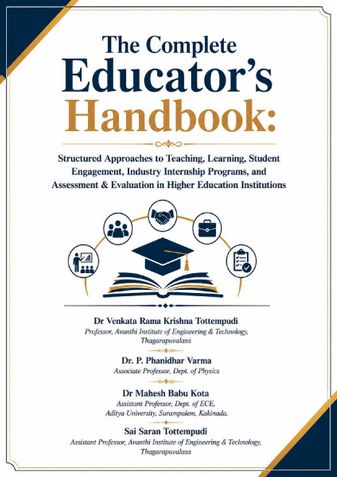
The Complete Educator’s Handbook: Structured Approaches to Teaching, Learning, Student Engagement, Industry Internship Programs, and Assessment & Evaluation in Higher Education Institutions (eBook)
Type:
e-book
Genre: Self-Improvement
Language: English
Price:
₹200
(Immediate Access on Full Payment)
Description
The Complete Educator’s Handbook: Structured Approaches to Teaching, Learning, Student Engagement, Industry Internship Programs, and Assessment & Evaluation in Higher Education Institutions is a comprehensive academic resource designed to support educators, academic administrators, researchers, curriculum planners, and institutional leaders in enhancing the quality of higher education through systematic, learner-centered, and outcome-oriented practices. In the rapidly evolving landscape of higher education, institutions are expected not only to impart disciplinary knowledge but also to develop employability skills, ethical values, critical thinking abilities, research aptitude, innovation capabilities, and lifelong learning competencies among students. This handbook addresses these emerging educational expectations by presenting a structured and practical framework that integrates teaching methodologies, student engagement strategies, industry internship practices, and modern assessment and evaluation systems within the context of contemporary higher education institutions.
The handbook begins by examining the foundational principles of higher education and the changing role of educators in a technology-driven and outcome-based academic environment. It discusses the influence of educational reforms, accreditation requirements, competency-based learning, and national and international quality standards on curriculum planning and academic delivery. Special emphasis is placed on Outcome-Based Education (OBE), Bloom’s Taxonomy, curriculum alignment, and the mapping of Course Outcomes (COs), Program Outcomes (POs), and Program Specific Outcomes (PSOs), which have become essential components of academic quality assurance in universities and professional institutions. The text provides educators with practical guidance on designing effective lesson plans, developing learner-centered curricula, and implementing instructional strategies that encourage active participation and meaningful learning experiences.
A significant contribution of this handbook lies in its extensive coverage of modern teaching and learning methodologies suitable for diverse classroom environments. It explores traditional and innovative pedagogical approaches including active learning, collaborative learning, experiential learning, project-based learning, problem-based learning, flipped classrooms, blended learning, online learning, and technology-enabled instruction. The integration of Information and Communication Technology (ICT), Learning Management Systems (LMS), digital platforms, virtual laboratories, multimedia tools, and artificial intelligence in education is discussed to help educators adapt to the digital transformation occurring in higher education. The handbook emphasizes the importance of inclusive teaching practices that accommodate students from varied educational, cultural, and socio-economic backgrounds while promoting equity, accessibility, and academic participation.
Student engagement forms another core dimension of the handbook. Recognizing that effective education extends beyond classroom instruction, the book highlights strategies for enhancing student motivation, participation, communication, mentoring, counseling, and academic support. It discusses the role of faculty mentors, student counseling systems, peer learning, co-curricular activities, professional societies, innovation clubs, and career guidance mechanisms in fostering holistic student development. Attention is also given to emotional well-being, interpersonal communication, classroom management, and the creation of positive learning environments that encourage confidence, collaboration, and leadership among students. By integrating academic and personal support systems, the handbook promotes a student-centered educational culture that contributes to improved retention, performance, and employability.
One of the distinguishing features of this handbook is its dedicated focus on Industry Internship Programs and industry–institution collaboration. In response to increasing demands for employability-oriented education and practical skill development, the handbook presents a structured framework for planning, implementing, monitoring, and evaluating internship programs in higher education institutions. It discusses the objectives of internships, industry partnership models, internship policies, student allocation procedures, mentor responsibilities, workplace ethics, and mechanisms for documenting internship activities through reports, diaries, presentations, and reflective learning practices. The handbook further explains methods for evaluating internship performance using rubrics, industry feedback, viva voce examinations, and competency-based assessment approaches. Challenges in internship implementation, including industry availability, monitoring difficulties, student preparedness, and coordination issues, are also addressed along with practical recommendations and best practices for improving internship effectiveness. Through these discussions, the handbook establishes internships as a critical bridge between academic learning and professional practice.
Assessment and evaluation constitute another major area of focus in this handbook. The book recognizes that meaningful assessment is essential for measuring learning outcomes, improving instructional quality, and supporting continuous academic improvement. It presents detailed discussions on formative and summative assessment methods, continuous internal evaluation, assignment and project evaluation, laboratory assessment, seminar evaluation, presentation rubrics, viva voce techniques, and online assessment strategies. The handbook also explains the preparation of question paper blueprints, Bloom’s Taxonomy-based question framing, rubric development, grading systems, and performance analysis methods that align with outcome-based educational practices. Special attention is given to CO attainment, PO attainment, direct and indirect assessment methods, data analysis, and continuous improvement processes that are widely used in accreditation frameworks such as NBA, NAAC, ABET, and Washington Accord standards.
In addition to instructional and assessment practices, the handbook explores broader institutional dimensions such as quality assurance, academic audits, accreditation procedures, research culture, faculty development, innovation ecosystems, entrepreneurship promotion, and institutional leadership. It provides educators and administrators with practical insights into documentation practices, IQAC activities, strategic planning, academic governance, and evidence-based decision-making required for institutional excellence and accreditation success. Emerging educational trends including artificial intelligence, learning analytics, virtual learning environments, MOOCs, competency-based education, and interdisciplinary learning are also discussed to prepare educators for the future of higher education.
Designed as both a theoretical guide and a practical reference, this handbook includes sample formats, templates, rubrics, case studies, best practices, and implementation models that can be readily adapted by higher education institutions. It aims to serve as a valuable resource for faculty training programs, orientation sessions, institutional policy development, academic quality enhancement initiatives, and educational research. By integrating pedagogical innovation, student engagement, industry exposure, and systematic assessment practices, the handbook contributes toward building effective, accountable, and future-ready higher education systems.
Overall, The Complete Educator’s Handbook presents a holistic and structured approach to academic excellence by connecting teaching effectiveness, learner engagement, internship-based experiential learning, and evidence-driven assessment within a unified educational framework. It supports educators in transforming classrooms into dynamic learning environments while enabling institutions to align academic practices with industry expectations, accreditation standards, and the evolving demands of global higher education.
About the Authors
Book Details
Publisher: Self
Number of Pages: 1262
Availability:
Available for Download (e-book)
Ratings & Reviews
The Complete Educator’s Handbook: Structured Approaches to Teaching, Learning, Student Engagement, Industry Internship Programs, and Assessment & Evaluation in Higher Education Institutions
Review This Book
Write your thoughts about this book.

Currently there are no reviews available for this book.
Be the first one to write a review for the book The Complete Educator’s Handbook: Structured Approaches to Teaching, Learning, Student Engagement, Industry Internship Programs, and Assessment & Evaluation in Higher Education Institutions.
Other Books in Self-Improvement
Dr. Mukul Dhobale

Moonlit Mindful Journals

Iris Stationeryy
BALDEV BHATIA