You can access the distribution details by navigating to My pre-printed books > Distribution
Add a Review
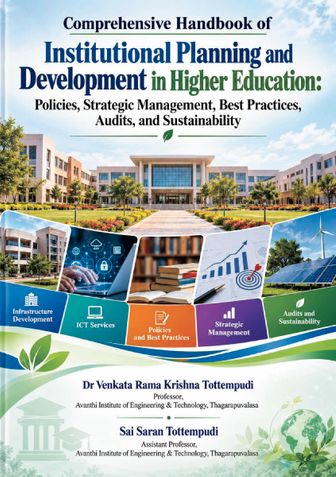
Comprehensive Handbook of Institutional Planning and Development in Higher Education: Policies, Strategic Management, Best Practices, Audits, and Sustainability (eBook)
Type:
e-book
Genre: Self-Improvement
Language: English
Price:
₹200
(Immediate Access on Full Payment)
Description
The Comprehensive Handbook of Institutional Planning and Development in Higher Education: Policies, Strategic Management, Best Practices, Audits, and Sustainability presents a systematic and practical framework for strengthening institutional planning, development, governance, quality enhancement, operational effectiveness, and sustainable growth in higher education institutions (HEIs). Contemporary higher education institutions operate in an increasingly complex environment characterized by changing academic expectations, technological transformation, infrastructure requirements, quality assurance mechanisms, sustainability priorities, stakeholder expectations, and the need for continuous institutional improvement. In this context, effective institutional planning and development have become essential for transforming institutional vision and mission into measurable goals, well-defined strategies, coordinated actions, efficient resource utilization, and sustainable outcomes. This handbook brings together the major institutional dimensions required for creating a structured, quality-oriented, and development-focused higher education ecosystem.
The handbook provides comprehensive coverage of physical facilities, maintenance, construction, ICT services, institutional policies, institutional development planning, strategic development planning, best-practice implementation, energy management, water management, environmental management, green audits, and sustainability-oriented institutional practices. The section on physical facilities and infrastructure emphasizes systematic planning, preventive maintenance, facility management, campus development, accessibility, ICT infrastructure, space allocation, green campus initiatives, sustainable construction, procurement, budgeting, waste management, energy and utilities management, safety, security, emergency response, water and wastewater management, vendor accountability, facility audits, and documentation. These areas are essential for ensuring that institutional infrastructure remains functional, safe, accessible, efficient, sustainable, and supportive of teaching, learning, research, administration, and student services.
The handbook also addresses IT services in higher education institutions, recognizing ICT as a critical institutional enabler. It covers institutional IT policies, IT cells, acceptable use, security and password management, internet access, network infrastructure, server administration, software licensing, antivirus protection, hardware and software inventories, ICT facility management, complaints and feedback mechanisms, obsolete equipment management, websites, ERP systems, and related documentation. The inclusion of mappings with quality and institutional frameworks further demonstrates the importance of systematically documenting ICT practices and their contribution to institutional performance.
A major component of the handbook is institutional planning and strategic development. Institutional Development Plans provide a structured approach for translating institutional mission, goals, and objectives into coordinated development initiatives. Strategic development planning further establishes mechanisms for SWOT analysis, PESTLE analysis, strategic objectives, operational goals, action plans, resource allocation, implementation timelines, monitoring and evaluation, balanced scorecards, and continuous improvement. The handbook presents institutional development as a progressive process involving assessment, strategy formulation, implementation, execution, monitoring and control, feedback, and improvement. Such an approach enables institutions to align academic, administrative, financial, research, human-resource, physical, digital, and networking dimensions with long-term institutional priorities.
The book gives particular importance to strategic implementation and institutionalization of best practices. It discusses the identification, implementation, institutionalization, internalization, dissemination, benchmarking, and systematic documentation of best practices. Best practices are considered across curriculum development, governance, human-resource management, teaching-learning and evaluation, student support and progression, research and innovation, consultancy, extension activities, infrastructure, ICT, mentoring, counselling, remedial education, alumni engagement, career development, scholarships, industry interaction, incubation, publications, patents, internal quality assurance, audits, budgeting, and sustainability. This broad approach recognizes that institutional excellence is not achieved through isolated initiatives but through the systematic integration and continuous improvement of successful practices throughout the institutional ecosystem.
Sustainability constitutes another important dimension of the handbook. The sections on energy management and auditing emphasize energy assessment, audit methodology, institutional energy inventories, power consumption analysis, energy-saving measures, renewable energy, solar systems, recommendations, and documentation. Similarly, the framework for water management, conservation, and auditing addresses water supply, storage, consumption, water analysis, conservation facilities, gardening, wastewater management, rainwater harvesting, water-efficient fixtures, metering, sensors, and other conservation mechanisms. These practices support the development of resource-efficient and environmentally responsible campuses.
The handbook further presents environmental and green audits as important mechanisms for evaluating institutional environmental performance. It covers environmental and green policies, audit planning, pre-audit activities, on-site assessment, post-audit procedures, environmental management systems, compliance, waste management, environmental health and safety, energy, sanitation and hygiene, air quality, ambient noise, carbon reduction, plastic-free initiatives, waste disposal, clean and green campuses, and sustainability activities extending beyond the campus. Through these components, the handbook emphasizes the importance of systematic auditing, evidence-based assessment, corrective actions, monitoring, and continuous environmental improvement.
An important feature of this handbook is its practical and evidence-oriented approach. Institutional planning and development require not only policies and strategies but also appropriate procedures, registers, schedules, checklists, audit formats, documentation systems, monitoring mechanisms, and institutional records. Accordingly, the handbook incorporates formats and documentation-oriented approaches that can support implementation, monitoring, assessment, reporting, and institutional review. This practical orientation makes the work relevant to institutional leaders, administrators, faculty members, IQAC teams, accreditation coordinators, infrastructure managers, IT professionals, sustainability committees, auditors, planners, and other stakeholders involved in institutional development.
Overall, this handbook seeks to establish an integrated perspective of institutional excellence through planning, strategic management, effective policies, systematic implementation, best-practice institutionalization, auditing, sustainability, and continuous quality improvement. It recognizes that sustainable institutional development requires coordinated action across academic, administrative, infrastructural, technological, environmental, financial, and quality-assurance dimensions. By bringing these areas together within a single comprehensive framework, the book serves as a practical reference for higher education institutions seeking to strengthen institutional systems, improve operational effectiveness, enhance quality, optimize resources, demonstrate evidence of performance, and build resilient and sustainable campuses. The handbook is intended to support HEIs in moving from fragmented initiatives toward an integrated culture of planned development, strategic execution, evidence-based assessment, institutional learning, sustainability, and continuous improvement.
About the Authors
Book Details
Publisher: Self
Number of Pages: 1607
Availability:
Available for Download (e-book)
Ratings & Reviews
Comprehensive Handbook of Institutional Planning and Development in Higher Education: Policies, Strategic Management, Best Practices, Audits, and Sustainability
Review This Book
Write your thoughts about this book.

Currently there are no reviews available for this book.
Be the first one to write a review for the book Comprehensive Handbook of Institutional Planning and Development in Higher Education: Policies, Strategic Management, Best Practices, Audits, and Sustainability.
Other Books in Self-Improvement

Yukti

SARDAR PARAMJIT SINGH
Milind Sahasrabudhe

Charles Johnson