You can access the distribution details by navigating to My pre-printed books > Distribution
Add a Review
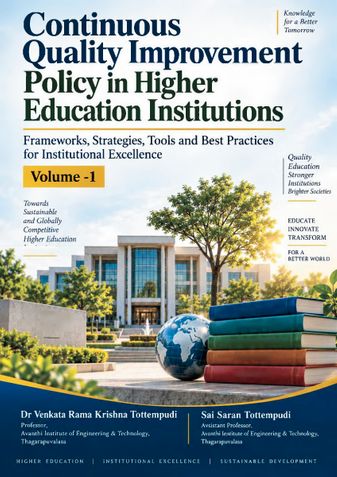
Continuous Quality Improvement Policy in Higher Education Institutions Frameworks, Strategies, Tools and Best Practices for Institutional Excellence Volume -1 (eBook)
Type:
e-book
Genre: Self-Improvement
Language: English
Price:
₹200
(Immediate Access on Full Payment)
Description
Continuous Quality Improvement Policy in Higher Education Institutions: Frameworks, Strategies, Tools and Best Practices for Institutional Excellence – Volume 1 presents a comprehensive framework for establishing, implementing, monitoring, evaluating, and continuously strengthening quality systems in higher education institutions. The book approaches Continuous Quality Improvement (CQI) as an institution-wide and systematic process that connects quality assurance, quality enhancement, evidence-based decision-making, stakeholder participation, institutional planning, accountability, innovation, and measurable improvement.
The volume begins with the meaning, evolution, principles, philosophy, and characteristics of Continuous Quality Improvement in higher education. It examines the transition from conventional inspection and quality assurance approaches toward continuous, evidence-driven improvement and explores the relationship among quality assurance, quality enhancement, and CQI. Particular emphasis is placed on developing a quality culture, cultivating a continuous improvement mindset, strengthening institutional ownership, promoting accountability and transparency, and encouraging innovation and adaptability.
The book further establishes the regulatory, policy, and institutional foundations of CQI, addressing the higher education quality ecosystem, institutional quality assurance, outcome-based accreditation, the National Education Policy (NEP) 2020, the National Higher Education Qualifications Framework (NHEQF), the Academic Bank of Credits (ABC), institutional autonomy, accountability, and regulatory compliance. It provides a structured approach to developing an institutional CQI policy, including policy objectives, scope, guiding principles, policy statements, roles and responsibilities, implementation mechanisms, and periodic review and revision.
A major focus of the volume is CQI governance and institutional leadership. It describes the roles of governing bodies, academic councils, IQACs, Boards of Studies, Department Quality Cells, Program Assessment Committees, examination and assessment committees, research and innovation committees, and student and stakeholder committees. The book also addresses participative governance, quality-oriented leadership, change management, faculty involvement, institutional ownership, and recognition and reward mechanisms.
The volume presents institutional quality planning as a central component of CQI, linking vision, mission, quality goals, strategic planning, annual quality plans, institutional development planning, quality objectives, targets, Key Performance Indicators (KPIs), milestones, and monitoring mechanisms. It extends this approach to curriculum design and review, stakeholder and industry inputs, emerging technologies, multidisciplinary education, curriculum benchmarking, and curriculum gap analysis.
A substantial part of the book focuses on Outcome-Based Education (OBE) and academic quality improvement, including Programme Educational Objectives, Programme Outcomes, Course Outcomes, CO–PO/PSO mapping, outcome attainment, gap identification, and Corrective and Preventive Actions (CAPA). The teaching-learning and assessment dimensions of quality are addressed through student-centred learning, active and experiential learning, problem- and project-based learning, ICT-enabled teaching, blended learning, innovative pedagogies, peer observation, continuous internal evaluation, formative and summative assessment, question-paper quality, Bloom’s taxonomy, rubrics, assessment analytics, examination reforms, feedback, and corrective action.
The book also integrates CQI with student success, faculty quality, research and innovation, community engagement, student welfare, stakeholder feedback, and student participation. It addresses student progression, academic support, mentoring, remedial education, advanced learner support, retention, graduation, employability, graduate outcomes, faculty recruitment and development, teaching and research competency, academic leadership, research productivity, publications, patents, consultancy, industry collaboration, research ethics, research impact, innovation ecosystems, community engagement, social responsibility, service learning, student support services, feedback systems, action taken reports, and student-led quality initiatives.
The final part of the volume addresses infrastructure and learning resource quality, covering physical infrastructure, laboratories, libraries, ICT infrastructure, learning resources, accessibility, maintenance systems, infrastructure audits, digital learning resources, and library audit and CQI. These areas reinforce the principle that institutional quality depends not only on academic processes but also on the availability, accessibility, utilization, maintenance, and continuous improvement of institutional resources and support systems.
Overall, this volume provides a structured policy-oriented foundation for developing a quality-driven, evidence-based, stakeholder-centred, outcome-oriented, accountable, innovative, and continuously improving higher education institution. It is intended to serve as a practical reference for institutional leaders, governing bodies, IQAC members, academic administrators, Deans, Heads of Departments, faculty members, accreditation coordinators, quality professionals, researchers, and other stakeholders responsible for planning and implementing institutional quality improvement. The central philosophy of the book is that CQI should move beyond compliance and become an integral institutional practice in which evidence is systematically converted into analysis, decisions, improvement actions, evaluation, learning, and the next cycle of quality enhancement.
About the Authors
Book Details
Publisher: Self
Number of Pages: 2195
Availability:
Available for Download (e-book)
Ratings & Reviews
Continuous Quality Improvement Policy in Higher Education Institutions Frameworks, Strategies, Tools and Best Practices for Institutional Excellence Volume -1
Review This Book
Write your thoughts about this book.

Currently there are no reviews available for this book.
Be the first one to write a review for the book Continuous Quality Improvement Policy in Higher Education Institutions Frameworks, Strategies, Tools and Best Practices for Institutional Excellence Volume -1.
Other Books in Self-Improvement

Dr. Prasad Sundararajan, Gemini AI

BIREN GANDHI

Kaushal P

BALDEV BHATIA