You can access the distribution details by navigating to My pre-printed books > Distribution
Add a Review
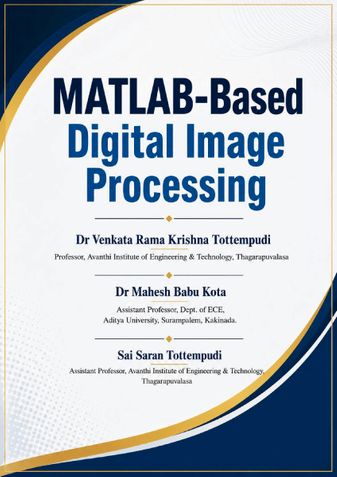
MATLAB-Based Digital Image Processing (eBook)
Type:
e-book
Genre: Computer Programming
Language: English
Price:
₹200
(Immediate Access on Full Payment)
Description
Digital Image Processing (DIP) has emerged as one of the most significant and rapidly evolving fields in science and engineering, with applications spanning medical imaging, remote sensing, machine vision, industrial automation, surveillance, robotics, multimedia systems, and artificial intelligence. The ability to acquire, process, analyze, enhance, compress, and interpret visual information has become essential in modern technological systems. MATLAB, with its powerful computational capabilities, extensive image processing toolbox, and user-friendly programming environment, has established itself as one of the most widely used platforms for learning, teaching, research, and developing image processing applications. This book, MATLAB-Based Digital Image Processing, provides a comprehensive introduction to the fundamental concepts, mathematical foundations, algorithms, and practical implementations of digital image processing using MATLAB.
The primary objective of this book is to bridge the gap between theoretical concepts and practical implementation by presenting image processing techniques through MATLAB programming examples, simulations, and experiments. The book introduces readers to the fundamentals of digital images, image acquisition systems, image representation, pixel relationships, intensity transformations, histogram processing, image enhancement, image restoration, image segmentation, image compression, morphological operations, feature extraction, pattern recognition, and machine learning-based image analysis. Each topic is explained with mathematical formulations, algorithmic procedures, and MATLAB implementations to facilitate deeper understanding and hands-on learning.
The book begins with an introduction to digital images, image formation models, image sampling and quantization, image representation, and MATLAB fundamentals required for image processing applications. It explains how images are stored, displayed, manipulated, and processed in MATLAB. Basic image operations such as image reading, writing, visualization, arithmetic operations, logical operations, and color space conversions are covered to establish a strong foundation for subsequent topics.
Image enhancement techniques form a major part of digital image processing and are discussed extensively in this book. Point processing operations such as image negatives, logarithmic transformations, power-law (gamma) transformations, contrast stretching, thresholding, and histogram equalization are presented in detail. Spatial domain enhancement methods including smoothing, sharpening, noise reduction, and edge enhancement are explained using linear and nonlinear filtering techniques. Frequency domain processing is introduced through Fourier Transform theory, Discrete Fourier Transform (DFT), Fast Fourier Transform (FFT), and frequency domain filtering methods such as ideal, Butterworth, and Gaussian filters.
Image restoration techniques are explored through degradation models, point spread functions (PSFs), inverse filtering, Wiener filtering, and constrained least squares methods. Various noise models including Gaussian, salt-and-pepper, Rayleigh, Erlang, exponential, and speckle noise are analyzed along with corresponding restoration approaches. Practical MATLAB implementations enable readers to understand the effects of degradation and the effectiveness of restoration techniques.
A significant portion of the book focuses on image segmentation, which is a critical step in image analysis and computer vision applications. Various segmentation methods such as edge detection, thresholding, region growing, region splitting and merging, watershed segmentation, and active contour models are discussed. Classical edge detectors including Roberts, Prewitt, Sobel, Laplacian of Gaussian (LoG), and Canny operators are presented with comparative performance analysis. Advanced segmentation techniques provide readers with tools for object extraction and scene understanding.
Morphological image processing is introduced through set theory and structuring element concepts. Fundamental operations such as erosion, dilation, opening, closing, hit-or-miss transformation, boundary extraction, skeletonization, thinning, thickening, and morphological reconstruction are explained with practical examples. The applications of morphology in object extraction, noise removal, shape analysis, and feature enhancement are demonstrated using MATLAB programs.
The book also covers image transforms and multiresolution analysis, including Discrete Cosine Transform (DCT), Walsh-Hadamard Transform (WHT), Karhunen-Loève Transform (KLT), Wavelet Transform, Singular Value Decomposition (SVD), and Radon Transform. These transforms are essential for image compression, feature extraction, and image analysis. Wavelet-based image processing techniques are presented through multilevel decomposition, denoising, compression, and reconstruction processes.
Image compression is another important topic addressed comprehensively. Both lossless and lossy compression techniques are discussed, including Huffman coding, Run-Length Encoding (RLE), Arithmetic Coding, LZW coding, Golomb coding, DPCM, transform coding, JPEG-style DCT compression, and wavelet-based compression. Performance evaluation metrics such as Compression Ratio (CR), Bits Per Pixel (BPP), Peak Signal-to-Noise Ratio (PSNR), and Structural Similarity Index Measure (SSIM) are used to assess compression quality and efficiency.
Feature extraction and pattern recognition techniques are presented to support image classification and object recognition applications. Feature descriptors such as histograms, texture measures, Gray-Level Co-occurrence Matrix (GLCM) features, shape descriptors, Hu moments, Histogram of Oriented Gradients (HOG), and principal component analysis (PCA) are discussed. Machine learning methods including k-Nearest Neighbour (k-NN), Linear Discriminant Analysis (LDA), Support Vector Machines (SVM), and Naïve Bayes classifiers are introduced for image-based classification tasks. Performance evaluation using confusion matrices, accuracy, precision, recall, F1-score, ROC curves, and learning curves is also included.
The book emphasizes practical learning through MATLAB simulations, laboratory experiments, case studies, and project-oriented exercises. Each chapter contains examples, code snippets, illustrations, and implementation guidelines that enable students, researchers, and practitioners to develop real-world image processing applications. The integration of theory and practice ensures that readers not only understand the mathematical concepts but also gain confidence in implementing algorithms independently.
Overall, MATLAB-Based Digital Image Processing serves as a comprehensive resource for undergraduate and postgraduate students, faculty members, researchers, and professionals working in electronics, computer science, information technology, artificial intelligence, biomedical engineering, remote sensing, and related disciplines. By combining mathematical rigor, algorithmic understanding, and MATLAB-based implementation, this book provides a systematic pathway for mastering digital image processing concepts and developing practical solutions to contemporary image analysis problems. It aims to foster innovation, research, and application development in the ever-expanding field of digital imaging and computer vision.
About the Authors
Book Details
Publisher: Self
Number of Pages: 1791
Availability:
Available for Download (e-book)
Ratings & Reviews
MATLAB-Based Digital Image Processing
Review This Book
Write your thoughts about this book.

Currently there are no reviews available for this book.
Be the first one to write a review for the book MATLAB-Based Digital Image Processing.
Other Books in Computer Programming
Rao S Yenamandra

Aravind choudhary

Deepak Patidar

ER. ARIF KHAN