You can access the distribution details by navigating to My pre-printed books > Distribution
Add a Review
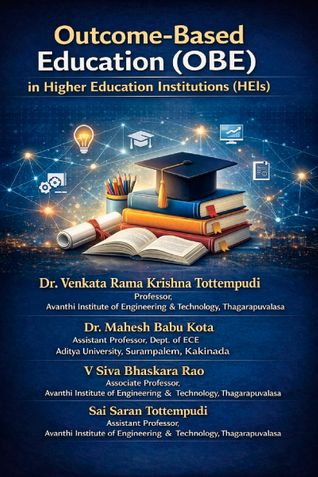
Outcome-Based Education (OBE) in Higher Education Institutions (HEIs) (eBook)
Type:
e-book
Genre: Engineering
Language: English
Price:
₹100
(Immediate Access on Full Payment)
Description
Outcome-Based Education (OBE) in Higher Education Institutions is a globally recognized educational framework that shifts the focus from traditional syllabus-driven teaching to the achievement of clearly defined competencies, ensuring graduates meet international quality and industry standards. Rooted in the philosophy of “Start with the end in mind,” OBE demands that curriculum design, teaching methodologies, and assessment strategies be aligned with the measurable outcomes expected from learners. Originating in the United States in the 1980s under the leadership of Dr. William Spady, the model was developed in response to limitations in rote-based, content-heavy education systems that lacked relevance to real-world skill requirements. Over the decades, OBE has been adopted across countries such as Australia, Canada, Singapore, South Africa, and the European higher education ecosystem. In India, OBE has become the backbone of quality assurance through NBA’s Washington Accord-aligned accreditation, NAAC’s outcome-centric reforms, and the competency-based direction outlined in NEP-2020. The framework is built on core principles such as clarity of focus, backward design, learner-centric pedagogy, high expectations for all learners, and authentic, continuous assessment. OBE emphasizes competencies across Knowledge, Skills, and Attitudes (KSA), ensuring that learners develop not just conceptual understanding but also practical abilities, professional behavior, and ethical values. The hierarchical structure of OBE—linking Vision, Mission, PEOs, POs, PSOs, and COs—ensures constructive alignment between the graduate profile and day-to-day teaching-learning practices. Compared with traditional input-based education, OBE prioritizes active learning, performance-based evaluation, and industry-aligned outcomes, shifting the focus from content coverage to holistic competency development. By promoting transparency, accountability, and data-driven attainment analysis, OBE equips institutions to enhance academic quality, improve employability, and respond effectively to rapidly evolving technological and societal needs.
The material presents a comprehensive framework for implementing Outcome-Based Education (OBE), with particular emphasis on Course Outcomes (COs) and Program Specific Outcomes (PSOs) as required by accreditation bodies such as the National Board of Accreditation (NBA). The OBE structure operates as a hierarchical and interconnected system progressing from Vision and Mission to Program Educational Objectives (PEOs), Program Outcomes (POs), PSOs, and ultimately the Course Outcomes that anchor all teaching and assessment processes.
Program Specific Outcomes (PSOs) represent the discipline-centered abilities students are expected to attain by graduation. They articulate the specialized knowledge, advanced technical competencies, and domain-specific application skills that distinguish one program (such as AI & ML, ECE, or Mechanical Engineering) from another. Effective PSOs are limited to two to four per department, and must be measurable, industry-aligned, and articulated using strong action verbs (e.g., design, implement, analyze). A well-constructed PSO combines three elements: (1) a clearly defined technical skill, (2) its application context, and (3) its relevance to emerging technologies, research, or industry practice.
Course Outcomes (COs) are the foundational building blocks of OBE. They define the precise, measurable learning that students should demonstrate upon completing a course. High-quality COs adhere to SMART criteria—Specific, Measurable, Attainable, Relevant, and Time-bound—and are written using Bloom’s Taxonomy action verbs to enable accurate measurement. Typically, a course includes four to six COs, with a progressive increase in cognitive levels across the course (e.g., CO1 mapped at L1/L2 and CO4/CO5 mapped at L4/L5/L6). COs directly contribute to PSO and PO attainment, making their clarity and measurable nature critical.
Assessment and Quality Assurance form the backbone of the OBE implementation. Attainment of COs—and consequently POs and PSOs—is determined using a blend of direct and indirect assessments. Direct methods account for 70–80% weightage and include internal assessments, end-semester examinations, lab evaluations, mini projects, major projects, and internships. These components rely on rubrics to assess subjective skills such as design, problem-solving, and innovation. Indirect assessments (20–30%) complement this by capturing stakeholder perceptions through graduate exit surveys, alumni feedback, and employer evaluations. CO–PO–PSO mapping uses a clearly defined correlation scale (1–Low, 2–Medium, 3–High), justified through syllabus content and assessment strategies.
To ensure consistency and fairness, the system mandates structured quality checks such as question paper blueprints, which map each question to its CO and Bloom level to maintain difficulty distribution, and pre- and post-moderation processes to validate question papers and marking schemes.
Continuous Quality Improvement (CQI) is central to the OBE cycle. Attainment data is analyzed to identify gaps—such as COs falling below the target value (e.g., Level 3). Root Cause Analysis (RCA), using tools like the 5-Why or Fishbone method, helps diagnose issues in pedagogy, assessment methods, student preparedness, or curriculum design. Corrective actions may include enhancing teaching strategies, integrating PBL and CBL activities, updating lab equipment, redesigning assignments, or offering faculty development programs. Long-term and preventive measures help close the loop and sustain improvement.
The framework also integrates the Sustainable Development Goals (SDGs) and aligns with the National Education Policy (NEP-2020). Courses, lab activities, assignments, and projects are mapped to relevant SDGs such as SDG 4 (Quality Education), SDG 7 (Clean Energy), SDG 9 (Innovation & Infrastructure), and SDG 12 (Responsible Consumption). This ensures that learners not only achieve technical competence but also develop awareness of sustainability, ethics, societal impact, and global responsibilities.
Analogy: The OBE framework functions like constructing a skyscraper. PSOs define the specialized design and purpose of the top floors, while COs act as the precisely structured bricks that build each level. Assessment tools serve as the engineering quality control systems—measuring alignment, strength, and durability. Indirect feedback from stakeholders acts as insights from future occupants. Through CQI, every part of the structure is inspected, corrected, and improved, ensuring that the final building is strong, purposeful, and future-ready
About the Authors
Book Details
Number of Pages: 1357
Availability:
Available for Download (e-book)
Ratings & Reviews
Outcome-Based Education (OBE) in Higher Education Institutions (HEIs)
Review This Book
Write your thoughts about this book.

Currently there are no reviews available for this book.
Be the first one to write a review for the book Outcome-Based Education (OBE) in Higher Education Institutions (HEIs).
Other Books in Engineering
Vijay M. Vaghela

Anusha Suryavanshi
Dhanshetti

EFY Enterprises Pvt Ltd