You can access the distribution details by navigating to My pre-printed books > Distribution
Add a Review
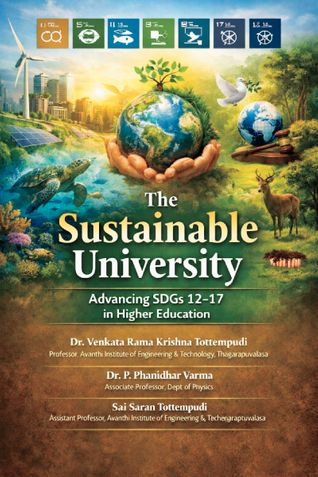
The Sustainable University: Advancing SDGs 12–17 in Higher Education (eBook)
Type:
e-book
Genre: Self-Improvement
Language: English
Price:
₹200
(Immediate Access on Full Payment)
Description
Universities occupy a uniquely influential position in society, functioning as knowledge producers, talent developers, innovation hubs, and anchor institutions within their regions. As the global community advances the 2030 Agenda, higher education institutions are increasingly called upon to translate the ambitions of the United Nations Sustainable Development Goals (SDGs) into measurable, scalable, and enduring impact. This work focuses on SDGs 12–17—Responsible Consumption and Production, Climate Action, Life Below Water, Life on Land, Peace, Justice and Strong Institutions, and Partnerships for the Goals—arguing that universities can act as systemic change agents by embedding sustainability across governance, curriculum, research, operations, and external engagement.
The central premise is that a “sustainable university” is not defined by isolated green initiatives but by an integrated institutional model in which sustainability principles shape decision-making at every level. For SDG 12, universities can transform procurement, resource management, and campus operations through circular economy practices, sustainable supply chains, waste minimization, and responsible consumption behaviours. Embedding lifecycle thinking into laboratories, canteens, housing, and procurement systems enables institutions to reduce material intensity and environmental footprints while educating students through living laboratories. Transparent reporting—aligned with frameworks such as the Global Reporting Initiative (GRI)—enhances accountability and creates a feedback loop for continuous improvement.
In addressing SDG 13, climate action becomes both an operational priority and an academic mission. Universities can set science-based targets for carbon neutrality, transition to renewable energy, and implement energy-efficient infrastructure, while simultaneously advancing climate research, adaptation strategies, and policy engagement. Climate literacy integrated into curricula across disciplines ensures that graduates possess the competencies required to respond to climate risks. Moreover, campuses can function as testbeds for resilience planning, including water management, disaster preparedness, and nature-based solutions, thereby demonstrating replicable models for cities and regions.
SDGs 14 and 15 extend the sustainability agenda beyond the campus boundary, emphasizing stewardship of marine and terrestrial ecosystems. Universities located in coastal or riverine regions can contribute to SDG 14 through marine research, pollution monitoring, biodiversity conservation, and community engagement with fisheries and coastal populations. Similarly, SDG 15 calls for institutional leadership in protecting biodiversity, restoring degraded land, and promoting sustainable land-use practices. Botanical gardens, biodiversity parks, and conservation research centres can serve both educational and ecological functions, while partnerships with local communities enable participatory conservation and knowledge co-creation.
SDG 16 underscores the importance of governance, ethics, transparency, and institutional integrity. A sustainable university must embody principles of fairness, inclusivity, and accountability through robust governance structures, anti-corruption policies, and participatory decision-making processes. Academic freedom, equitable access, grievance redressal mechanisms, and ethical research practices contribute to building trust and legitimacy. Universities also play a critical role in educating students on democratic values, human rights, and social justice, thereby strengthening the foundations of peaceful and inclusive societies.
SDG 17 highlights partnerships as the enabling mechanism that amplifies impact across all other goals. Universities can leverage multi-stakeholder collaborations with governments, industry, civil society, and international networks to scale solutions and mobilize resources. Strategic alliances facilitate joint research, capacity building, technology transfer, and policy influence. By aligning institutional priorities with regional and national development agendas, universities can ensure that their contributions are both locally relevant and globally connected.
A key contribution of this work is the articulation of an integrated implementation framework for SDGs 12–17 within higher education. This framework comprises five interdependent pillars: (1) governance and strategy alignment; (2) curriculum transformation and competency development; (3) research and innovation ecosystems; (4) sustainable campus operations; and (5) community engagement and partnerships. Each pillar is associated with measurable indicators, enabling institutions to track progress and demonstrate impact. For example, governance indicators may include the integration of SDGs into strategic plans and the establishment of sustainability committees; curriculum indicators may track the proportion of courses incorporating SDG content; research indicators may measure publications, patents, and funded projects aligned with SDGs; operational indicators may capture energy use, waste reduction, and water conservation; and engagement indicators may assess partnerships and outreach programmes.
The work also emphasizes the importance of evidence-based reporting and benchmarking, particularly in the context of global frameworks such as the Times Higher Education Impact Rankings. By systematically mapping institutional activities to SDG targets and indicators, universities can enhance transparency, improve performance, and strengthen their global visibility. The establishment of centralized SDG data systems, dashboards, and public evidence portals is recommended to ensure data integrity and accessibility. Continuous monitoring, internal audits, and peer benchmarking enable institutions to identify gaps and refine strategies.
Importantly, the transformation toward sustainability requires cultural change alongside structural reforms. Leadership commitment, stakeholder engagement, and capacity building are critical success factors. Faculty development programmes, student-led initiatives, and incentives for interdisciplinary collaboration can foster a culture of sustainability across the institution. Financial sustainability must also be considered, with innovative funding models, green financing, and resource optimization supporting long-term implementation.
The abstract concludes by asserting that advancing SDGs 12–17 within higher education is not merely a compliance exercise but a strategic opportunity to redefine the role of universities in the 21st century. By integrating sustainability into their core mission, universities can produce responsible graduates, generate impactful knowledge, and contribute meaningfully to global challenges. The sustainable university thus emerges as a catalyst for systemic transformation, bridging local action and global goals, and shaping a more equitable, resilient, and sustainable future.
About the Authors
Book Details
Publisher: Self
Number of Pages: 1299
Availability:
Available for Download (e-book)
Ratings & Reviews
The Sustainable University: Advancing SDGs 12–17 in Higher Education
Review This Book
Write your thoughts about this book.

Currently there are no reviews available for this book.
Be the first one to write a review for the book The Sustainable University: Advancing SDGs 12–17 in Higher Education.
Other Books in Self-Improvement

Devesh Gupta

rohit kumar

Jussi Saksa

Harish Walavalkar