You can access the distribution details by navigating to My pre-printed books > Distribution
Add a Review
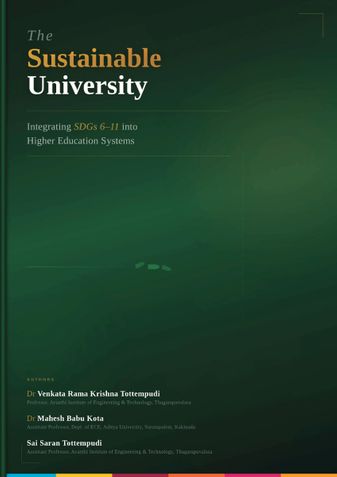
The Sustainable University: Integrating SDGs 6–11 into Higher Education Systems (eBook)
Type:
e-book
Genre: Self-Improvement
Language: English
Price:
₹200
(Immediate Access on Full Payment)
Description
The global pursuit of sustainable development demands transformative engagement from every sector of society, with Higher Education Institutions (HEIs) occupying a uniquely powerful position at the intersection of knowledge creation, human capital development, and community transformation. This book, The Sustainable University: Aligning Higher Education Institutions with the SDGs, presents a comprehensive framework for integrating six critical United Nations Sustainable Development Goals — SDG-6 (Clean Water and Sanitation), SDG-7 (Affordable and Clean Energy), SDG-8 (Decent Work and Economic Growth), SDG-9 (Industry, Innovation and Infrastructure), SDG-10 (Reduced Inequalities), and SDG-11 (Sustainable Cities and Communities) — into the academic, operational, research, and outreach functions of universities and colleges across India and the developing world.
The 2030 Agenda for Sustainable Development, adopted by all United Nations member states in 2015, established 17 interconnected goals that collectively address poverty, inequality, environmental degradation, and institutional capacity. While governments and international organizations bear primary responsibility for policy implementation, HEIs serve as indispensable engines of progress through their threefold mandate of teaching, research, and societal engagement. Universities produce the professionals, innovators, and leaders who will design and deliver sustainable solutions for decades to come. Yet, despite this potential, many institutions lack structured frameworks for aligning campus operations, curricula, research agendas, and community partnerships with specific SDG targets and indicators. This book addresses that gap by providing actionable data collection formats, implementation checklists, programme tracking tools, and monitoring frameworks tailored for the Indian higher education context while remaining applicable to institutions worldwide.
SDG-6, Clean Water and Sanitation, forms the foundational pillar of this work. The book examines how HEIs can contribute to water security through campus-level rainwater harvesting systems, sewage treatment plants, greywater recycling, water quality monitoring, and zero liquid discharge initiatives. It presents frameworks for tracking India-specific programmes such as Jal Jeevan Mission, Namami Gange, AMRUT, and the National Water Mission, while documenting institutional contributions to water literacy, watershed management research, and community water conservation outreach. Data collection formats enable institutions to measure their water footprint, track consumption patterns, and benchmark performance against national and international standards.
SDG-7, Affordable and Clean Energy, addresses the imperative of transitioning HEI campuses toward renewable energy independence. The book provides comprehensive monitoring tools for solar photovoltaic installations, biogas generation plants, solar steam cooking systems, LED lighting retrofits, and energy efficiency measures. It examines India's Panchamrit commitments, the National Solar Mission targeting 280 GW, PM-KUSUM solar pumps, the UJALA LED programme that has distributed over 380 million bulbs saving 38 million tonnes of CO₂ annually, and the Street Lighting National Programme. Institutional frameworks for carbon footprint auditing, energy performance indexing, and green building certification through GRIHA and LEED are presented alongside research tracking across clean energy themes.
SDG-8, Decent Work and Economic Growth, explores the role of HEIs in fostering entrepreneurship, employability, and inclusive economic participation. The book details frameworks aligned with India's unique institutional structures including Innovation, Incubation and Entrepreneurship Cells, the Entrepreneurial-Academic Model built on five foundational principles, village adoption programmes targeting ten villages per institution, the "Each One Reach One" financial literacy initiative, Rural Tourism Development Circuits, and NITI Aayog's nine aspirational indicators. Data collection formats track placement outcomes, startup incubation, skill development programmes, industry-academia collaboration, and community economic impact across twenty-five government schemes.
SDG-9, Industry, Innovation and Infrastructure, examines how universities can strengthen national innovation ecosystems through research commercialization, technology transfer, intellectual property generation, and infrastructure modernization. The book presents tracking mechanisms for research output, patent filings, industry partnerships, digital infrastructure, laboratory modernization, and participation in programmes such as Atal Innovation Mission, Startup India, Make in India, and the National Research Foundation. It emphasizes the role of HEIs as nodes in regional innovation systems connecting academic discovery with industrial application and societal benefit.
SDG-10, Reduced Inequalities, addresses perhaps the most morally urgent dimension of sustainable development. The book provides frameworks for measuring and advancing equity across multiple dimensions: caste, gender, disability, economic status, geographic origin, and religious identity. It tracks institutional compliance with reservation policies, scholarship distribution, accessibility infrastructure, anti-discrimination mechanisms, grievance redressal systems, and inclusive pedagogy. Data collection formats capture disaggregated enrollment, retention, and completion data while monitoring the effectiveness of programmes designed to ensure that no student is left behind due to circumstances of birth.
SDG-11, Sustainable Cities and Communities, positions HEIs as laboratories and catalysts for urban sustainability. The book examines institutional contributions to sustainable transport systems, green campus infrastructure, waste management, disaster resilience, cultural heritage preservation, and inclusive urban planning. It tracks alignment with Smart Cities Mission, AMRUT, Swachh Bharat Mission, and heritage conservation programmes while providing frameworks for safe, accessible, and environmentally responsible campus development.
Throughout all six SDGs, the book maintains a consistent analytical architecture comprising official UN indicator tracking sheets, India-specific government programme monitoring tools, HEI campus implementation frameworks, research area mapping across discipline-specific themes, and comprehensive metadata with data entry instructions. Each SDG section includes professionally designed data collection workbooks with auto-calculated formulas, colour-coded sheets, and standardized formats suitable for NAAC accreditation documentation, NIRF ranking submissions, and Times Higher Education Impact Rankings reporting.
This work is intended for university administrators, IQAC coordinators, sustainability officers, faculty researchers, policy makers, and students committed to transforming their institutions into active contributors to the 2030 Agenda. By providing the measurement tools and implementation frameworks that bridge aspiration and action, The Sustainable University demonstrates that aligning higher education with the SDGs is not merely an institutional obligation but a profound opportunity to reshape the relationship between knowledge, society, and the planet.
About the Authors
Book Details
Publisher: Self
Number of Pages: 1190
Availability:
Available for Download (e-book)
Ratings & Reviews
The Sustainable University: Integrating SDGs 6–11 into Higher Education Systems
Review This Book
Write your thoughts about this book.

Currently there are no reviews available for this book.
Be the first one to write a review for the book The Sustainable University: Integrating SDGs 6–11 into Higher Education Systems.
Other Books in Self-Improvement

Harish Lodwal

Ranjot Singh Chahal

Satvinder Singh Ghotra

Sanjay Matai