You can access the distribution details by navigating to My pre-printed books > Distribution
Add a Review
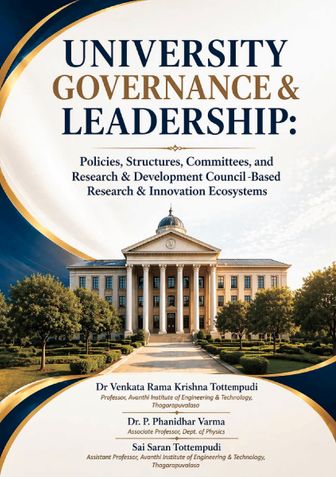
University Governance & Leadership: Policies, Structures, Committees, and Research & Development Council -Based Research & Innovation Ecosystems (eBook)
Type:
e-book
Genre: Self-Improvement
Language: English
Price:
₹200
(Immediate Access on Full Payment)
Description
Effective university governance and leadership are central to achieving academic excellence, institutional sustainability, and global competitiveness. In the contemporary higher education landscape, universities are expected not only to impart knowledge but also to foster innovation, entrepreneurship, and societal impact. This necessitates a well-defined governance framework supported by robust policies, decentralized structures, functional committees, and dynamic research and development (R&D) ecosystems. This abstract explores the interrelationship between governance mechanisms and innovation outcomes, emphasizing the role of leadership and institutional frameworks in shaping research-driven universities.
University governance refers to the system through which institutions are directed, controlled, and held accountable. It encompasses policies, regulations, decision-making processes, and organizational structures that guide academic and administrative functions. Leadership within this context plays a transformative role by setting strategic direction, ensuring transparency, and fostering a culture of collaboration and accountability. Effective leadership aligns institutional vision and mission with national education policies and global standards, such as accreditation frameworks and ranking systems. Governance models in universities typically follow a hierarchical yet participatory approach, involving statutory bodies like Boards of Governors, Academic Councils, and Finance Committees.
Policies form the backbone of governance by providing a structured approach to decision-making and operations. These include academic policies, research policies, intellectual property rights (IPR) policies, consultancy policies, and quality assurance frameworks. Well-articulated policies ensure consistency, fairness, and compliance with regulatory requirements while enabling flexibility for innovation. In particular, research policies play a critical role in defining priorities, funding mechanisms, ethical standards, and collaboration strategies. Universities that regularly review and update their policies are better positioned to adapt to emerging challenges and opportunities in higher education.
Organizational structures in universities are designed to facilitate efficient functioning and effective coordination among various stakeholders. These structures typically include academic departments, administrative units, research centers, and support services. Decentralization is increasingly adopted to empower departments and faculties, allowing for quicker decision-making and localized innovation. Within this structure, committees act as operational units that ensure participatory governance. Key committees include curriculum development committees, examination committees, internal quality assurance cells (IQAC), and departmental development committees (DDC). These committees are responsible for planning, implementation, monitoring, and evaluation of various academic and administrative processes.
Committees play a pivotal role in bridging the gap between policy and practice. They enable stakeholder participation, including faculty, students, industry experts, and alumni, thereby ensuring that decisions are inclusive and informed. For instance, curriculum committees ensure alignment with industry requirements and outcome-based education (OBE) frameworks, while quality assurance committees monitor continuous improvement processes. The effectiveness of these committees depends on clear roles, accountability mechanisms, and regular review processes. Documentation, transparency, and data-driven decision-making are essential components of committee functioning, particularly in the context of accreditation and ranking exercises.
A critical component of modern university governance is the establishment of Research and Development Councils (RDCs). These councils serve as apex bodies responsible for promoting, coordinating, and monitoring research activities within the institution. The RDC typically comprises senior faculty members, research experts, industry representatives, and administrators. Its primary functions include formulating research strategies, facilitating funding opportunities, promoting interdisciplinary research, and ensuring compliance with ethical and regulatory standards. The RDC acts as a catalyst for creating a vibrant research culture and aligning institutional research goals with national and global priorities.
The concept of research and innovation ecosystems has gained prominence as universities strive to become hubs of knowledge creation and technology transfer. An effective ecosystem integrates various components, including research centers, incubation facilities, industry partnerships, funding agencies, and intellectual property management systems. The RDC plays a central role in orchestrating these components, ensuring synergy and optimal utilization of resources. By fostering collaborations with industry and other academic institutions, universities can enhance the relevance and impact of their research. Innovation ecosystems also support entrepreneurship through startup incubation, mentoring, and access to venture capital.
Leadership is a key driver in building and sustaining research and innovation ecosystems. Visionary leaders create an enabling environment that encourages creativity, risk-taking, and interdisciplinary collaboration. They allocate resources strategically, recognize and reward research achievements, and establish partnerships that enhance institutional capabilities. Leadership also involves addressing challenges such as limited funding, bureaucratic constraints, and resistance to change. By promoting a culture of continuous improvement and accountability, leaders can ensure that governance structures and processes remain effective and responsive.
Technology plays an increasingly important role in university governance and research ecosystems. Digital platforms facilitate data management, communication, and decision-making, enabling more efficient and transparent operations. Learning management systems, research information systems, and digital repositories support academic and research activities, while analytics tools provide insights for strategic planning. The integration of technology into governance processes enhances efficiency, reduces administrative burden, and improves stakeholder engagement.
In conclusion, university governance and leadership are fundamental to the development of robust research and innovation ecosystems. Policies, structures, and committees provide the framework within which academic and research activities are conducted, while the Research and Development Council acts as a central coordinating body. Effective governance requires a balance between centralization and decentralization, ensuring both strategic direction and operational flexibility. Leadership plays a transformative role in aligning institutional goals with societal needs and global trends. By fostering a culture of innovation, collaboration, and continuous improvement, universities can enhance their research output, contribute to economic development, and address societal challenges. The integration of governance mechanisms with research and innovation strategies is essential for building future-ready institutions capable of thriving in a rapidly evolving global landscape
About the Authors
Book Details
Publisher: Self
Number of Pages: 2290
Availability:
Available for Download (e-book)
Ratings & Reviews
University Governance & Leadership: Policies, Structures, Committees, and Research & Development Council -Based Research & Innovation Ecosystems
Review This Book
Write your thoughts about this book.

Currently there are no reviews available for this book.
Be the first one to write a review for the book University Governance & Leadership: Policies, Structures, Committees, and Research & Development Council -Based Research & Innovation Ecosystems.
Other Books in Self-Improvement

Harmit Singh Bharara

Utsaah Club

Subas Mahapatra

Ashwini Kumar Aggarwal