You can access the distribution details by navigating to My pre-printed books > Distribution
Add a Review
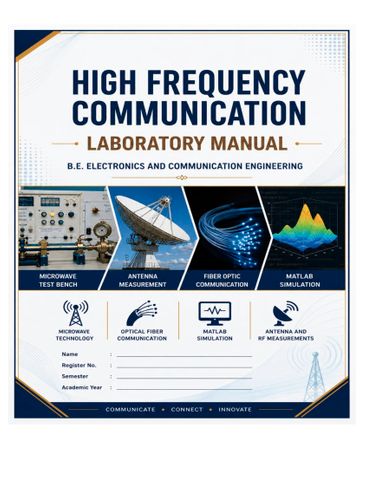
HIGH FREQUENCY COMMUNICATION LABORATORY MANUAL (eBook)
OPTICAL AND MICROWAVE LABORATORY MANUAL
Type:
e-book
Genre: Engineering, Science & Technology
Language: English
Price:
₹150
(Immediate Access on Full Payment)
Description
High Frequency Communication forms the foundation of modern wireless, microwave,
satellite, radar, optical fiber, and broadband communication systems. Rapid advancements in
communication technologies have created a growing demand for engineers with strong practical
knowledge of microwave measurements, optical communication, antenna systems, and wireless
channel analysis. Laboratory-based learning is therefore essential for bridging the gap between
theoretical concepts and real-world engineering applications.
This High Frequency Communication Laboratory Manual has been prepared to provide a
systematic and practical approach to performing laboratory experiments prescribed for the
undergraduate B.E. Electronics and Communication Engineering programme. The manual serves as a
comprehensive guide for students to understand the principles, procedures, observations, and analysis
involved in high-frequency communication systems.
The manual is organized into three major sections. The first section focuses on RF and
Microwave Communication, covering experiments on the Reflex Klystron, Gunn Diode Oscillator,
VSWR measurement, frequency and wavelength measurement, microwave passive components, and
antenna parameter evaluation using a microwave test bench. The second section introduces Optical Fiber
Communication, including the measurement of numerical aperture, attenuation, bending losses, and the
transmission of analog and digital signals through optical fiber links. The final section presents
MATLAB-based simulations that enable students to investigate wireless channel behavior under fading
and Doppler effects, as well as channel estimation, synchronization, and equalization techniques used in
modern communication systems.
Each experiment has been carefully designed with clearly stated objectives, theoretical
background, apparatus requirements, experimental procedures, observation tables, calculations, result
analysis, precautions, applications, and viva-voce questions. This structured approach encourages
students to develop analytical thinking, experimental skills, and confidence in handling advanced
communication equipment and simulation tools.
It is hoped that this laboratory manual will serve as a valuable resource for students, faculty
members, and laboratory instructors in conducting experiments effectively while strengthening the
practical understanding of high-frequency communication principles. Constructive suggestions from
faculty members, students, and readers for improving future editions of this manual are sincerely
welcomed and greatly appreciated.
Author
About the Author
Book Details
ISBN: 9789360769949
Publisher: AUTHOR AND SELF PUBLISHER GANGADURAI ELUMALAI
Number of Pages: 99
Availability:
Available for Download (e-book)
Ratings & Reviews
HIGH FREQUENCY COMMUNICATION LABORATORY MANUAL
Review This Book
Write your thoughts about this book.

Currently there are no reviews available for this book.
Be the first one to write a review for the book HIGH FREQUENCY COMMUNICATION LABORATORY MANUAL.
Other Books in Engineering, Science & Technology

akshit negi

Dr Deepika Shukla, Dr. Madhu Yadav, Ashish Pal, ...

Dr. SHAHUL HAMEED PAKKIR MOHAMED, Dr. Mathar Mohideen ...

DR. JOSE KUDAKASSERIL