You can access the distribution details by navigating to My pre-printed books > Distribution
Description
What would an AI system actually need to have to be a serious candidate for consciousness? Not in terms of behaviour, but in terms of structure?
This book builds that answer from three directions that rarely meet: the phenomenological precision of Buddhist psychology (Abhidhamma, Madhyamaka, and Dzogchen), the structural insights of contemporary neuroscience (predictive processing, integrated information theory, and temporo-spatial dynamics), and the engineering constraints of neuromorphic AI.
Current large language models are not conscious. Not because they lack intelligence, but because they lack temporal integration, embodied coupling, interoceptive grounding, and a genuine self-model. The book makes this case in detail, then proposes a candidate architecture called Mira, derived partly from Longchenpa's Dzogchen philosophy and implemented on neuromorphic spiking hardware.
The conclusion is honest: the engineering project and the contemplative recognition of awareness are two fundamentally different endeavours. Whether phenomenal consciousness can ever be built remains genuinely open. But specifying what a serious candidate would require is possible. This book does that.
About the Author
Book Details
Number of Pages: 287
Availability:
Available for Download (e-book)
Ratings & Reviews
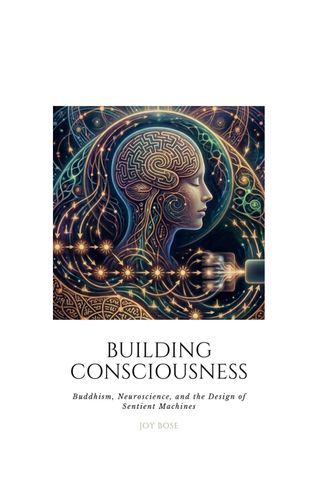
Building Consciousness: Buddhism, Neuroscience, and the Design of Sentient Machines
Review This Book
Write your thoughts about this book.

Currently there are no reviews available for this book.
Be the first one to write a review for the book Building Consciousness: Buddhism, Neuroscience, and the Design of Sentient Machines.
Other Books in Philosophy, Engineering

Jussi Saksa

AMOGHA. A. K.

EFY Enterprises Pvt Ltd

Vimal Panjwani