You can access the distribution details by navigating to My pre-printed books > Distribution
Description
Someone you love is dying. Or you have been given a diagnosis. Or you are sitting at a deathbed with no idea what to do. Forty-Nine Days was written for that moment, and for the preparation that must begin long before the crisis arrives.
This book brings together what four Buddhist traditions have learned about dying with what contemporary neuroscience is only beginning to confirm. The dying brain remains active far longer than we assume. The dying person can still hear, still register whether the room is calm or frightened, still be reached by a familiar voice. This has practical consequences for everyone who will ever sit at a deathbed.
The four traditions each offer a distinct answer. Tibetan Vajrayana provides a detailed map of the dying process and practices for the forty-nine days that follow. Jodo Shinshu offers a complete release from the requirement to perform at the moment of death. Korean Zen kido is sustained collective chanting for the dead, giving grief somewhere to go. Theravada offers rigorous mind-training centred on the direct encounter with impermanence that anyone can begin today.
The author has practiced in all four traditions, sat with dying teachers, and trained in both neuroscience and contemplative practice. This is not a comparative religion textbook. It is a practitioner's synthesis written for anyone who will one day be dying or sitting with someone who is.
About the Author
Book Details
Number of Pages: 274
Availability:
Available for Download (e-book)
Ratings & Reviews
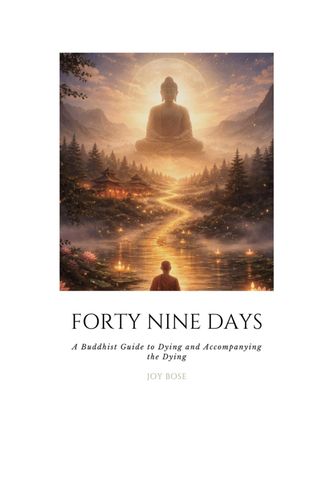
Forty Nine Days: A Buddhist Guide to Dying and Accompanying the Dying
Review This Book
Write your thoughts about this book.

Currently there are no reviews available for this book.
Be the first one to write a review for the book Forty Nine Days: A Buddhist Guide to Dying and Accompanying the Dying.
Other Books in Self-Improvement, Religion & Spirituality

Harshdeep Singh

కొప్పుల అనిల్ కుమార్ (Koppula Anilkumar)
M.G.GOPALAKRISHNAN

Akshita sharma