You can access the distribution details by navigating to My pre-printed books > Distribution
Add a Review
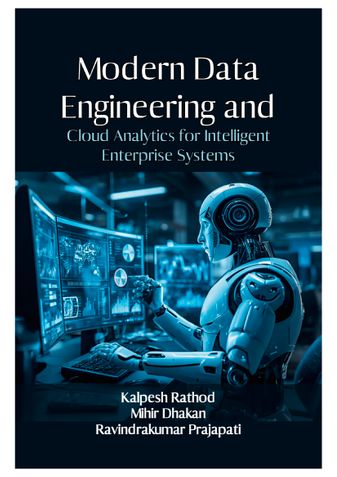
Modern Data Engineering and Cloud Analytics for Intelligent Enterprise Systems (eBook)
Type:
e-book
Genre: Computer Programming
Language: English
Price:
₹500
(Immediate Access on Full Payment)
Description
The modern business landscape is being transformed by an unprecedented growth in data generation, digital connectivity, and intelligent technologies. Organizations across industries are no longer competing solely on products, services, or operational efficiency; they are increasingly competing on their ability to collect, manage, analyze, and act upon data. In this environment, data has emerged as one of the most valuable strategic assets, driving innovation, improving decision-making, and enabling organizations to respond rapidly to changing market conditions. As enterprises continue their digital transformation journeys, the disciplines of data engineering and cloud analytics have become essential foundations for building intelligent and resilient business systems.
This book, Modern Data Engineering and Cloud Analytics for Intelligent Enterprise Systems, has been written to provide a comprehensive understanding of the technologies, methodologies, and architectural principles that underpin modern data-driven enterprises. It aims to bridge the gap between theoretical concepts and practical implementation by exploring how organizations can design scalable data infrastructures, leverage cloud-native technologies, and harness advanced analytics to generate meaningful business value.
The rapid evolution of cloud computing has fundamentally changed the way organizations store, process, and analyze information. Traditional on-premises infrastructures are increasingly being replaced by flexible, scalable, and cost-effective cloud platforms capable of supporting complex analytical workloads. Simultaneously, advances in artificial intelligence, machine learning, streaming analytics, and distributed computing have expanded the possibilities for extracting insights from vast and diverse datasets. These developments have created new opportunities for organizations to become truly intelligent enterprises-businesses that use data and technology as central components of strategy, operations, and innovation.
This book is organized into nine chapters that guide readers through the complete ecosystem of modern data engineering and cloud analytics. The early chapters introduce the foundations of enterprise data management, data architecture, governance, and cloud computing principles. Subsequent chapters explore data integration, pipeline engineering, big data processing, and real-time analytics, highlighting the technologies and frameworks that enable large-scale data operations. The later chapters focus on artificial intelligence, advanced analytics, security, privacy, reliability, and emerging trends such as data mesh, digital twins, edge computing, and autonomous analytics.
A distinguishing feature of this book is its emphasis on the integration of technology, business strategy, and organizational transformation. Data engineering is presented not merely as a technical discipline but as a critical enabler of enterprise intelligence. Similarly, cloud analytics is examined not only as a collection of tools and platforms but as a catalyst for innovation, operational excellence, and competitive advantage. Throughout the book, practical examples, conceptual explanations, and industry-oriented discussions are used to demonstrate how organizations can apply these technologies effectively in real-world environments.
This text is intended for a broad audience, including undergraduate and postgraduate students, researchers, data engineers, cloud architects, analytics professionals, information technology managers, and business leaders. Readers seeking to understand the modern data ecosystem will find both foundational knowledge and advanced perspectives that can support academic study, professional development, and organizational initiatives.
As technology continues to evolve, the importance of intelligent enterprise systems will only increase. Future organizations will depend on their ability to manage complex data environments, integrate artificial intelligence into decision-making processes, and build adaptive infrastructures capable of supporting continuous innovation. It is our hope that this book serves as a valuable guide for understanding these transformations and provides readers with the knowledge necessary to contribute meaningfully to the next generation of data-driven enterprises.
We extend our gratitude to the researchers, practitioners, educators, and technology communities whose contributions have advanced the fields of data engineering, cloud computing, analytics, and artificial intelligence. Their innovations and insights continue to shape the future of intelligent enterprise systems and inspire ongoing learning and discovery.
May this book encourage curiosity, foster innovation, and support the development of intelligent solutions that transform data into meaningful value for organizations and society alike.
About the Authors
Book Details
Publisher: WISSIRA RESEARCH LAB
Number of Pages: 193
Availability:
Available for Download (e-book)
Ratings & Reviews
Modern Data Engineering and Cloud Analytics for Intelligent Enterprise Systems
Review This Book
Write your thoughts about this book.

Currently there are no reviews available for this book.
Be the first one to write a review for the book Modern Data Engineering and Cloud Analytics for Intelligent Enterprise Systems.
Other Books in Computer Programming
Aravind choudhary
Dr. Manish Kumar, Prof. (Dr.) B. K. Sarkar, ...
Chandra Shekhar Kumar