You can access the distribution details by navigating to My pre-printed books > Distribution
Add a Review
Type:
e-book
Genre: Poetry
Language: English
Price:
₹963
(Immediate Access on Full Payment)
Description
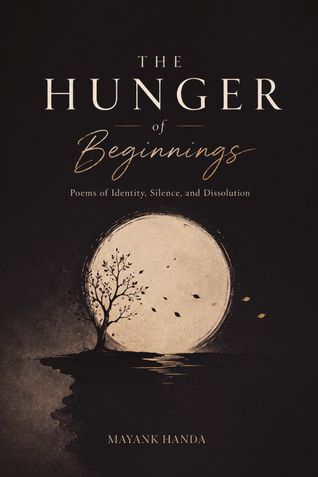
The manuscript, The Hunger of Beginnings: Poems of Identity, Silence, and Dissolution, starts with a voice that feels emotionally raw and searching. In the opening section, the speaker is driven by desire, loneliness, attraction, and confusion. They are reaching for people, meaning, and identity without really understanding themselves yet. There is a feeling of hunger—not literal hunger, but a deep emotional and psychological need. The speaker repeatedly discovers that things they believed were real (love, distance, certainty, identity) may actually be illusions or projections.
As the book continues, the speaker becomes more philosophical. Fate begins to feel like a force controlling life. Language itself becomes suspicious: words seem unable to fully communicate truth. Questions multiply faster than answers. Instead of finding certainty, the speaker discovers that every answer simply opens another question.
In the middle of the manuscript, time and identity become major subjects. The narrator begins wondering:
Am I one person or many versions of myself?
Am I living life or just observing it?
Is the world genuine, or are we all acting inside some invisible performance?
The world starts feeling like a stage where everyone is performing roles. The speaker no longer trusts a stable sense of self. Identity becomes something fluid and unstable rather than something solid.
The emotional focus later shifts toward love and human relationships. But love here is not comforting or romantic in the usual sense. Love appears as something painful, uncertain, and changing. The speaker realizes people are partly real and partly creations of our own perceptions and memories. Betrayal is explored not simply as someone hurting another person, but as the changing nature of emotions themselves. Love transforms over time, and that transformation feels like betrayal.
Toward the final sections, reality itself starts becoming unstable. The poems move into symbolism and abstract ideas:
Death stops being just an ending.
Heaven and hell stop being physical places.
Morality stops feeling absolute.
Reality and imagination start blending together.
The speaker repeatedly realizes that many categories humans create—good and evil, truth and illusion, heaven and hell—might only exist because humans constructed them.
By the ending, the book reaches its final realization: there may never have been a final answer at all. The goal was never resolution. The journey itself mattered more than arriving anywhere. Even silence is not really empty; it exists beneath all speech. The final feeling is that thought creates reality and then begins questioning the reality it created.
About the Author
Book Details
Publisher: Pro Author Publishers
Number of Pages: 78
Availability:
Available for Download (e-book)
Ratings & Reviews
The Hunger of Beginnings
Review This Book
Write your thoughts about this book.

Currently there are no reviews available for this book.
Be the first one to write a review for the book The Hunger of Beginnings.
Other Books in Poetry
Sumat

ਰਣਦੀਪ ਕੌਰ ਦੰਦੀਵਾਲ

মৌসুমী গুহ রায়

Jyotirmoy Mallik