Description
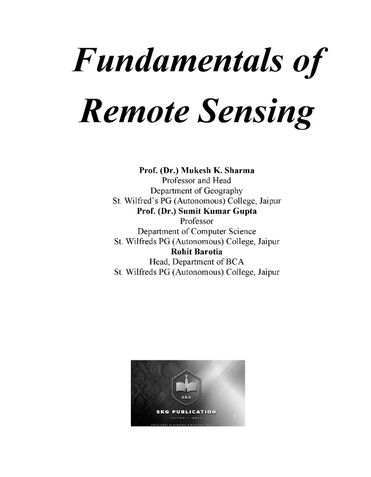
Fundamentals of Remote Sensing is an introductory book that provides a comprehensive
understanding of the principles, methods, and applications of remote sensing. It serves as
an essential resource for students, researchers, and professionals in fields such as
geography, environmental science, agriculture, forestry, geology, civil engineering, and
urban planning. The book explains how information about the Earth's surface can be
collected, analyzed, and interpreted without making direct physical contact with the
objects or areas being studied. By combining scientific concepts with practical
applications, it helps readers understand how remote sensing technology contributes to
monitoring and managing natural and human-made environments.
Remote sensing is the science and technology of obtaining information about objects,
areas, or phenomena from a distance by detecting and measuring the electromagnetic
energy reflected or emitted from the Earth's surface. This information is collected using
sensors mounted on satellites, aircraft, drones, or other platforms. The book begins by
introducing the history and evolution of remote sensing, showing how the technology has
developed from simple aerial photography to advanced satellite imaging systems capable
of capturing highly detailed information about the planet.
One of the most important topics covered in the book is electromagnetic radiation (EMR),
which forms the foundation of remote sensing. The Sun is the primary source of energy for
most remote sensing systems. Solar radiation travels through the atmosphere and interacts
with the Earth's surface. Different materials such as vegetation, water, soil, rocks, and
buildings absorb, reflect, and emit electromagnetic energy in different ways. These unique
patterns, known as spectral signatures, allow scientists to identify and classify various
surface features. The book explains the electromagnetic spectrum, including visible light,
infrared, and microwave regions, and discusses how different wavelengths are used for
different remote sensing applications.
The book also explains the interaction of electromagnetic radiation with the atmosphere.
Before reaching the Earth's surface, radiation may be scattered or absorbed by atmospheric
gases, dust, and water vapor. These atmospheric effects influence the quality of satellite
images. Understanding atmospheric interactions helps improve the accuracy of remote
sensing data through correction techniques and proper image interpretation.
Another major topic is remote sensing platforms. Platforms are the structures that carry
remote sensing sensors. They include ground-based systems, aircraft, drones, and
satellites. Aircraft and drones are commonly used for local or regional studies because they
can capture high-resolution images over specific areas. Satellites are used for large-scale
monitoring of the Earth's surface and provide repeated observations over time. The book
discusses the advantages and limitations of each platform, helping readers understand
which system is most suitable for different purposes.
Fundamentals of Remote Sensing
The book provides detailed information about remote sensing sensors, which are devices
used to detect and record electromagnetic energy. Sensors are generally classified into two
categories: passive and active sensors. Passive sensors depend on natural energy, mainly
sunlight, and record the radiation reflected or emitted by objects. Most optical satellite
cameras are passive sensors. Active sensors, such as radar and LiDAR, produce their own
energy and measure the reflected signals from the Earth's surface. Active sensors can
collect information during both day and night and often operate effectively even under
cloudy conditions. The comparison between passive and active sensing helps readers
understand the strengths and limitations of different technologies.
A significant portion of the book focuses on satellite imagery and image interpretation.
Satellite images contain valuable information that can be interpreted visually or analyzed
using computer-based digital techniques. Visual image interpretation involves examining
characteristics such as color, tone, texture, shape, size, pattern, shadow, and location to
identify objects. Digital image processing uses computer software to enhance image
quality, classify land cover, detect changes, and extract useful information. These
techniques improve the accuracy and efficiency of analyzing remote sensing data.
The book also explains the concept of resolution, which determines the quality and
usefulness of remote sensing data. Four important types of resolution are discussed. Spatial
resolution refers to the size of the smallest object that can be detected in an image. Spectral
resolution indicates the ability of a sensor to distinguish different wavelengths of
electromagnetic energy. Temporal resolution refers to how frequently a satellite revisits
the same location. Radiometric resolution describes the sensor's ability to detect small
differences in energy intensity. Understanding these types of resolution helps users select
appropriate satellite data for different applications.
Another important section introduces readers to various Earth observation satellite systems
used around the world. These satellites continuously monitor the Earth's land, oceans,
atmosphere, and environment. The book explains how satellite data support weather
forecasting, environmental monitoring, climate research, agriculture, forest management,
mineral exploration, and disaster response. Modern satellite missions provide accurate,
timely, and reliable information that assists governments, scientists, and organizations in
making informed decisions.
The applications of remote sensing are one of the most valuable parts of the book. In
agriculture, remote sensing helps monitor crop health, estimate crop yields, detect diseases,
assess soil moisture, and improve irrigation management. In forestry, it is used to map
forests, monitor deforestation, estimate biomass, and detect forest fires. In geology, remote
sensing assists in identifying rock formations, locating mineral resources, and studying
geological structures. Environmental scientists use remote sensing to monitor pollution,
land degradation, desertification, biodiversity, and climate change.
The book also highlights the importance of remote sensing in water resource management.
Fundamentals of Remote Sensing
Satellite data are used to monitor rivers, lakes, reservoirs, wetlands, groundwater recharge
areas, and coastal regions. They help assess water quality, detect floods, and support
sustainable water management. In urban planning, remote sensing provides accurate
information about land use, transportation networks, infrastructure development, and urban
expansion. It enables planners to manage cities more efficiently and monitor changes over
time.
Remote sensing plays a crucial role in disaster management. Satellite imagery is widely
used before, during, and after natural disasters such as floods, earthquakes, cyclones,
landslides, droughts, volcanic eruptions, and wildfires. It helps identify vulnerable areas,
assess damage, coordinate rescue operations, and support rehabilitation efforts. Because
satellite data cover large areas quickly, remote sensing has become an essential tool for
emergency response and disaster risk reduction.
The book also introduces the relationship between remote sensing and Geographic
Information Systems (GIS). Remote sensing provides up-to-date spatial information, while
GIS stores, manages, analyzes, and displays that information in map form. Together, these
technologies support decision-making in resource management, environmental
conservation, transportation planning, agriculture, public health, and sustainable
development.
In conclusion, Fundamentals of Remote Sensing is an excellent introductory resource that
explains the scientific principles, technologies, and practical applications of remote
sensing in a clear and systematic manner. It builds a strong foundation by covering
electromagnetic radiation, sensors, platforms, image interpretation, satellite systems,
resolutions, and digital image processing. The book demonstrates how remote sensing has
become an indispensable tool for understanding the Earth's environment and solving realworld problems. Its simple language, logical organization, and practical examples make it
highly valuable for students, educators, researchers, and professionals who wish to gain a
thorough understanding of remote sensing and its growing importance in science,
technology, and sustainable development
Prof. (Dr.) Mukesh Kumar Sharma ‘Bhatt’ : A Biography
Professor and Head, St. Wilfred’s P.G. (Autonomous) College, Jaipur
Dr. Mukesh Kumar Sharma is an Indian geographer, researcher, education administrator, and
traditiona Bhatt Pansari (herbal medicine expert). He is known as Mukesh Bhatt in his locality.
He was born on April 29, 1977, in the Khetri town of Jhunjhunu district, located in the
Shekhawati Region of Rajasthan. Currently, he serves as a Professor and Head of the
Geography Department at St. Wilfred's P.G. Autonomous College in Jaipur. He has dedicated
his entire life to geography, medicinal plants, preservation of traditional knowledge, and social
service. This biography presents his life, education, work, and achievements in simple
language.
Early Life and Family Background
Dr. Sharma was born in the town of Khetri in the Shekhawati region of Rajasthan. This area is
known for its copper mines, rich cultural heritage, intricately painted havelis (mansions), and
harsh desert climate. The soil here nurtures numerous medicinal plants that local communities
have used for centuries. The hills, mineral wealth, and natural beauty of Khetri left a deep
impression on young Mukesh's mind.
His family has been engaged in the traditional profession of Pansari (herbal medicine
practitioner) for generations. The Pansari shop was not merely a place of trade but, in Indian
culture, served as a center of Ayurvedic knowledge, folk medicine, and social interaction.
Sitting at the shop with his father during childhood, observing various dried herbs, spices, and
medicines, identifying their aromas, and listening to customers discuss their properties—this
was no less than any university course for him. He learned to identify and understand the uses
of medicines like turmeric, ginger, dried ginger, triphala, guggal, and ashwagandha right in his
own courtyard. This is why his research work later became practical and inspired by traditional
experience, rather than being solely bookish knowledge.
Education and Doctoral Degree
Dr. Sharma completed his early education in schools in Khetri and surrounding areas. During
his schooling itself, he developed a special interest in geography. He observed how soil, water,
weather, and plants are deeply interconnected. He understood from the very beginning that
geography is not merely the study of rivers and mountains but the science of understanding the
interrelationships between humans and nature.
For higher education, he went to the University of Rajasthan, Jaipur, where he earned his
M.A./M.Sc. degree in Geography. During his university years, he gained in-depth knowledge
of physical geography, human geography, cartography, statistics, and remote sensing. It was
during this time that he firmly decided to scientifically study the medicinal plants of his region
and map their geographical distribution.
Dr. Sharma completed his doctoral research on the topic "Applied Phytogeography of
Medicinal Plants of Shekhawati Region, Rajasthan" and received his Ph.D. degree in 2006. This
topic was an unparalleled synthesis of his family background, local issues, and modern
geography.
In this research, he cataloged hundreds of medicinal plants found in the Shekhawati region,
prepared maps of their geographical distribution, identified which plants grow in which types
of soil, water, and climatic conditions, and gathered information about traditional uses of these
plants from local people. His work proved extremely important for the region, as it not only
brought forth scientific information but also helped preserve the declining traditional medical
practices.
Academic Career and Administrative Experience
Dr. Sharma has over 25 years of teaching experience and approximately 15 years of
administrative experience. He has served as Lecturer, Head of Department, Principal, and
Assistant Professor in various colleges across Rajasthan.
While serving in institutions, he skillfully handled administrative responsibilities alongside
teaching. As a proficient administrator, he focused particularly on institutional discipline,
academic quality, and infrastructure development. During his tenure, academic results
improved, and the institutional environment became more conducive to learning. Notably, his
work in women's colleges inspired hundreds of female students to pursue higher education and
He firmly believes that being the head of an educational institution does
not mean being the center of power, but rather the center of responsibilities.
His teaching style in the classroom is highly engaging and effective. He explains complex
geographical theories so effortlessly through local examples and his field experiences that they
become permanently etched in students' minds. Maps, charts, and field visits are the soul of his
teaching. He believes in recognizing and nurturing the hidden talents of every student.
Current Position
Currently, Dr. Mukesh Kumar Sharma is a Professor and Head of the Geography Department
at the prestigious St. Wilfred's P.G. Autonomous College in Jaipur. This is an Autonomous
College, a status granted by the University Grants Commission (UGC). Being autonomous
means the institution can design its own curriculum and adopt new teaching methodologies.
Under Dr. Sharma's leadership, the Geography Department is focusing particularly on regional
studies, Geographic Information Systems (GIS), remote sensing, medicinal plant geography,
medical geography, and sustainable development.
Role as Research Supervisor and Examiner
Dr. Sharma is not only a teacher and researcher but also a recognized research supervisor for
Ph.D. candidates in Geography. Under his guidance, numerous research scholars have earned
their doctoral degrees on topics such as agricultural geography, medical geography, water
resource management, biodiversity, and sustainable development. He aims to create a research
group that works on the integration of environment and Ayurveda, presenting new solutions for
society.
Additionally, he serves as an examiner for Ph.D. theses at many private universities in
Rajasthan and as an expert member of Doctoral Research Committees (DRC). In this role, he
evaluates the quality of scholars' work and provides appropriate guidance. He is also invited as
a practical examiner for undergraduate and postgraduate examinations at various government
and private colleges.
Roles in Examination Administration
Dr. Sharma has extensive experience and contributions in the field of examination
administration. He has served as an Observer in IGNOU (Indira Gandhi National Open
University) examinations. IGNOU is the largest open university in the country, and the role of
an observer in its examinations is extremely significant—inspecting examination centers,
ensuring the fairness of examination procedures, and preventing any irregularities.
Similarly, he has also served as an Observer in PTET (Pre-Teacher Education Test)
examinations. PTET is an important eligibility test for becoming a teacher in Rajasthan, and
the future of thousands of candidates depends on its fairness. His selection for the role of
Observer in such high-level examinations demonstrates the administration's deep trust in his
impartiality and reliability.
Additionally, Dr. Sharma has served as Center Superintendent for many examinations. The
Center Superintendent is the chief administrative officer of any examination center, responsible
8
for ensuring smooth and malpractice-free conduct of examinations, maintaining the security of
question papers, attending to candidates' comfort, and making appropriate decisions in
emergency situations. This is an extremely sensitive and responsible position, which Dr.
Sharma has always executed with great skill.
Role as Flying Squad Member in Universities
Dr. Sharma is also appointed as a member of the Flying Squad during examinations at many
government universities in Rajasthan. The Flying Squad's function is to conduct surprise
inspections of examination centers and ensure that examinations are conducted in a fair and
malpractice-free environment. This responsibility reflects the university administration's trust
in his integrity and honesty.
Research, Publications, and 72 Books
Dr. Sharma has published over 135 research papers in national and international journals and
conference proceedings throughout his research career. The main themes of his research
include:
• Applied Phytogeography
• Geographical distribution of medicinal plants in Rajasthan and Shekhawati
• Medical Geography
• Biodiversity Conservation
• Ethnobotany (the relationship between people and plants)
• Water Resource Management
• Sustainable Development
• Climate Change and Regional Impacts
• Application of GIS and Remote Sensing
• Traditional Medical Knowledge
His research is not merely bookish; it is based on years of rigorous fieldwork and dialogue with
local communities. His research papers discuss everything from villages of Shekhawati to
global environmental issues. The authenticity of his data and the clarity of his analysis are
particularly commendable in his writing.
Additionally, Dr. Sharma has published 72 books to date—an extraordinary achievement.
These books cover diverse subjects including geography, environment, medicinal plants,
Ayurveda, sustainable development, water management, and the cultural-natural heritage of the
Shekhawati region. This vast number of books reflects his tireless writing and deep dedication
to knowledge dissemination. These books will continue to serve as guides for future students
and researchers.
Two International Patents
Another testament to Dr. Sharma's research brilliance is the two international patents he has
obtained. These patents have been registered in South Africa and Germany. A patent signifies
9
legal rights over a new discovery or invention. His patents relate to innovations connected with
medicinal plants and traditional knowledge. This achievement demonstrates that his work is
recognized and useful at an international level.
Two World Records
Dr. Sharma holds two unique world records that highlight his extraordinary academic
contributions:
1. The World's Thickest Book – He has compiled or authored a book that holds the record for
being the thickest book in the world in terms of thickness. This book is likely an attempt to
bring together his vast collection of research and knowledge in a single volume.
2. The World's Longest Research Paper – He has written a research paper that is the world's
longest in terms of page count. This is evidence of his in-depth study and comprehensive
understanding of the subject.
These records reflect his unique dedication and commitment to knowledge.
Participation in International Conferences
Dr. Sharma has not confined his research to India alone. He has presented research papers at
international conferences held in countries such as Egypt, Pakistan, the United States, Kenya,
Azerbaijan, Indonesia, and Italy. At these conferences, he presented information about
Rajasthan's desert medicinal plants to scholars from around the world and gave international
recognition to India's traditional medical practices.
Furthermore, he has been invited to serve as a session moderator at many international
conferences. A session moderator is the person who connects the ideas of different scholars,
gives direction to discussions, and conducts the entire session. This honor reflects his subject
knowledge and leadership abilities.
Traditional Pansari and Ayurvedic Service
Despite all his modern academic achievements, Dr. Sharma has never abandoned his family's
traditional Pansari heritage. He remains an active Pansari today, treating people through herbs.
This is not just a profession for him but a medium of service.
He has also completed a certificate course in Ayurvedic medicine to make his traditional
knowledge more scientific. He considers Ayurveda not merely a medical system but a lifestyle.
Thus, he has become a bridge between ancient knowledge and modern science. This quality
distinguishes him from other academics. When he looks at a plant, his vision encompasses both
the scientific analysis of a geographer and the experiential knowledge of a Pansari. This dual
perspective makes his work invaluable.
Dr. Sharma expresses deep concern that in the blind race of modernization, we are losing our
invaluable traditional medical heritage. The knowledge possessed by village elders is not being
transmitted to the new generation. To prevent this loss, he himself is working as a bridge. He
periodically conducts workshops in rural areas, where he explains Ayurvedic principles,
identification of local herbs, and their household uses in simple language. Through easily
10
available plants like Tulsi, Giloy, Aloe vera, and Adusa, he teaches people how to establish a
"primary health center" right in their own kitchens.
Social Thought and Service
Dr. Mukesh Kumar Sharma is a true social thinker in every sense. He believes that the real
purpose of education is character building and social transformation. He does not support
education that merely distributes degrees, but rather advocates for an education system that
connects students to their soil, their environment, and their society. He says that until our
knowledge serves our village, our farmers, our laborers, and our nature, it remains incomplete.
His commitment to environmental conservation is unparalleled. Who better than him can
understand the value of every drop of water and every green tree on Rajasthan's parched land?
Through his lectures and writings, he has continuously promoted water conservation,
afforestation, and the importance of biodiversity. He has conducted awareness campaigns in
rural areas in collaboration with various volunteer organizations. His social philosophy is based
on the concept of "Sarve Bhavantu Sukhinah" (May all beings be happy).
Personality
Dr. Mukesh Kumar Sharma is known for his simplicity, discipline, and spirit of service. He
neither likes ostentation nor self-praise. He believes that action is the greatest proof. He always
maintains a cooperative and respectful demeanor with his colleagues and students. His former
students remember him as a mentor who not only taught geography but also the art of living.
His daily life is highly regular and disciplined. Teaching, research writing, administrative work,
examination administration, Pansari service, and student guidance—he manages all of these
with complete dedication and balance.
Future Goals and Visions
Dr. Sharma has clearly defined his goals for the future:
• Launching comprehensive research projects for the conservation of endangered medicinal
species in the Shekhawati region
• Writing more authoritative books on subjects such as "Environmental Geography of
Rajasthan" and "Medicinal Plant Wealth of Shekhawati"
• Developing Medical Geography as an independent and employment-oriented subject in Indian
universities
• Organizing regular free Ayurvedic medical camps in rural areas
• Digitally recording and preserving folk medicine knowledge available with village vaidyas
(traditional healers) and experienced elders
• Preparing a group of young researchers who work on the integration of environment and
Ayurveda, presenting new solutions for society
Dr. Mukesh Kumar Sharma's life represents the integrated form of multifaceted talent. He is a
successful teacher, brilliant researcher, skilled administrator, proficient examination
11
administration officer, internationally recognized patent holder, author of 72 books, holder of
two world records, and a true carrier of his ancestors' medical tradition. On one hand, he is a
scholar of geography—a logical and scientific subject—and on the other, a sensitive advocate
of Ayurveda and traditional folk medicine.
His personality is like a banyan tree whose roots are deeply embedded in the silver soil of
Shekhawati, and whose branches reach toward the sky of modern scientific research. His labor,
sacrifice, and commitment to human welfare are exemplary not only for Rajasthan but for the
entire country.
The numerous research scholars trained under his guidance, the thousands of students he has
taught, the readers benefiting from his books, the candidates who have experienced fair
examinations under his supervision, and the countless patients who have gained health benefits
from his herbs—these are his greatest assets.
Dr. Mukesh Kumar Sharma's life is a living testament that knowledge and service, tradition and
modernity, science and faith—all these can coexist, and it is then that human life becomes
meaningful. Such dedicated teachers, researchers, and social workers are our national heritage,
from whom future generations will always draw inspiration.
Prof. (Dr.) Sumit Kumar Gupta is a seasoned academician and researcher with over 24 years of experience. He holds dual Ph.D. degrees in Materials Science and Artificial Intelligence & Data Science, along with M.Tech, M.Sc. (Physics), M.Phil., and B.Ed. qualifications. A NAAC Assessor and IIT-JEE Physics Subject Expert, he has supervised 16 Ph.D. scholars and guides three currently. Dr. Gupta has published over 55 indexed research papers, authored 15 textbooks, and holds 50 patents. He serves on the editorial boards of 31 international journals and is an elected member of the Royal Society of Chemistry, London