You can access the distribution details by navigating to My pre-printed books > Distribution
Add a Review
Type:
e-book
Genre: Education & Language, Reference
Language: English, Hindi
Price:
₹90
(Immediate Access on Full Payment)
Description
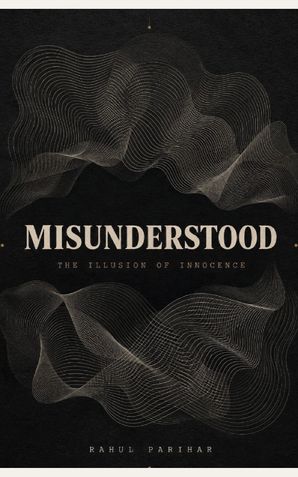
Misunderstood: The Illusion of Innocence is a psychology and social-behaviour book about the way people judge, label, and interpret one another, often without realizing how incomplete their understanding may be.
A person may be quiet in one situation, confident in another, awkward somewhere else, or completely different around people they trust. Human behaviour changes with place, people, mood, experience, and circumstance. Yet society often notices only a few visible moments and turns them into a fixed image of who someone is.
A single conversation, an unusual reaction, a mistake, silence at the wrong moment, or even someone else's opinion can slowly become part of a person's social identity.
Once a label is formed, people may begin to see everything through that label. New behaviour is interpreted according to the old impression. Contradictory evidence may be ignored, while anything that supports the existing belief is remembered more easily. Over time, the person in front of them can become less important than the idea people have already created about them.
The book explores how these impressions begin, how they spread from one person to another, and why they can remain even when reality is far more complicated.
It also looks at the difference between identity and perception. Who a person actually is may not always be the same as who others believe them to be. Someone considered innocent by one group may appear foolish to another. Confidence may be seen as arrogance, silence as weakness, kindness as naivety, and unusual thinking as something strange simply because it does not fit an expected pattern.
Through simple psychological ideas, everyday observations, and familiar human situations, the book explores questions such as:
How do social labels become part of someone's identity?
Why do people often believe an old impression more than new evidence?
Why can one small incident influence the way someone is seen for years?
How can the same behaviour look innocent, strange, intelligent, weak, confident, or arrogant depending on who is watching?
Why does group opinion influence the way an individual is understood?
What happens when people begin reacting to a reputation instead of the actual person?
Can repeated assumptions eventually affect the way a person sees themselves?
And how much of another person do we ever truly understand?
The book does not attempt to divide people into simple categories or provide fixed explanations for every behaviour. Instead, it looks at the uncertainty that exists between what happens, what people observe, and what they finally believe happened.
It is also about contradiction. People can be confident and insecure, intelligent and confused, mature in one situation and inexperienced in another. Human beings do not always behave in ways that fit a single description, yet social perception often tries to reduce complicated people into simple labels.
Misunderstood: The Illusion of Innocence is not a motivational guide or a book of rules. It is an observation of human behaviour, perception, identity, judgment, assumptions, social influence, and the contradictions that exist in the way people understand one another.
Sometimes a person is not misunderstood because nobody listened.
Sometimes they are misunderstood because everyone had already decided what they were seeing.
About the Author
Book Details
ISBN: 9789358119466
Publisher: RAHUL PARIHAR
Number of Pages: 117
Availability:
Available for Download (e-book)
Ratings & Reviews
Misunderstood: The Illusion of Innocence
Review This Book
Write your thoughts about this book.

Currently there are no reviews available for this book.
Be the first one to write a review for the book Misunderstood: The Illusion of Innocence.
Other Books in Education & Language, Reference

Dr. Sukra Kumar Chakma
Amarjeet Paswan

Dr. Chander Parkash Singh, Dr. Ajaymeet Singh, Pawanpreet ...

Dr Sanjay Kumar, Dr. Anita Singh