You can access the distribution details by navigating to My pre-printed books > Distribution

Add a Review
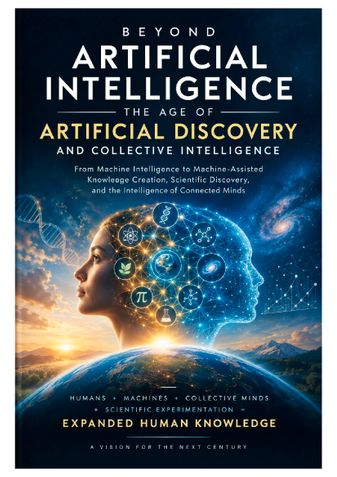
Beyond Artificial Intelligence (eBook)

The Age of Artificial Discovery and Collective Intelligence
Type: e-book
Genre: Computers & Internet, Computer Programming
Language: English
Price: ₹175
(Immediate Access on Full Payment)
Available Formats: PDF

Description

From Machine Intelligence to Machine-Assisted Knowledge Creation,
Scientific Discovery, and the Intelligence of Connected Minds
Artificial intelligence has traditionally been discussed as a question of machine capability: Can
machines recognize patterns? Can they understand language? Can they solve problems? Can they
learn from data? Can they generate images, text, mathematics, software, designs, and predictions?
But these questions may represent only the beginning of a much larger transformation.
What happens when machines move beyond performing intelligent tasks and begin participating in
the process of discovering new knowledge?
This book explores that possibility.
Beyond Artificial Intelligence: The Age of Artificial Discovery and Collective Intelligence examines a
potential transition from artificial intelligence to artificial discovery—from machines that primarily
process, predict, generate, and optimize toward systems that may increasingly participate in asking
questions, generating hypotheses, designing experiments, interpreting evidence, identifying
unexplained relationships, and contributing to the expansion of scientific knowledge.
The distinction is profound.
Artificial intelligence asks:
Can a machine perform a task that requires intelligence?
Artificial discovery asks:
Can a machine participate in the process through which the unknown becomes known?
A machine capable of answering a question is useful.
A machine capable of identifying an important question that humans have not yet considered could
be transformative.
A system that predicts an outcome may be powerful.
A system that discovers an unexpected relationship, proposes a testable explanation, designs an
experiment, evaluates the results, rejects an unsuccessful hypothesis, and develops a new model
could become part of a fundamentally different scientific ecosystem.
This book explores what such a future could mean.

About the Author

Rupesh Ranjan is a writer, researcher, poet, and interdisciplinary thinker whose work explores the
intersections of science, technology, philosophy, society, human consciousness, and the future of
civilization.
An academically diverse author, Rupesh Ranjan holds an MBA from MNNIT Allahabad and a
B.Tech. in Civil Engineering. His intellectual interests extend far beyond the boundaries of a single
academic discipline. His writings frequently explore questions concerning artificial intelligence,
quantum physics, information, human cognition, scientific discovery, philosophy, social
transformation, education, governance, history, spirituality, and the relationship between technology
and human life.
He is the author of more than 38 books covering different fields and has written research papers and
developed patented ideas, reflecting his continuing interest in research, innovation, and knowledge
creation. His literary work also includes thousands of poems, through which he explores love,
nature, human emotions, existence, society, and the inner dimensions of human experience.
Ranjan's approach to writing is fundamentally interdisciplinary. He believes that some of the most
important questions of the modern world cannot be adequately understood through isolated
disciplines. Artificial intelligence, for example, is not merely a technological subject. It raises
questions about philosophy, cognition, mathematics, neuroscience, economics, education, ethics,
creativity, scientific methodology, and the future organization of society.
This perspective is central to Beyond Artificial Intelligence: The Age of Artificial Discovery and
Collective Intelligence.
In this book, Ranjan examines a possibility that extends beyond the conventional discussion of
artificial intelligence: the emergence of systems that may participate in the generation of new
knowledge. His interest lies not simply in whether machines can imitate human intellectual abilities,
but in whether human beings and intelligent machines can together create new forms of scientific
inquiry and collective knowledge.
His writing often begins with apparently simple questions and follows them toward deeper
philosophical and scientific possibilities:
What is information?
What is intelligence?
What does it mean to understand something?
How does discovery happen?
Can a machine participate in discovery?
Could intelligence become collective rather than individual?
And what happens when the systems helping humanity discover new knowledge become more
capable than any individual human mind?
Ranjan does not approach these questions by assuming that technological possibilities are
automatically realities. His work seeks to distinguish between what is scientifically established, what
is technologically emerging, what remains speculative, and what belongs to philosophy. This distinction is particularly important in discussions of artificial intelligence. Rather than
assuming that contemporary AI possesses consciousness or human-like understanding, he examines
the observable capabilities of intelligent systems while considering the larger possibilities that may
emerge from their integration with scientific instruments, databases, robotic laboratories,
computational models, and human researchers.
His broader intellectual philosophy is centered on curiosity, interdisciplinary inquiry, and the
continuous expansion of human knowledge.
For Ranjan, writing is not merely a means of presenting conclusions. It is a method of investigation.
A book can become a laboratory of ideas in which established assumptions are examined, alternative
possibilities are considered, and unanswered questions are allowed to remain open.
His work therefore seeks to encourage readers not merely to acquire information but to think beyond
existing boundaries.
In an era in which humanity is producing information at unprecedented speed, Ranjan is particularly
interested in the transformation of information into knowledge, knowledge into understanding, and
understanding into wisdom. He sees the future of technology not only in increasingly powerful
machines, but also in the possibility of creating better relationships between human intelligence,
artificial intelligence, scientific inquiry, and collective intelligence.
Beyond Artificial Intelligence represents this continuing intellectual journey.
It asks readers to look beyond the familiar question of whether machines can become intelligent and
consider a larger possibility:
What if the most important achievement of artificial intelligence is not creating machines that think
like humans, but creating new systems through which humanity can discover what no individual
human could discover alone?
Through his books and research-oriented writings, Rupesh Ranjan continues to explore the boundary
between what humanity knows, what it thinks it knows, and what remains waiting to be discovered.

Book Details

Number of Pages: 1164
Availability: Available for Download (e-book)

Ratings & Reviews

Beyond Artificial Intelligence

Beyond Artificial Intelligence

(Not Available)

Review This Book

Write your thoughts about this book.

Currently there are no reviews available for this book.

Be the first one to write a review for the book Beyond Artificial Intelligence.

Other Books in Computers & Internet, Computer Programming
Shop with confidence

Safe and secured checkout, payments powered by Razorpay. Pay with Credit/Debit Cards, Net Banking, Wallets, UPI or via bank account transfer and Cheque/DD. Payment Option FAQs.