You can access the distribution details by navigating to My pre-printed books > Distribution
Add a Review
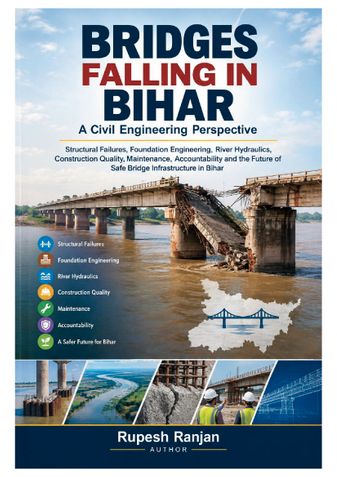
BRIDGES FALLING IN BIHAR (eBook)
Structural Failures, Foundation Engineering, River Hydraulics, Construction Quality, Maintenance, Accountability and the Future of Safe Bridge Infrastructure in Bihar
Type:
e-book
Genre: Engineering, Exam Preparation
Language: English
Price:
₹116
(Immediate Access on Full Payment)
Description
Bridges are essential components of modern infrastructure. They connect villages with cities, link
agricultural regions with markets, facilitate access to education and healthcare, and support trade,
transportation, and economic development. In a state like Bihar, where rivers, floodplains, seasonal
flooding, and shifting river channels shape the landscape, bridges are particularly important. Their
safety and reliability are therefore not merely engineering concerns; they are fundamental to public
welfare and regional development.
Bridges Falling in Bihar: A Civil Engineering Perspective is a technical exploration of the engineering
principles, environmental conditions, construction practices, maintenance systems, and institutional
responsibilities associated with bridge safety. The book examines why bridges may deteriorate,
become unsafe, or fail, and how scientific investigation, sound engineering, effective supervision,
and long-term maintenance can reduce these risks.
The book approaches bridge failure as a complex phenomenon rather than attributing every incident
to a single cause. A bridge may be affected by inadequate foundation investigation, excessive scour,
unexpected river behaviour, structural design deficiencies, poor-quality construction materials,
errors during construction, insufficient inspection, deterioration, or ineffective maintenance. In
many cases, several factors interact, making a systematic and evidence-based investigation essential.
Beginning with the broader bridge infrastructure challenge, the book introduces readers to the
principal components of bridges and the mechanisms through which loads are transferred from the
deck to the foundations and surrounding ground. It then explores Bihar's river systems, floodplains,
and geomorphology, followed by detailed discussions of geotechnical engineering, foundation
performance, river hydraulics, flood discharge, and scour.
Subsequent chapters examine structural design and safety margins, concrete and steel performance,
construction-stage risks, quality assurance, contractor responsibilities, project management, and
engineering accountability. The discussion extends to ageing bridges, deterioration mechanisms,
inspection techniques, structural audits, health monitoring, and forensic engineering methods used
to investigate failures.
A dedicated chapter considers lessons from bridge failures and reported incidents in Bihar,
emphasising the importance of distinguishing verified facts from preliminary observations, technical
hypotheses, and unconfirmed allegations. The book also discusses advanced modelling, failure
prediction, climate resilience, extreme floods, river training, rehabilitation, retrofitting, emergency
response, and the role of Indian engineering codes and institutional reforms.
The central argument of this work is that bridge safety must be managed throughout the entire life
cycle of a structure. Safety begins with site selection and investigation, continues through design, procurement, construction, and commissioning, and must remain a priority during operation,
inspection, repair, and eventual rehabilitation or replacement. No single inspection, design
calculation, or administrative order can substitute for a comprehensive safety system.
The book also highlights the importance of professional ethics and public accountability.
About the Author
Book Details
Number of Pages: 446
Availability:
Available for Download (e-book)
Ratings & Reviews
BRIDGES FALLING IN BIHAR
Review This Book
Write your thoughts about this book.

Currently there are no reviews available for this book.
Be the first one to write a review for the book BRIDGES FALLING IN BIHAR.
Other Books in Engineering, Exam Preparation

Manoj Dole

Ashwini Dole

YCT EXPERT, TEAM

Mr. RajKumar K.K., Ms. Saranya N., Dr. Suma ...