You can access the distribution details by navigating to My pre-printed books > Distribution
Add a Review
Type:
e-book
Genre: Mathematics, Science & Technology
Language: English
Price:
₹189
(Immediate Access on Full Payment)
Description
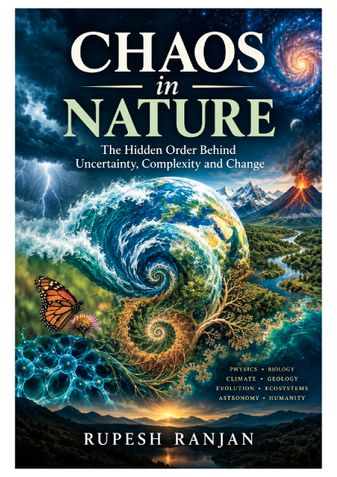
Chaos in Nature: The Hidden Order Behind Uncertainty, Complexity and Change is an interdisciplinary exploration of one of the most fascinating characteristics of the natural world: its capacity to generate complexity, unpredictability, patterns, adaptation, and transformation from relatively simple underlying principles.
The word chaos is commonly associated with disorder, confusion, and randomness. Nature, however, presents a much more profound picture. A storm may be difficult to predict while still obeying physical laws. A river may follow an apparently irregular path while creating recognizable patterns across a landscape. Ecosystems may fluctuate continuously while maintaining remarkable resilience. Evolution may contain randomness while producing extraordinary biological organization. Even the motion of celestial bodies can become extraordinarily complex through simple gravitational interactions.
This book examines these phenomena through the interconnected ideas of nonlinearity, feedback, sensitivity to initial conditions, emergence, self-organization, adaptation, instability, probability, interconnectedness, and continual change.
Beginning with the philosophical paradox of order emerging from apparent chaos, the book traces the development of the concept of chaos from ancient ideas to modern scientific thought. It then explores how nonlinear systems can amplify small differences, why the famous butterfly effect challenges long-term prediction, and why weather and climate provide some of the clearest examples of complex natural behavior.
The exploration then moves into the biological world. Evolution, mutation, adaptation, extinction, competition, cooperation, and ecological interactions reveal that life is not static. Forests, oceans, grasslands, rivers, deserts, and microbial communities exist within constantly changing networks in which disturbance and stability coexist.
The book also examines the mathematical geometry of nature. Fractals, branching patterns, coastlines, rivers, clouds, lightning, trees, blood vessels, and mountain systems demonstrate that irregularity does not necessarily mean the absence of structure. Nature can produce remarkable patterns through relatively simple processes repeated across different scales.
From there, the journey extends to Earth's geological systems, the oceans, and the cosmos. Earthquakes, volcanoes, erosion, floods, wildfires, tectonic processes, ocean currents, waves, storms, planetary motion, stellar systems, and galactic interactions demonstrate different forms of instability and transformation. At every scale, nature reveals an extraordinary combination of lawfulness and unpredictability.
The book also places human beings within this larger system. Humanity is not an observer standing outside nature. Agriculture, cities, technology, population growth, resource consumption, environmental degradation, pandemics, and climate change introduce new variables into already complex natural systems. Understanding nature's complexity therefore becomes essential not only for science but also for responsible human decision-making.
A central question of the book is: If nature follows laws, why can its behavior still be so difficult to predict?
The answer lies partly in the difference between knowing the rules and being able to predict every consequence of those rules. In complex systems, countless interactions can produce outcomes that are highly sensitive to initial conditions. Limited information, feedback, nonlinear relationships, enormous numbers of interacting components, and computational constraints can make precise long-term prediction practically impossible.
Yet uncertainty should not be mistaken for ignorance.
One of the principal arguments of Chaos in Nature is that unpredictability does not necessarily imply lawlessness. A system can be deterministic and still behave in ways that are extraordinarily difficult to forecast. Similarly, randomness at one level can coexist with structure and organization at another.
The book therefore challenges the simplistic opposition between order and chaos. Nature is neither a perfectly predictable machine nor an entirely random phenomenon. It is a dynamic reality in which order and disorder, stability and instability, randomness and structure, destruction and creation continually interact.
Ultimately, Chaos in Nature invites readers to develop a more sophisticated relationship with uncertainty. It encourages us to recognize that nature does not promise permanence, perfect predictability, or simplicity. Instead, it offers something more remarkable: a constantly evolving universe in which complexity can arise from simplicity, patterns can emerge from apparent disorder, and transformation can become the foundation of new forms of order.
This is a book about storms and stars, rivers and ecosystems, evolution and extinction, oceans and mountains, mathematics and life—but above all, it is a book about how nature creates, changes, adapts, and surprises us.
Chaos is not merely the absence of order. In many of nature's most fascinating systems, chaos is part of the process through which new patterns, structures, and possibilities emerge.
About the Author
Book Details
Number of Pages: 278
Availability:
Available for Download (e-book)
Ratings & Reviews
Chaos in Nature
Review This Book
Write your thoughts about this book.

Currently there are no reviews available for this book.
Be the first one to write a review for the book Chaos in Nature.
Other Books in Mathematics, Science & Technology

Sai Dheeraj Gummadi

Ashwani Tewari

Rishikesh Jaiswal

Govind Narayan