You can access the distribution details by navigating to My pre-printed books > Distribution
Add a Review
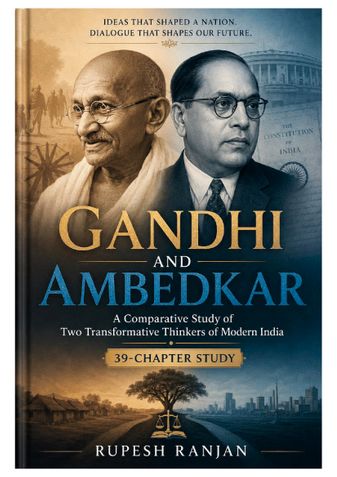
GANDHI AND AMBEDKAR (eBook)
A Comparative Study of Two Transformative Thinkers of Modern India
Type:
e-book
Genre: History
Language: English
Price:
₹161
(Immediate Access on Full Payment)
Description
Gandhi and Ambedkar: A Comparative Study of Two Transformative Thinkers of Modern India presents a comprehensive and balanced exploration of two of the most influential intellectual and political figures in modern Indian history—Mahatma Gandhi and Dr. B. R. Ambedkar.
Although Gandhi and Ambedkar shared a deep concern for human dignity, social injustice, and the transformation of Indian society, they approached these questions from markedly different intellectual, social, political, and philosophical perspectives. Their disagreements over caste, untouchability, political representation, separate electorates, religion, village society, economic development, and the methods of social change remain among the most important debates in the intellectual history of modern India.
This book examines those disagreements without reducing either thinker to a political stereotype. It explores Gandhi's ideas of Ahimsa, Satyagraha, Swaraj, trusteeship, village self-reliance, moral reform, religious pluralism, and constructive work, alongside Ambedkar's powerful arguments concerning liberty, equality, fraternity, constitutional democracy, education, political representation, economic rights, social justice, and the annihilation of caste.
Particular attention is given to the historical relationship between the two thinkers, including the Round Table Conferences, the Communal Award, the Poona Pact, debates over caste and representation, and their differing visions of India's future. The book also examines their views on women, labour, education, minorities, religion, industrialization, agriculture, democracy, and the relationship between political freedom and social freedom.
Rather than asking simply who was right or wrong, the book encourages readers to understand why Gandhi and Ambedkar thought differently, what historical experiences shaped their ideas, where their visions conflicted, and where they unexpectedly converged. It recognizes both their extraordinary contributions and the limitations and tensions within their respective philosophies.
The book ultimately presents Gandhi and Ambedkar not merely as opposing figures, but as participants in a continuing intellectual dialogue about the meaning of freedom, equality, justice, community, democracy, morality, and human dignity.
For contemporary India, their ideas remain deeply relevant. Questions of caste discrimination, social inequality, constitutional rights, religious harmony, economic development, education, gender justice, citizenship, and democratic participation continue to shape public life.
Gandhi and Ambedkar therefore seeks to provide students, researchers, teachers, civil-service aspirants, political thinkers, and general readers with a thoughtful framework for understanding two transformative visions of India—and the unfinished social project that connects them.
At its heart, this is a book about a fundamental question: How can political freedom become meaningful when social inequality and human indignity remain?
It is also an invitation to continue the dialogue between Gandhi's moral vision and Ambedkar's constitutional vision, and to reflect on what each can teach a changing India.
About the Author
Book Details
Number of Pages: 631
Availability:
Available for Download (e-book)
Ratings & Reviews
GANDHI AND AMBEDKAR
Review This Book
Write your thoughts about this book.

Currently there are no reviews available for this book.
Be the first one to write a review for the book GANDHI AND AMBEDKAR.
Other Books in History

अशोक कुमार जाखड़ ‘निस्वार्थी’

దిగవల్లి వేంకట శివరావు

SANDEEP RAGHUNATH PATASKAR

Tanmoy Chatterjee