You can access the distribution details by navigating to My pre-printed books > Distribution
Add a Review
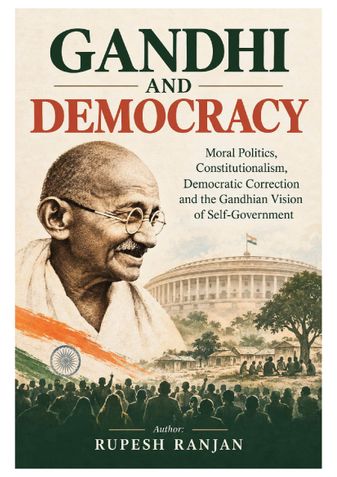
GANDHI AND DEMOCRACY (eBook)
Moral Politics, Constitutionalism, Democratic Correction and the Gandhian Vision of Self-Government
Type:
e-book
Genre: Philosophy, History
Language: English
Price:
₹249
(Immediate Access on Full Payment)
Description
Gandhi and Democracy examines one of the most important and continuing questions in modern
political life: How can democracy correct itself without destroying the institutions that make
democratic life possible?
Mahatma Gandhi is generally remembered as the leader of India's freedom struggle, the foremost
advocate of non-violence and the practitioner of Satyagraha. Yet his political philosophy also contains
a profound and distinctive understanding of self-government, political responsibility, dissent,
leadership, institutional reform, public morality and the relationship between the individual and the
state.
For Gandhi, Swaraj was much more than the replacement of British rule by Indian rule. True self-
government required individuals and communities to acquire the capacity for self-discipline,
responsibility and ethical action. A nation could become politically independent without becoming
genuinely free if its people remained governed by fear, hatred, greed, social divisions or blind
obedience to authority.
This book explores that deeper meaning of Gandhian democracy.
At the heart of the work is the proposition that democracy should be capable of correction. Gandhi's
political methods were often directed toward exposing injustice and transforming institutions rather
than simply eliminating institutions or replacing one set of rulers with another. Satyagraha, civil
disobedience, constructive work, persuasion, dialogue, non-violence and moral pressure were
different instruments through which he attempted to challenge injustice while keeping open the
possibility of reconciliation and reconstruction.
The book also examines Gandhi's own political practice, including the complicated relationship
between democratic procedure and moral authority.
The history of the Indian National Congress provides particularly important examples. Gandhi's
influence over Congress politics raises difficult questions about the relationship between majority
decisions and the intervention of a highly influential moral leader. The episode surrounding the
Congress leadership in 1946, involving Sardar Vallabhbhai Patel and Jawaharlal Nehru, is examined
as a case study in leadership, political judgment, consensus and democratic legitimacy. Similarly, the
confrontation between Gandhi and Subhas Chandra Bose during the Congress presidential crisis of
1939 illustrates the tensions that can arise when electoral victory, organisational authority,
ideological differences and moral influence intersect.
These episodes are not treated merely as stories of political rivalry. They are used to ask larger
questions:
Is majority rule sufficient for democracy?
Can moral authority legitimately influence democratic decisions? When can conscience challenge the majority?
Where does persuasion end and political pressure begin?
How should a democratic movement reconcile disagreement with collective action?
The book deliberately approaches these questions without turning Gandhi into either an
unquestionable hero or a simple political critic. His achievements, contradictions, experiments and
limitations are considered together. Gandhi's democratic thought contains powerful insights, but it
also presents tensions that deserve serious examination in the context of modern constitutional
democracy.
The work further explores Gandhi's belief that democratic transformation begins with the individual.
Citizens frequently demand accountability from governments, political parties and institutions, but
Gandhi asked a more uncomfortable question: are citizens themselves prepared to accept
responsibility? Can individuals practise honesty, restraint and non-violence in their own lives? Can
political opponents disagree without hatred? Can citizens defend democratic freedoms even when
those freedoms benefit people with whom they disagree?
This emphasis on self-correction gives Gandhian democracy a distinctive character.
The book also examines the institutional dimension of Gandhi's thought. His vision of Village Swaraj,
decentralisation, Gram Sabha, local participation and Panchayati Raj is studied in relation to the
continuing search for deeper democratic participation in India. Gandhi believed that democracy
should not remain concentrated in distant centres of power. Political participation should reach the
ordinary citizen and communities should have meaningful opportunities to influence decisions
affecting their lives.
Another important theme is Antyodaya—the concern for the last person. Gandhi's democratic test
was ultimately human rather than merely institutional. A democracy may possess elections,
legislatures and formal rights, but its moral quality must also be judged by how it treats the weakest,
poorest and least powerful members of society.
The book therefore connects democracy with economic equality, social justice and human dignity.
Gandhi's ideas of trusteeship and economic responsibility are examined not as simple economic
formulas but as attempts to address the concentration of economic power and its potential influence
on political freedom.
In the contemporary context, the book considers the relevance of Gandhian methods to peaceful
protest, civil resistance, institutional reform, political polarisation, public accountability, democratic
dissent and social reconciliation. It asks whether the Gandhian preference for correction rather than
destruction can provide a useful framework for strengthening democratic institutions in an age of
intense political conflict.
The argument is not that modern India can simply reproduce Gandhi's political methods. The
constitutional state of today is fundamentally different from the colonial political environment in
which Gandhi operated. Modern democracy has developed sophisticated institutions, fundamental
rights, electoral mechanisms, courts, administrative systems and representative structures that
require their own principles and safeguards.
Yet Gandhi's questions remain relevant.
How should power be restrained?
How should dissent be protected? How should majorities treat minorities?
How can citizens hold institutions accountable without undermining institutional legitimacy?
How can political opposition remain firm without becoming hateful?
How can democratic reform occur without democratic destruction?
And perhaps the most fundamental question:
Can a society reform its democracy without first examining itself?
Gandhi and Democracy seeks to explore these questions through a broad examination of Gandhian
political thought and practice. It presents Gandhi not simply as a figure from India's freedom
struggle, but as a continuing subject of democratic inquiry.
The book's central message is ultimately simple but demanding:
A democracy becomes stronger not merely when rulers change, but when citizens, institutions and
political practices learn to correct themselves.
Gandhi's democratic legacy lies in this unfinished experiment—the attempt to connect freedom with
responsibility, dissent with non-violence, political struggle with moral discipline, leadership with
service, institutions with accountability, and self-government with self-correction.
In that sense, Gandhi's question is still India's question—and perhaps the question of every
democracy:
How do we govern ourselves without becoming the kind of power we once opposed?
About the Author
Book Details
Number of Pages: 909
Availability:
Available for Download (e-book)
Ratings & Reviews
GANDHI AND DEMOCRACY
Review This Book
Write your thoughts about this book.

Currently there are no reviews available for this book.
Be the first one to write a review for the book GANDHI AND DEMOCRACY.
Other Books in Philosophy, History

Ritesh Sharma

Naresh Das Vaishnav Nimbark

ଭବାନୀ ଶଙ୍କର ଆଚାର୍ଯ୍ୟ

Dr. Shiban K.Kachru