You can access the distribution details by navigating to My pre-printed books > Distribution
Add a Review
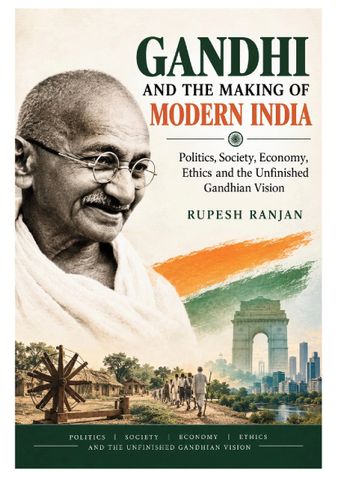
GANDHI AND THE MAKING OF MODERN INDIA (eBook)
Politics, Society, Economy, Ethics and the Unfinished Gandhian Vision
Type:
e-book
Genre: Politics & Society, History
Language: English
Price:
₹201
(Immediate Access on Full Payment)
Description
Politics, Society, Economy, Ethics and the Unfinished Gandhian Vision
Mahatma Gandhi is one of the most influential and debated figures in the history of modern India.
His name is inseparably associated with India's freedom struggle, but his intellectual and historical
significance extends far beyond the achievement of political independence. Gandhi attempted to
reshape the meaning of politics itself. He connected freedom with responsibility, politics with ethics,
economic activity with social justice, and national independence with individual and community self-
rule.
Gandhi and the Making of Modern India is a comprehensive analytical study of Gandhi's ideas,
political methods, social interventions and continuing influence on India's intellectual and national
development.
Rather than presenting Gandhi simply as a heroic freedom fighter or a symbolic figure of non-
violence, this book examines him as a complex historical personality whose ideas contained both
remarkable insights and important contradictions. It asks how Gandhi contributed to the
transformation of Indian political consciousness, how he brought millions of ordinary people into the
freedom movement, and how his vision of independent India compared with the path that the
country eventually followed.
At the heart of the book is the concept of Swaraj.
For Gandhi, Swaraj was not merely the replacement of British rulers by Indian rulers. It represented
a deeper form of freedom involving self-discipline, moral responsibility, social cooperation,
economic self-reliance and the ability of communities and individuals to participate meaningfully in
their own governance. This broader understanding of freedom provides an important framework for
examining both Gandhi's political philosophy and the subsequent development of India.
The book begins with Gandhi's conception of India and his understanding of nationalism,
civilization, truth and non-violence. It then examines his transformation from an activist in South
Africa into one of the central leaders of India's independence movement. The major experiments of
Champaran, Kheda and Ahmedabad, followed by Non-Cooperation, Civil Disobedience, the Salt
March and Quit India, are considered not simply as historical events but as experiments in mass
politics and political resistance.
A major theme of the book is Gandhi's relationship with Indian society.
His engagement with caste, untouchability, women, religious communities, villages, peasants,
workers and marginalized groups reveals an attempt to connect political freedom with social
transformation. Yet these efforts were accompanied by serious disagreements and criticisms.
Gandhi's relationship with Dr. B. R. Ambedkar, in particular, reveals two powerful but substantially
different approaches to caste, representation and social justice. Their disagreements remain relevant
to contemporary debates about equality and dignity.
The book therefore does not avoid difficult questions.
Was Gandhi's approach to caste sufficient? How should his views on women be understood in the context of both his era and the present?
Could his ideal of village-centered development coexist with large-scale industrialization?
Were his methods of non-violent resistance always politically practical?
Could trusteeship provide a realistic alternative to more structural approaches to economic
inequality?
These questions are explored as part of a broader effort to understand Gandhi historically rather than
mythologically.
The economic dimension of Gandhi's thought receives particular attention. Gandhi questioned
uncontrolled industrialization, excessive consumption and the concentration of wealth. Through
concepts such as Swadeshi, Khadi, trusteeship and dignity of labour, he attempted to imagine an
economy in which production served human needs rather than human beings becoming servants of
production and consumption.
The book does not argue that modern India should simply return to Gandhi's economic model.
Instead, it asks whether some of the principles underlying his critique can contribute to
contemporary discussions about inequality, unemployment, sustainable development, ethical
consumption and environmental responsibility.
This question becomes increasingly important in an age of rapid technological change.
Artificial intelligence, automation, digital platforms and advanced manufacturing are transforming
the meaning of work. Economic growth has lifted millions from poverty while creating new forms of
inequality and insecurity. Consumer culture has expanded dramatically. Climate change has forced
societies to reconsider the environmental consequences of unlimited production and consumption.
In this context, Gandhi's warnings about human needs, materialism, technological power and
ecological limits acquire renewed significance.
The book also examines Gandhi's ideas about democracy and the state. Gandhi was deeply
suspicious of excessive centralized power and emphasized local participation, community
responsibility and Gram Swaraj. His vision raises important questions about the relationship between
citizens and institutions, centralization and decentralization, political authority and moral
responsibility.
The contrast between Gandhi's vision and the modern Indian state is particularly significant.
Independent India adopted a strong constitutional and democratic state, pursued planned economic
development and invested heavily in science, technology, infrastructure and industrialization. This
trajectory differed in important respects from Gandhi's preferred model.
The intellectual disagreements between Gandhi and other major leaders therefore become essential
to understanding modern India.
The book examines Gandhi's relationships and differences with Jawaharlal Nehru, Vallabhbhai Patel,
Subhas Chandra Bose and B. R. Ambedkar, among others. These debates demonstrate that India's
future was never determined by a single vision. Modern India emerged through competing ideas
about nationalism, democracy, social justice, economic development, industrialization and political
power.
The book subsequently moves beyond Gandhi's lifetime to examine the unfinished Gandhian vision.
What happened to Gandhian ideas after independence?
Which of them entered India's political and institutional life? Which were marginalized?
Which survived through social movements and grassroots organizations?
And which became increasingly difficult to reconcile with the realities of a modernizing economy?
These questions are followed into contemporary debates concerning education, technology,
environmental sustainability, human rights, peace, economic inequality and democratic culture.
Gandhi's educational philosophy, particularly Nai Talim, is examined in relation to contemporary
discussions about vocational education, skill development, experiential learning and holistic
education. His views on technology are reconsidered in the context of artificial intelligence and
automation. His economic philosophy is examined alongside modern debates about sustainable
development and responsible consumption. His commitment to communal harmony and non-
violence is considered in an era of political polarization and social conflict.
Yet the book also emphasizes an essential principle:
Gandhi should not be treated as beyond criticism.
Historical figures must be understood within their contexts, but contextual understanding should not
prevent critical examination. Gandhi's ideas concerning caste, gender, race, sexuality,
industrialization, political strategy and social organization have generated substantial debate. A
meaningful engagement with Gandhi therefore requires both appreciation and criticism.
The Gandhi presented in this book is neither a flawless saint nor an irrelevant figure of the past.
He is a historical thinker whose ideas remain alive because they continue to provoke questions.
The deeper purpose of this work is consequently not to determine whether Gandhi was completely
right or completely wrong. It is to understand why his ideas became so influential, why they
generated such intense disagreement, what they contributed to the making of modern India, and
what aspects of his intellectual legacy may still be useful in confronting the challenges of the twenty-
first century.
Modern India is itself an unfinished project.
The country continues to negotiate the relationship between tradition and modernity, economic
growth and equality, individual freedom and collective responsibility, technology and human
welfare, national unity and diversity, central authority and local participation.
These were, in different forms, also questions that Gandhi confronted.
His answers may not always be adequate for the present.
But his questions remain powerful.
Gandhi and the Making of Modern India is therefore an invitation to revisit those questions—not
merely to remember Gandhi, but to think more deeply about India.
It is a book about a man who helped change the course of Indian history.
More importantly, it is a book about the ideas, struggles, contradictions and unfinished possibilities
that emerged from his attempt to imagine a free India.
About the Author
Book Details
Number of Pages: 806
Availability:
Available for Download (e-book)
Ratings & Reviews
GANDHI AND THE MAKING OF MODERN INDIA
Review This Book
Write your thoughts about this book.

Currently there are no reviews available for this book.
Be the first one to write a review for the book GANDHI AND THE MAKING OF MODERN INDIA.
Other Books in Politics & Society, History
Mayank Chaudhary
A J Khan
Sidharth Dashora
केवलम् माधव पाणीकर Kevalam Màdhava Pàṇīkara