You can access the distribution details by navigating to My pre-printed books > Distribution
Add a Review
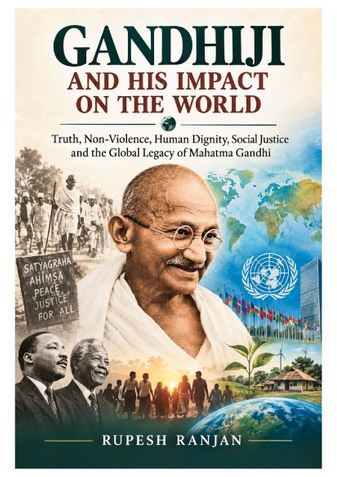
GANDHIJI AND HIS IMPACT ON THE WORLD (eBook)
Truth, Non-Violence, Human Dignity, Social Justice and the Global Legacy of Mahatma Gandhi
Type:
e-book
Genre: Philosophy, History
Language: English
Price:
₹211
(Immediate Access on Full Payment)
Description
GANDHIJI AND HIS IMPACT ON THE WORLD
Truth, Non-Violence, Human Dignity, Social Justice and the Global
Legacy of Mahatma Gandhi
Mahatma Gandhi was one of the most influential and controversial figures of the twentieth century.
His life was inseparably connected with India's struggle against colonial rule, yet the significance of
his ideas extended far beyond the boundaries of India. His experiments with truth, non-violence,
civil resistance, social reform, economic ethics and human dignity created a distinctive political and
moral vocabulary that continues to influence debates about justice, peace and human freedom.
Gandhiji and His Impact on the World is a comprehensive exploration of Gandhi's intellectual
journey, political action, social philosophy and enduring international legacy. The book moves
beyond the conventional image of Gandhi as merely the "Father of the Nation" or the leader of India's
freedom movement. It examines him as a political thinker, moral philosopher, social reformer,
strategist of mass mobilisation and global symbol of non-violent resistance.
Beginning with Gandhi's formative years and his transformative experiences in South Africa, the
book traces the emergence of Satyagraha and Ahimsa as powerful instruments of resistance. It
explores how Gandhi attempted to transform political struggle from a contest of physical force into a
disciplined confrontation between injustice and conscience.
The narrative then enters the decisive period of India's freedom struggle. The movements associated
with Champaran, Kheda, Ahmedabad, Non-Cooperation, Civil Disobedience and the Salt March are
examined not merely as historical episodes but as experiments in mass politics. Particular attention is
given to Gandhi's ability to connect national politics with the everyday experiences of peasants,
workers, women and ordinary citizens.
Yet political freedom was never Gandhi's only objective.
He believed that independence would remain incomplete without social transformation. The book
therefore examines his campaigns against untouchability, his ideas concerning caste, his engagement
with women's participation, his concern for poverty and human dignity, and his efforts to promote
village industries, Swadeshi, constructive work and local self-reliance.
At the philosophical level, the book explores the ideas that formed the foundation of Gandhian
thought: Truth, Ahimsa, Satyagraha, self-discipline, civil disobedience, moral responsibility, religious
tolerance and the relationship between means and ends. Gandhi's insistence that ethical methods
matter as much as political objectives remains one of the most challenging aspects of his philosophy.
The book then moves beyond India to examine Gandhi's international impact.
It considers the relationship between Gandhian ideas and the civil rights movement associated with
Martin Luther King Jr., the complicated South African legacy connecting Gandhi with the struggle
against apartheid, African freedom movements, global civil-rights campaigns, democratic resistance,
peace activism and international institutions.
But influence is not treated as simple imitation. Movements across the world adapted Gandhi according to their own historical circumstances. Some
adopted non-violent resistance while rejecting aspects of his spiritual or economic philosophy. Others
transformed his methods into new forms of civil resistance. Understanding this process of adaptation
is essential to understanding Gandhi's genuine global impact.
The book also brings Gandhi into conversation with the problems of the modern world.
What might Gandhi's philosophy contribute to contemporary democracy? Can his ideas about human
dignity illuminate present debates about human rights and social justice? Does his critique of
excessive consumption have relevance to climate change and ecological crisis? Can his ideas of
restraint and responsible consumption contribute to sustainable development? What might truth and
non-violence mean in an age of social media, misinformation, algorithms and artificial intelligence?
These questions do not have easy answers.
The book therefore deliberately avoids presenting Gandhi as an infallible thinker. His contradictions,
limitations and controversial positions receive serious attention. His disagreements with Dr. B. R.
Ambedkar, revolutionary nationalists and other contemporaries are examined as part of the larger
intellectual history surrounding him. His views on caste, gender, industrialisation, economics and
political strategy are considered critically rather than protected from examination because of his
iconic status.
This critical approach is central to the book.
Gandhi's greatness does not require the denial of his imperfections. Likewise, identifying his
limitations does not erase his historical achievements. A mature understanding of Gandhi requires
the ability to hold both realities together.
The central proposition of this work is that Gandhi should be understood as an unfinished intellectual
experiment.
His life was an attempt to discover whether truth could become a political force, whether non-
violence could confront organised power, whether ordinary people could participate in
transformative politics, whether social reform could accompany political liberation, and whether
economic life could be guided by ethical responsibility rather than material accumulation alone.
Some of these experiments produced extraordinary results. Others generated contradictions or
remained incomplete.
That incompleteness makes Gandhi relevant.
The world of the twenty-first century is fundamentally different from the world in which Gandhi
lived. Yet humanity continues to face problems that are disturbingly familiar: war, political violence,
inequality, discrimination, religious conflict, authoritarianism, economic exploitation, social hatred
and the struggle for human dignity.
At the same time, new challenges have emerged—climate change, digital misinformation, artificial
intelligence, technological unemployment, algorithmic manipulation, global consumerism and
unprecedented forms of social polarisation.
Gandhi cannot provide ready-made solutions to these problems.
But he can provide questions.
What are the ethical limits of power?
Can political objectives justify unethical methods? How much is enough for a human being?
What responsibility does wealth carry toward society?
Can disagreement exist without hatred?
Can resistance remain powerful without becoming destructive?
Can political freedom survive without moral responsibility?
What does human progress mean if human dignity is sacrificed in the process?
These questions form the intellectual heart of this book.
Gandhiji and His Impact on the World is therefore not simply a biography, a political history or a
celebration of a national icon. It is an extended inquiry into the journey of an idea—from an
individual's experiments with truth to a global vocabulary of resistance, peace and human dignity.
The book invites readers to approach Gandhi neither with blind reverence nor automatic rejection,
but with curiosity, historical understanding and critical thought.
Its ultimate concern is larger than Gandhi himself.
It is about the continuing human search for a form of politics in which power does not completely
destroy morality, resistance does not require hatred, development does not require unlimited
consumption, and freedom remains connected with responsibility.
In that sense, Gandhi's story is not only a story about the twentieth century.
It is also a question addressed to the twenty-first.
What kind of world do human beings wish to create—and what kind of human beings must they
become to create it?
Rupesh Ranjan
About the Author
Book Details
Number of Pages: 794
Availability:
Available for Download (e-book)
Ratings & Reviews
GANDHIJI AND HIS IMPACT ON THE WORLD
Review This Book
Write your thoughts about this book.

Currently there are no reviews available for this book.
Be the first one to write a review for the book GANDHIJI AND HIS IMPACT ON THE WORLD.
Other Books in Philosophy, History
GAJENDRA THAKUR

கி.வா. ஜகந்நாதன்
Archana Verma

डॉ. सेठ गोविन्ददास, डॉ. ओमप्रकाश शर्मा