You can access the distribution details by navigating to My pre-printed books > Distribution
Add a Review
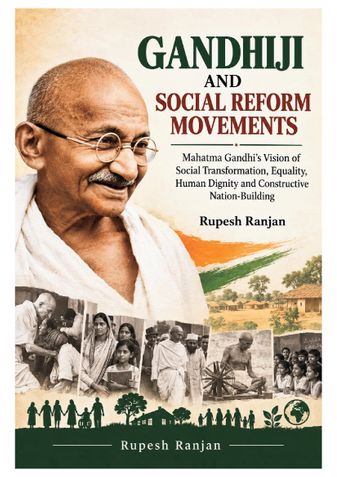
GANDHIJI AND SOCIAL REFORM MOVEMENTS (eBook)
Mahatma Gandhi’s Vision of Social Transformation, Equality, Human Dignity and Constructive Nation-Building
Type:
e-book
Genre: Philosophy, History
Language: English
Price:
₹179
(Immediate Access on Full Payment)
Description
GANDHIJI AND SOCIAL REFORM MOVEMENTS
Mahatma Gandhi’s Vision of Social Transformation, Equality, Human
Dignity and Constructive Nation-Building
Gandhiji and Social Reform Movements is a comprehensive exploration of Mahatma Gandhi’s role as a
social reformer, moral thinker and architect of constructive nation-building. While Gandhi is
popularly remembered as one of the central figures of India’s freedom struggle, this book looks
beyond the familiar political narrative to examine his sustained engagement with the deeper social
problems of Indian society.
For Gandhi, political independence could not by itself create a free and just society. Swaraj had to
include freedom from social discrimination, untouchability, communal hatred, poverty, ignorance,
exploitation and practices that denied human dignity. His vision of national reconstruction therefore
extended into the village, the family, the school, the workplace, the religious community and the
individual conscience.
The book examines Gandhi’s understanding of truth, non-violence, Swaraj, self-discipline, dignity of
labour, social responsibility and constructive action. It explores how these principles were
transformed from philosophical ideas into practical programmes of social intervention. Gandhi’s
experiments with community life, education, sanitation, Khadi, village industries, rural
reconstruction and voluntary service are examined as important components of his wider vision of
social transformation.
A major section of the book is devoted to Gandhi’s campaign against untouchability and caste-based
discrimination. It examines the historical context of these practices, Gandhi’s public campaigns, the
Harijan movement, temple-entry initiatives, educational work and efforts to change social attitudes.
At the same time, the book does not avoid the difficult debates surrounding Gandhi’s views on caste
and Varna.
The relationship between Gandhi and Dr. B. R. Ambedkar receives particular attention. Their
disagreements concerning caste, political representation, social justice and the Poona Pact provide an
important window into two influential approaches to the transformation of Indian society. Rather
than reducing their relationship to a simple opposition, the book examines the historical context,
areas of convergence, major disagreements and continuing significance of their debate.
The book also explores Gandhi’s contribution to women’s participation and empowerment. Gandhi
encouraged women to enter public life and participate in the national movement in unprecedented
numbers. His campaigns and constructive activities created new spaces for women's public
participation. At the same time, his ideas about gender, sexuality, family and women’s social roles
have attracted significant criticism and reinterpretation. The book therefore presents both the
progressive dimensions and limitations of his gender philosophy.
Another major theme is religious harmony and pluralism. Gandhi regarded religious diversity as a
fundamental feature of Indian society rather than a problem to be eliminated. His efforts toward
Hindu-Muslim unity, his participation in the Khilafat movement, his interfaith approach and his peace campaigns are examined alongside the difficult communal circumstances of the period. His
response to communal violence, including his peace missions and fasts, demonstrates the central
place that reconciliation occupied in his social philosophy.
Economic justice forms another important part of Gandhi’s reform programme. Through concepts
such as Swadeshi, Khadi, trusteeship, village industries and Village Swaraj, Gandhi proposed an
economic order that placed human needs and social responsibility above unlimited accumulation.
The book examines his critique of excessive materialism, his concern for rural employment and his
belief in decentralised economic activity. It also considers criticisms of his economic philosophy in
the context of modern industrialisation, technological development and globalisation.
Gandhi’s emphasis on dignity of labour, cleanliness and sanitation receives special attention. He
challenged the social stigma associated with manual work and personally participated in activities
that many members of society regarded as degrading. His insistence that sanitation was a shared civic
responsibility reflected his broader attempt to connect social equality with everyday behaviour.
Education was another foundation of Gandhi’s social vision. His concept of Nai Talim or Basic
Education sought to combine intellectual development, productive work, vocational skills, character
formation and community life. The book examines his educational philosophy and its relevance to
questions of rural education, self-reliance, practical learning and the education of disadvantaged
communities.
The book further explores Gandhi’s understanding of youth, citizenship and civil society. Gandhi
believed that social reconstruction could not depend exclusively upon governments and political
leaders. Citizens themselves had to become participants in the process of reform. Voluntary service,
ethical conduct, community organisation and constructive work were therefore essential to his vision
of nation-building.
The major movements associated with Gandhi are also revisited from a social rather than exclusively
political perspective. Champaran, Kheda and Ahmedabad demonstrate how local struggles could
become laboratories for community mobilisation and social intervention. The Non-Cooperation
Movement and Civil Disobedience Movement brought millions of ordinary Indians into public life
and altered the social character of the nationalist movement. Gandhi’s use of Satyagraha and fasting
is examined both as a method of moral politics and as a subject of continuing ethical and political
debate.
Importantly, this book adopts a critical and balanced approach. Gandhi is neither presented as an
infallible saint nor reduced to his limitations. His ideas developed over time, and his writings and
actions sometimes contained tensions and contradictions. The book therefore considers criticism
from Dalit and Ambedkarite thinkers, feminists, socialists, revolutionaries and other intellectual
traditions.
The final chapters turn toward Gandhi’s legacy and contemporary relevance. Questions concerning
caste discrimination, communal harmony, poverty, economic inequality, sanitation, rural
development, environmental sustainability, education, gender justice and ethical citizenship remain
important in contemporary society. Gandhi cannot simply be transplanted into the twenty-first
century, but his questions about human needs, social responsibility, violence, consumption,
inequality and the meaning of freedom continue to invite serious reflection.
A Book About Gandhi—and About Society
At its heart, this book is not only a study of Gandhi. It is also a study of the society Gandhi attempted to transform.
It asks fundamental questions:
Can political freedom exist without social equality?
Can a nation become strong while large sections of its people remain marginalised?
Can economic development be separated from human dignity?
Can religious diversity coexist with genuine national unity?
Can social change be achieved without hatred and violence?
What responsibilities do individuals have toward the poorest and most vulnerable?
What can Gandhi’s successes and failures teach contemporary society?
Through 32 chapters, the book connects Gandhi’s philosophy with the historical realities of colonial
India and with the continuing challenges of modern society.
Gandhiji and Social Reform Movements is intended for students, teachers, researchers, civil-service
aspirants, history and political science readers, social thinkers, and general readers interested in
Gandhi and modern India. Written in clear and descriptive English, the work seeks to make complex
historical and intellectual questions accessible without abandoning critical analysis.
Ultimately, the book presents Gandhi’s social reform legacy as an unfinished conversation. His
methods may be debated, his assumptions may be challenged, and some of his prescriptions may
require reinterpretation. Yet his insistence that freedom must be accompanied by responsibility, that
social progress must protect human dignity, and that the weakest members of society must remain
central to the idea of development continues to make his social thought worthy of examination.
This book is an invitation to move beyond the familiar image of Gandhi the political leader and
encounter Gandhi the social reformer, community organiser, moral philosopher and advocate of
constructive nation-building.
About the Author
Book Details
Number of Pages: 623
Availability:
Available for Download (e-book)
Ratings & Reviews
GANDHIJI AND SOCIAL REFORM MOVEMENTS
Review This Book
Write your thoughts about this book.

Currently there are no reviews available for this book.
Be the first one to write a review for the book GANDHIJI AND SOCIAL REFORM MOVEMENTS.
Other Books in Philosophy, History

A.J. Cronic


Páll Thormod Morrisson

Aijaz Ahmad