You can access the distribution details by navigating to My pre-printed books > Distribution
Add a Review
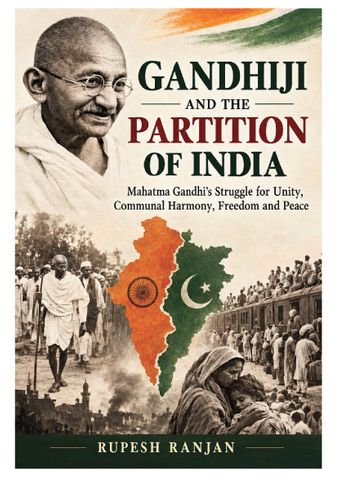
GANDHIJI AND THE PARTITION OF INDIA (eBook)
Mahatma Gandhi’s Struggle for Unity, Communal Harmony, Freedom and Peace
Type:
e-book
Genre: Politics & Society, Exam Preparation
Language: English
Price:
₹171
(Immediate Access on Full Payment)
Description
GANDHIJI AND THE PARTITION OF INDIA
Mahatma Gandhi’s Struggle for Unity, Communal Harmony, Freedom
and Peace
The Partition of India in 1947 was one of the most transformative and traumatic events of modern
South Asian history. It brought an end to British colonial rule and created two independent states, but
independence arrived alongside unprecedented communal violence, mass migration, displacement,
fear and human suffering. Millions of people were compelled to leave homes that their families had
inhabited for generations, while countless others experienced violence, separation and the
destruction of familiar social worlds.
At the centre of this extraordinary historical moment stood Mahatma Gandhi.
For decades, Gandhi had advocated an India in which people of different religions could live together
as equal members of a shared national community. His political philosophy was rooted in Swaraj,
truth, non-violence, moral responsibility and communal harmony. He regarded Hindu–Muslim unity
not simply as a political convenience but as an essential condition for India's freedom and moral
integrity.
Yet India was partitioned.
This book explores that profound historical paradox.
Why could Gandhi, one of the most influential leaders of India's freedom movement, not prevent the
division of the country?
The answer cannot be found in Gandhi alone. Partition emerged from a complex interaction of
political, constitutional, social and historical forces. The book therefore examines Gandhi's role
alongside the development of communal politics, the evolution of the Muslim League, the Pakistan
demand, British constitutional policies, Congress politics, negotiations between political leaders and
the rapidly changing circumstances of the 1940s.
The narrative begins with Gandhi's conception of India and his understanding of Swaraj. It examines
his philosophy of religion and politics, his commitment to Hindu–Muslim cooperation and his
attempts to construct an inclusive form of Indian nationalism.
It then follows the political journey toward Partition—from the Khilafat and Non-Cooperation
movements to separate electorates, the growth of communal political identities, the Lahore
Resolution, the Pakistan demand, the Cripps Mission and the final years of the independence
struggle.
Particular attention is given to the critical period of 1946–1948, when Gandhi's struggle increasingly
shifted from conventional political negotiations toward direct efforts to save lives and restore
communal harmony.
The book explores Gandhi's response to the violence of Calcutta, Noakhali and Bihar, his work
among ordinary people, and his determination to oppose revenge even when communities were
suffering from deep fear and anger. His presence in Bengal around the time of independence reveals the extraordinary difference between the formal political celebration of freedom and the devastating
reality experienced by many ordinary Indians.
The book also examines Gandhi's relationship with major political figures, especially Muhammad Ali
Jinnah, while placing their disagreements within the larger political environment of the period. It
considers the Cabinet Mission, the Mountbatten Plan, the Congress leadership and the difficult
decisions that ultimately resulted in Partition.
A central theme is the distinction between political power and moral authority.
Gandhi possessed extraordinary moral influence, but moral authority had limits when confronted by
competing political objectives, institutional structures, communal fears and the urgency of British
withdrawal. His inability to prevent Partition should therefore be studied neither as proof of complete
political failure nor as something that can simply be ignored because of his moral stature.
The book seeks a more balanced historical understanding.
It presents Gandhi as a remarkable but complex human being whose ideals were tested by
circumstances of extraordinary violence. His methods of fasting, dialogue, personal sacrifice, prayer
and non-violent intervention could sometimes produce remarkable results, but they could not
resolve every constitutional or political conflict.
The human consequences of Partition form another major focus of the book.
Behind political decisions were millions of individual lives. Refugees carried memories of villages,
houses, schools, marketplaces, neighbours and family histories across newly created borders. For
many, Partition transformed identity, geography and belonging within a matter of months. The book
therefore treats Partition not merely as a constitutional settlement but as a profound human
experience.
Gandhi's response to refugees and minorities becomes especially significant in this context. He
consistently opposed the idea that an entire community should be punished for the actions of
individuals. His concern for vulnerable minorities reflected his broader understanding of justice: the
moral character of a society should be measured by how it treats those who are most vulnerable.
The final chapters examine Gandhi's last struggle in independent India, including his January 1948
fast in Delhi, his position regarding India–Pakistan relations, his defence of minorities and the
circumstances surrounding his assassination on 30 January 1948.
His assassination closed the life of a leader who had spent his final months trying to bring peace to a
society emerging from one of the greatest episodes of communal violence in its history.
But it did not close the questions he raised.
Can a nation remain united despite deep religious and cultural differences?
Can political freedom exist without social harmony?
What happens when fear becomes stronger than trust?
Can violence ever create lasting security?
What responsibilities does a majority have toward minorities?
Can historical wounds be healed through reconciliation?
And, perhaps most importantly, what does Gandhi's experience teach us about the possibilities and
limitations of non-violence in a deeply divided society?
This book does not seek to provide a simplistic answer to these questions. Instead, it invites readers to examine Gandhi, Partition and the final years of the independence struggle through multiple
perspectives.
It neither treats Gandhi as beyond criticism nor reduces his legacy to the fact that Partition occurred.
The book argues that Gandhi's historical significance lies partly in this very contradiction: he could
not prevent the political division of India, yet he continued to fight against the human division
created by hatred and violence.
His struggle in Noakhali, Bihar, Calcutta and Delhi demonstrates that the pursuit of peace does not
always depend upon political victory. Sometimes it consists simply of standing with vulnerable
people, refusing revenge, protecting minorities and insisting upon the humanity of those whom
society has begun to regard as enemies.
In this sense, Gandhi's final struggle was not only about preserving a united India.
It was about preserving the possibility of human unity within diversity.
Gandhiji and the Partition of India is therefore both a historical study and a reflection on the moral
challenges created by political division. It seeks to understand the past while encouraging readers to
think about the continuing relevance of Gandhi's ideas in a world still confronted by communal
tensions, nationalism, political polarisation, displacement and identity conflicts.
The book ultimately asks readers to look beyond the map of 1947 and examine the human beings
who lived through it.
Because the deepest story of Partition was not simply about the division of territory.
It was about the division of lives—and about one man's final, determined attempt to heal them.
About the Author
Book Details
Number of Pages: 630
Availability:
Available for Download (e-book)
Ratings & Reviews
GANDHIJI AND THE PARTITION OF INDIA
Review This Book
Write your thoughts about this book.

Currently there are no reviews available for this book.
Be the first one to write a review for the book GANDHIJI AND THE PARTITION OF INDIA.
Other Books in Politics & Society, Exam Preparation

Dr. Jivitesh Singh

NEETMINDS
संपादक: ज्योति सिंह एवं मनीष कुमार
Ho-Chi-Minh