You can access the distribution details by navigating to My pre-printed books > Distribution
Add a Review
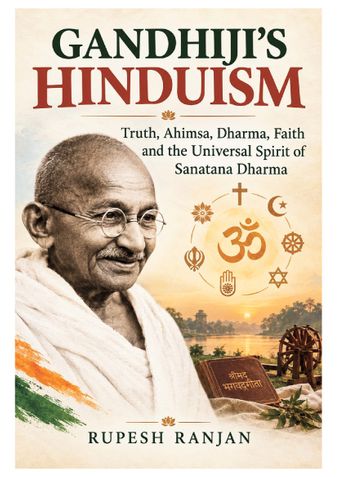
GANDHIJI’S HINDUISM (eBook)
Truth, Ahimsa, Dharma, Faith and the Universal Spirit of Sanatana Dharma
Type:
e-book
Genre: Philosophy, History
Language: English
Price:
₹161
(Immediate Access on Full Payment)
Description
What did Hinduism mean to Mahatma Gandhi?
Was it merely a religious identity inherited from birth? Was it a collection of rituals and customs? Or
was it, for Gandhi, a lifelong search for Truth, moral discipline, self-purification, compassion
and service to humanity?
Gandhiji’s Hinduism explores these questions through a philosophical, historical and critical
examination of Gandhi's religious thought. The book presents Gandhi not simply as a political
leader of India's freedom movement, but as a deeply religious thinker who attempted to translate
spiritual principles into everyday conduct and public action.
At the heart of Gandhi's Hinduism were Satya (Truth) and Ahimsa (Non-violence). These were
not abstract doctrines for him. They were disciplines through which an individual could transform
personal character, confront injustice and serve society. His understanding of religion therefore
extended beyond ritual and institutional authority into the practical dimensions of life.
The book examines Gandhi's relationship with Sanatana Dharma, the Bhagavad Gita, Rama,
Ramayana, Ramanama, prayer, Nishkama Karma, Brahmacharya, Aparigraha and
Sarvodaya. It explores how these concepts influenced his understanding of duty, self-control,
simplicity, social responsibility and the welfare of all.
A central feature of Gandhi's religious thought was his openness toward other traditions. He
remained deeply rooted in Hinduism while engaging seriously with Christianity, Islam, Jainism,
Buddhism, Judaism and other religious traditions. His approach was not based on the claim
that all religions were identical, but on the conviction that human beings could discover valuable
truths across religious boundaries.
The book also confronts the difficult questions. Gandhi's position on caste and varna, his
campaign against untouchability, his use of the term Harijan, his views on religious conversion,
cow protection, vegetarianism and the relationship between religion and politics are examined
without unquestioning admiration or simplistic rejection.
The discussion of Ram Rajya and Satyagraha is particularly significant. Gandhi's Ram Rajya is
examined not as a blueprint for a sectarian religious state, but as his conception of a morally
ordered society founded upon justice, equality, welfare and human dignity. Similarly, Satyagraha is
explored as the practical application of Truth and Ahimsa in the struggle against injustice.
The book deliberately maintains a critical distance from both hagiography and ideological
dismissal. Gandhi was neither an infallible saint nor merely a political symbol. His religious philosophy contained remarkable insights as well as contradictions, historical limitations and
unresolved tensions. Understanding those tensions makes Gandhi more intellectually interesting
rather than less.
The final chapters bring Gandhi's religious philosophy into conversation with the twenty-first
century. In an age of misinformation, religious polarization, consumerism, technological
transformation and political hostility, Gandhi's questions about Truth, restraint, compassion,
pluralism and moral responsibility remain worthy of serious examination.
Ultimately, Gandhiji’s Hinduism presents Gandhi's religious journey as a living ethical experiment
—a movement from inherited faith toward examined faith, from ritual toward moral action, from
individual spiritual development toward service, and from religious identity toward universal human
fellowship.
It is an invitation to reconsider Hinduism through Gandhi's eyes—not as a closed system, but as a
tradition capable of self-criticism, ethical renewal, interfaith dialogue and universal human
concern.
This is not merely a book about what Gandhi believed. It is an exploration of how faith can
become a way of living, how religion can become an ethical discipline, and how an inherited
tradition can continuously question and transform itself in search of Truth.
About the Author
Book Details
Number of Pages: 327
Availability:
Available for Download (e-book)
Ratings & Reviews
GANDHIJI’S HINDUISM
Review This Book
Write your thoughts about this book.

Currently there are no reviews available for this book.
Be the first one to write a review for the book GANDHIJI’S HINDUISM.
Other Books in Philosophy, History
Perumal Pugazhendhi

Christophe Borsella

ગોવર્ધનરામ માધવરામ ત્રિપાઠી

ડૉ. જયંતિ રુસાત