You can access the distribution details by navigating to My pre-printed books > Distribution
Add a Review
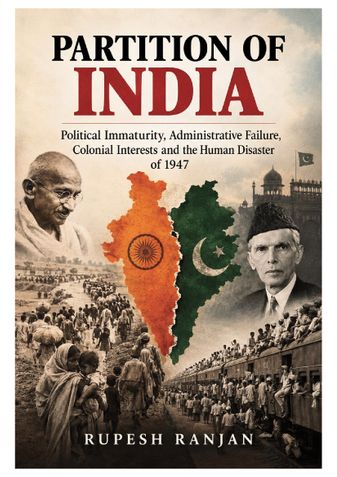
PARTITION OF INDIA (eBook)
Political Immaturity, Administrative Failure, Colonial Interests and the Human Disaster of 1947
Type:
e-book
Genre: Politics & Society, History
Language: English
Price:
₹179
(Immediate Access on Full Payment)
Description
PARTITION OF INDIA
Political Immaturity, Administrative Failure, Colonial Interests and the
Human Disaster of 1947
The Partition of India in 1947 was one of the most consequential political decisions of the twentieth
century—and one of its greatest human tragedies. The creation of India and Pakistan brought the end
of British colonial rule, but independence was accompanied by the division of territory,
communities, families and lives on an enormous scale.
Partition of India: Political Immaturity, Administrative Failure, Colonial Interests and the Human
Disaster of 1947, by Rupesh Ranjan, is a critical and reflective examination of the political
circumstances that produced Partition and the human consequences that followed.
The book does not attempt to explain Partition through a single cause or assign responsibility to one
community, one political organisation or one individual. Instead, it examines the interaction of
colonial interests, political competition, constitutional disagreements, communal mobilisation,
leadership failures, administrative weaknesses and the absence of adequate preparation for an
extraordinarily complex transfer of power.
At the heart of the book is a difficult question:
Was Partition inevitable, or was it partly the consequence of political failure and insufficient
imagination at a decisive moment in history?
The answer is approached with caution. History does not provide laboratories in which alternative
decisions can be tested. It is therefore impossible to establish with certainty that another
constitutional arrangement would definitely have prevented Partition. Yet it remains entirely
legitimate to examine the alternatives that existed, the negotiations that failed and the decisions that
narrowed the possibilities for compromise.
The book critically examines the role of the Indian National Congress, while also recognising its
enormous contribution to India's struggle for independence. Congress represented a broad national
movement, but its leadership faced profound difficulties in reconciling competing political demands.
The acceptance of Partition therefore deserves examination—not simply as an unavoidable historical
outcome, but as a political decision shaped by circumstances, calculations, exhaustion, mistrust and
the desire for an early settlement.
The Muslim League and the evolution of the demand for Pakistan receive equally serious attention.
Questions of political representation, constitutional safeguards, minority fears, competing
nationalisms and the changing relationship between Congress and the League are examined as part of
the wider story.
The book also places the British Empire under critical scrutiny. Colonial rule was fundamentally
connected with British economic, strategic and political interests. As Britain emerged from the
Second World War weakened and increasingly unable to sustain its empire, the question of
withdrawal became urgent. But the manner in which an empire leaves a country can be as
consequential as the decision to leave. The transfer of power in 1947 involved the division of provinces and institutions, the creation of new
borders, enormous population movements and the protection of millions of vulnerable people. Such
a transformation required extraordinary administrative preparation.
The book therefore gives special attention to the administrative disaster surrounding Partition.
The hurried political transition, the boundary-making process, uncertainty over territories,
inadequate security arrangements, disruption of transport and communication, refugee movements
and the collapse of law and order created conditions in which violence could spread rapidly.
This raises another fundamental question:
Could stronger administration, better planning and greater political will have reduced the scale of
the human catastrophe?
The book argues that this question deserves serious consideration.
Political leaders may disagree. Political negotiations may fail. Constitutional settlements may collapse.
But the protection of human life remains a fundamental responsibility of government. When political
conflict begins to produce mass violence, the state cannot simply become a spectator.
Partition demonstrated what can happen when political uncertainty, communal fear and institutional
weakness interact.
The human story is therefore central to this work.
Behind the millions who crossed newly created borders were individual human beings who had
homes, farms, businesses, schools, friendships, memories and ancestral connections. Many did not
initially consider themselves refugees. They became refugees because the political geography around
them changed.
A border drawn on a map could transform a citizen into a displaced person.
The book examines the Great Migration, the destruction of communities, violence against civilians,
the suffering of women and children, refugee experiences and the long-term psychological
consequences of displacement.
Particular attention is given to women, whose experiences of Partition included abduction, sexual
violence, forced separation and displacement. Their stories reveal a dimension of Partition that
cannot be understood merely through political documents or demographic statistics.
The book also explores the continuing significance of memory.
Partition did not end when the borders were established. Its memories travelled across generations.
Families preserved stories of lost homes. Refugees rebuilt lives in unfamiliar surroundings. Children
inherited memories of places they had never visited. Political narratives developed around competing
interpretations of the past.
In this sense, Partition became both a historical event and a continuing psychological inheritance.
A separate part of the book examines Mahatma Gandhi.
Gandhi's commitment to Hindu-Muslim unity and his opposition to communal hatred represented
one of the strongest moral alternatives to the politics of division. Yet he could not prevent Partition.
His political influence had declined at precisely the moment when the constitutional future of India
was being determined.
This raises a profound historical paradox.
How could the most influential moral leader of India's freedom movement fail to prevent the division of the country?
The book does not use Gandhi's failure to diminish his entire legacy. Instead, it examines the limits of
moral authority in the face of political conflict while also considering the extraordinary significance
of his final efforts to stop communal violence.
In the midst of one of the greatest political failures of the period, Gandhi continued to insist that
human life and communal harmony were more important than political victory.
His response to Partition therefore becomes an important part of the book's larger moral question:
What is the meaning of freedom if human beings cannot live together with dignity and security?
The book is deliberately critical of all forms of historical romanticism.
It does not portray the British as the only actors responsible for Partition. It does not portray
Congress as entirely blameless. It does not reduce the Muslim League's politics to a single
explanation. It does not treat Gandhi, Nehru, Patel, Jinnah or Mountbatten as either perfect heroes or
complete villains.
Instead, it asks readers to confront the complexity of political responsibility.
The central argument is that Partition represented a failure of political imagination as much as a
clash of political interests.
There were constitutional possibilities that deserved deeper exploration. There were opportunities for
compromise that ultimately disappeared. There was an enormous administrative responsibility that
was not adequately matched by preparation. And there was a human cost that political calculations
could not fully anticipate—or perhaps did not adequately prioritise.
Yet this book does not argue that history can simply be rewritten.
Its purpose is to learn from history.
The lessons of Partition extend far beyond India and Pakistan. They concern every plural society in
which different communities must share political institutions. They concern the importance of
constitutional safeguards, responsible leadership, effective administration, minority protection and
the willingness to compromise.
Most importantly, Partition teaches that political maps are ultimately made for human beings, not
human beings for political maps.
Political leaders may negotiate borders, constitutions and institutions, but ordinary people must live
with the consequences.
That is why the book treats Partition primarily as a human disaster, even while recognising that
independence itself was an extraordinary historical achievement.
The end of colonial rule deserves its place in history.
But so does the suffering that accompanied it.
The two realities must be remembered together.
Partition of India is therefore an attempt to revisit 1947 with historical seriousness, political courage
and human empathy. It asks uncomfortable questions without claiming easy answers. It examines
responsibility without turning history into communal accusation. It remembers suffering without
encouraging hatred.
Its ultimate message is simple:
History should not merely tell us who won and who lost. It should teach us how political decisions can protect—or destroy—the lives of ordinary people.
Partition was a disaster.
The responsibility of future generations is to understand why it happened, remember those who
suffered, recognise the failures that made the catastrophe possible, and ensure that political
disagreement never again becomes an excuse for the destruction of human dignity.
— Rupesh Ranjan
About the Author
Book Details
Number of Pages: 711
Availability:
Available for Download (e-book)
Ratings & Reviews
PARTITION OF INDIA
Review This Book
Write your thoughts about this book.

Currently there are no reviews available for this book.
Be the first one to write a review for the book PARTITION OF INDIA.
Other Books in Politics & Society, History
Aadit Chakrabarty

A Common Researcher
lava kush singh "vishwmanav"

Darragh Christie